Ears
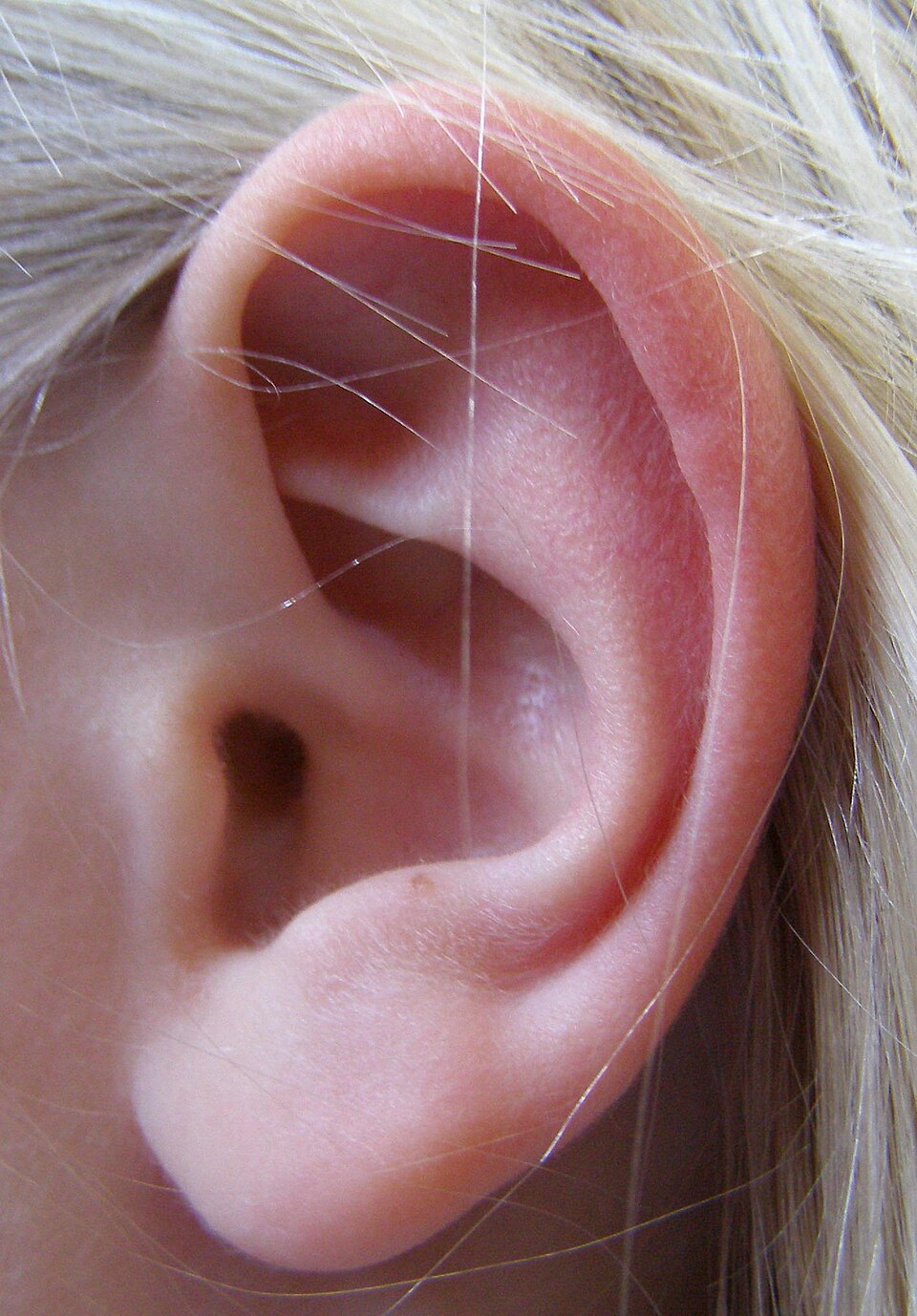

The ear is the part of the body which allows animals (including people) to hear. People and most mammals have ears. Non-mammals, such as lizards or frogs, can also hear, but may have holes instead of external ears. The ear works by directing sound waves to the inner ear. These vibrations are sent to the brain by an organized group of nerves. This system is called the auditory system — auditory meaning relating to hearing and how we hear. The ear is self-cleaning. It uses muscles (such as when the person is chewing or talking) and part of the head or face to push earwax like a “conveyor belt” out of the ear, to the outer ear.
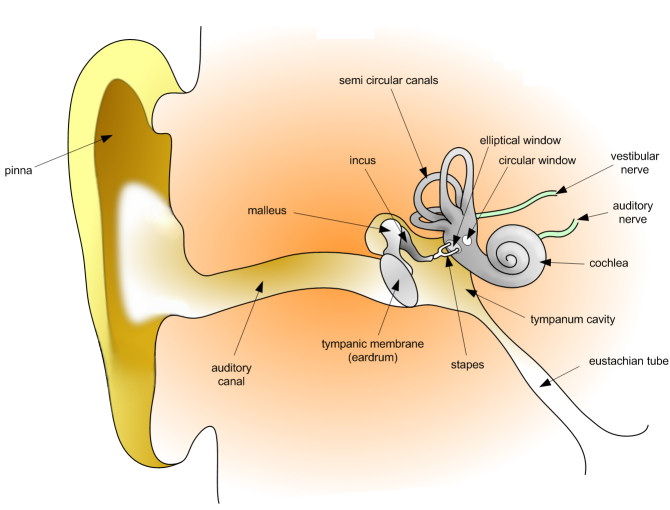
The inner ear is in most vertebrates, but mammals have special adaptations for hearing which even other land vertebrates do not have. These include the external ear and the three little bones which transmit sounds to the brain (the ossicles). The part of the ear that sticks out and can be seen is called the pinna.
Ears are also used in other ways. African elephants use their large ears to cool themselves when it is very hot. Bats rely on their ears to find prey by echolocation. Some animals use their ears for signalling (sending messages) to each other.
Other hearing
In ordinary language, “ear” refers to this receptor which conducts sound and sends signals to the brain. It does not refer to the many other methods of hearing found in fish and invertebrates. Many animals do not hear through ears. Spiders have small hairs on their legs that they can hear with.
Written for younger readers
Ears, in simpler words
This version comes from Wikijunior, a set of books written for children aged 8 to 11. It is shorter and uses plainer language than the article above.
From Wikijunior: Human Body
When looked from the outside, human ears have a roughly oval shape. Several crest like structures, elevations and creases make the surface of the ear look crumpled. In the middle, the auditory canal leads to the middle and inner ear. The middle ear starts with the eardrum, which is connected with the inner ear by tiny bones, called the ossicles. The inner ear, called the cochlea, is a spiral.
The outer ear collects air waves, modifies them by its surface and leads them through the auditory canal to the eardrum. Like with a trampoline, air waves bounce off the eardrum which transmits these movements to the inner ear. The inner ear can separate different pitches of sounds in air waves and gets excited at distinct part each corresponding to a distinct pitch. The inner ear then transmits this information to the brain which makes us experience sounds. The inner ear also has the capabilities to measure body movements which helps us orient with eyes closed or in the dark, and controls our balance.
The inner ear is connected with the brain via the auditory nerve which carries sound and body movement information. That’s why you can hear since the ears are connected to the brain.
The ear is a very sensitive organ that can easily be damaged if it is exposed to too high sound levels. There are a few things you can do to keep your ears safe:
- Do not turn your music up too loud
- Protect your ears from insects and bugs.
Where this page comes from
The article above is adapted from “Ears” on Simple English Wikipedia, by its contributors. We removed reference markers, navigation boxes and tables, expanded measurement templates into readable numbers, and kept the prose otherwise intact. The simpler version is adapted from Wikijunior on Wikibooks.
Both sources are published under CC BY-SA 4.0, so this page is published under the same licence. You may share and adapt it, including commercially, as long as you credit the original and keep the same licence.
Worksheets, answer keys and printable layouts elsewhere on K5Print are our own work and are not covered by this licence.