Hemoglobin
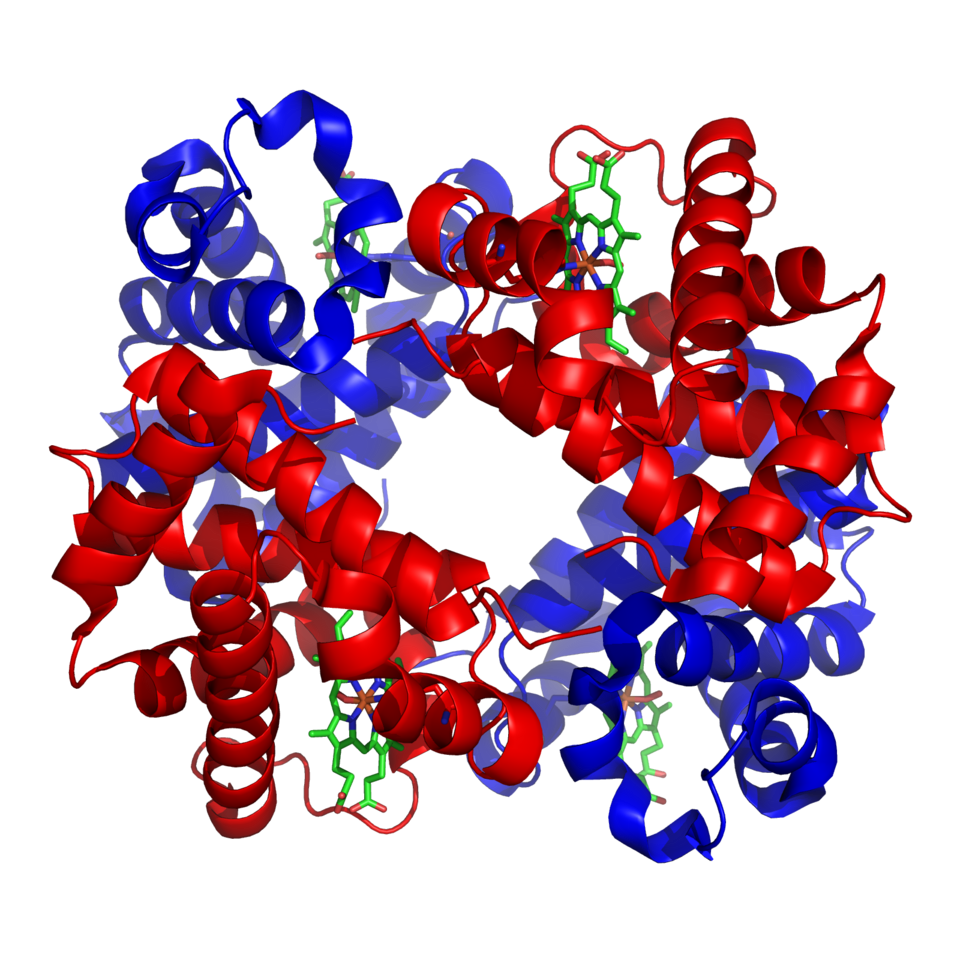

Hemoglobin (or haemoglobin) is a protein in red blood cells which contains iron. It is used to transport oxygen around the human body.
Hemoglobin is found in the red blood cells of almost all vertebrates. The exceptions are the fish family Channichthyidae, and the tissues of some invertebrates. It does occur in some invertebrates, but most invertebrates use other chemicals, such as hemocyanin.
Hemoglobin is involved in the transport of other gases. It carries some of the body’s respiratory carbon dioxide (about 20-25% of the total).
Red blood cells get their color from hemoglobin, which is red. There are millions of hemoglobin molecules in each red blood cell, and millions of red blood cells in the human body. When hemoglobin has oxygen attached, it is called oxyhemoglobin.
Structure
The most common type of hemoglobin in mammals contains four such subunits. Each subunit of hemoglobin is a globular protein (globin) with a heme group inside it. Each heme group has one iron atom. This binds one oxygen molecule. So the complete hemoglobin molecule has four globin chains, four heme molecules, and four iron atoms. When hemoglobin is in the lungs, it picks up oxygen in its hemes, and carries it to the rest of the body.
Its structure took years to work out. Max Perutz and John Kendrew worked out the structure of myoglobin first. That muscle globin is smaller, with only one heme group.
Where this page comes from
The article above is adapted from “Hemoglobin” on Simple English Wikipedia, by its contributors. We removed reference markers, navigation boxes and tables, expanded measurement templates into readable numbers, and kept the prose otherwise intact.
Both sources are published under CC BY-SA 4.0, so this page is published under the same licence. You may share and adapt it, including commercially, as long as you credit the original and keep the same licence.
Worksheets, answer keys and printable layouts elsewhere on K5Print are our own work and are not covered by this licence.