Hymen
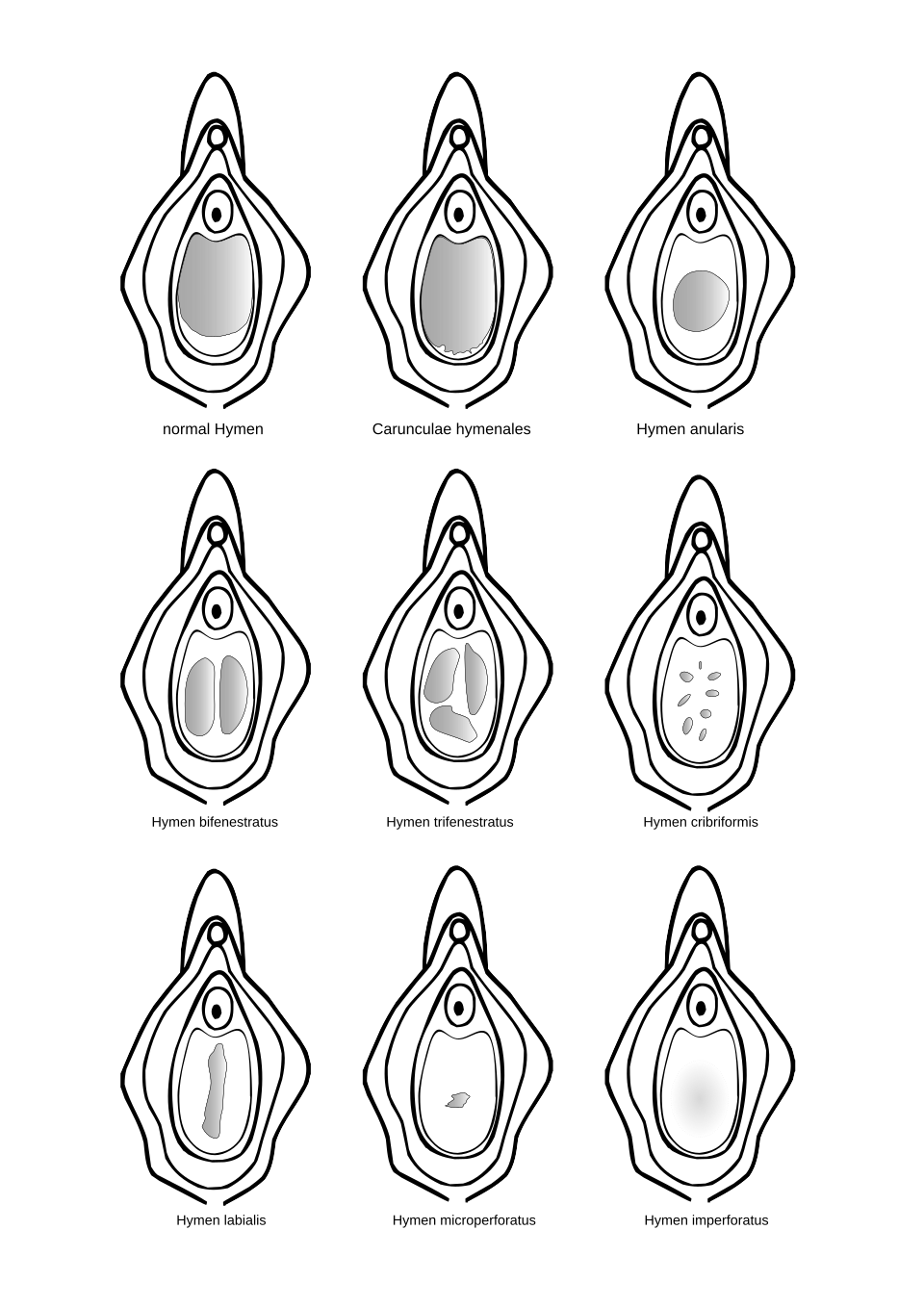

The hymen (also called the maidenhead) is a thin fold of membranous connective tissue which “encompasses (surrounds) the lumen of the vagina”. It surrounds and partially covers the opening of the vagina all around the edges, or sometimes completely blocks it (called a imperforate hymen) until it is fixed. It is close to behind or deeper inside the labia minora.
The hymen has no known use. People used to believe that the hymen always tears after having sexual intercourse for the first time, and that you could tell if a woman was a virgin by looking at her hymen and seeing if it was torn. However, it turns out that it is impossible to tell if someone is a virgin by looking at their hymen. Studies have confirmed that all girls are born with hymens.
Types
There are several different types of hymen. In about 1 in 2,000 females, the hymen does not develop at all. The hymen may also not have a hole in it; this is called an “imperforate hymen”. In this case a hole will need to be surgically cut into it to allow menstrual fluid (period blood) or other secretions out. Without this surgery, the patient might feel discomfort, pain, or be more prone to vagina infections.
Other types of hymen are:
- crescent-shaped
- folding in on itself
- has one or more bands going across the opening
- has several holes
What might damage the hymen
When a girl reaches puberty, the hymen becomes stretchy. The hymen may be damaged by girls fall directly onto sharp objects .
Sexual intercourse is an easy way to damage the hymen along with horseback riding and biking. A woman’s hymen can also break while playing some sports.
Hymens in other animals
These animals all have a hymen: There are many more animals which have hymens, but not all are listed here.
The stages of growth
When a fetus is developing, there is no vaginal opening. The hymen comes from the skin covering the vagina at that time.
In young babies, the hymen is thick and pink. This is because the mother is giving the baby hormones through breast feeding which keeps it thick. In adolescent girls, the hymen becomes thin, smooth and delicate because she has stopped taking in hormones. The hymen becomes very sensitive and can easily cause pain if touched. From puberty, the hymen gets thicker again and becomes pale pink. This is because of the hormone estrogen.
Where this page comes from
The article above is adapted from “Hymen” on Simple English Wikipedia, by its contributors. We removed reference markers, navigation boxes and tables, expanded measurement templates into readable numbers, and kept the prose otherwise intact.
Both sources are published under CC BY-SA 4.0, so this page is published under the same licence. You may share and adapt it, including commercially, as long as you credit the original and keep the same licence.
Worksheets, answer keys and printable layouts elsewhere on K5Print are our own work and are not covered by this licence.