Muscles

Muscle is a tissue in animal bodies. Muscles are basically tissue which may contract (shorten). They usually attach to bones and are the way animals move.
Their main purpose is to help us to move our body parts. They are one of the major systems of all animal bodies. When a muscle is activated it contracts, making itself shorter and thicker, thereby pulling its ends closer.
Types of muscles
There are three kinds of muscles:
- Skeletal muscle, the muscle attached to bones. They pull on bones to make movements.
- Smooth muscle, for example, the muscle in blood vessels and the bladder
- Cardiac muscle, the muscle of the heart
Muscle action can be classified as being either voluntary or involuntary.
Image: Muscles anterior labeled.png|Skeletal muscles, viewed from the front Image: Muscle posterior labeled.png|Skeletal muscles, viewed from the back
The skeletal muscles move the limbs (arms and legs). They move the jaw up and down so that food can be chewed. Skeletal muscles are the only voluntary muscles, the only ones that we can choose to move.
The cardiac muscle is the muscle in the heart. When this muscle contracts it pushes blood through the circulatory system. The cardiac muscle is not voluntary.
The smooth muscles are the other muscles in the body that are involuntary. Smooth muscles are in many places. They are in:
- The gastrointestinal system – this includes the stomach and intestines. This is how food moves through us and we take energy from it.
- Blood vessels – smooth muscles make blood vessels smaller or bigger. This controls blood pressure.
- Hairs – smooth muscle attached to hair follicles makes your hair stand up when you are scared or get cold.
Muscle structure
Muscles are made of many muscle cells. The cells contract together to make the muscle get shorter. The muscle cells know to do this together because many of them get information sent to them by nerves. The cells that get the message from nerves tell other cells that are near them. They tell the other cells by sending an electrical current.
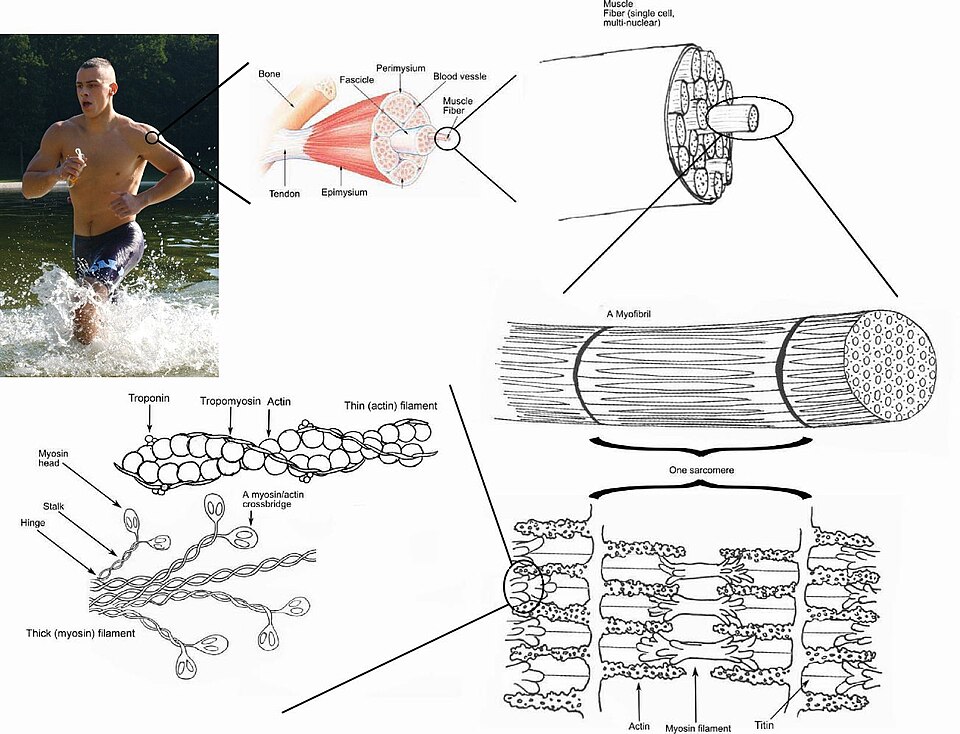
Muscle cells are filled with proteins called actin and myosin. These are the proteins that make the muscle contract (get shorter).
Muscle contraction
When a nerve tells a muscle to contract, the muscle opens holes in its cell membrane. These holes are proteins that are called calcium channels. The calcium ions rush into the cell. Calcium also comes out of a special place in the cell called the sarcoplasmic reticulum. This calcium sticks to the specialized proteins actin and myosin. This triggers these proteins to contract the muscle.
Contraction also needs ATP. This is the energy that your cells use. It is made from using glucose in the cell. It takes a lot of energy to release contracted muscles. They use most of the energy for building muscles.
Exercise
Exercise makes muscles get bigger (see hypertrophy). Exercise also makes muscles stronger. If a person does not exercise, their muscles become smaller and weaker. This is called muscle atrophy.
Diseases of muscles
There are many different kinds of muscle diseases. There are three big groups of diseases:
- Neuromuscular diseases – these are problems with how the nerves tell the muscles to move. Strokes, cerebral palsy, and Parkinson’s disease are neuromuscular diseases.
- Motor endplate diseases – these are problems with the place where the nerve tells the muscle to move. Tetanus and myasthenia gravis are motor endplate diseases.
- Myopathies – these are problems with the structure of the muscle. Muscular dystrophy, cancers like Ewing’s sarcoma, and cardiomyopathy are myopathies.
Distribution
What has muscles? All animals except the very simplest, and no other kind of living thing. Not trees, for instance.
Written for younger readers
Muscles, in simpler words
This version comes from Wikijunior, a set of books written for children aged 8 to 11. It is shorter and uses plainer language than the article above.
From Wikijunior: Human Body
Muscles are the organs that make us move. All our movements from running, jumping, to blinking and smiling are made by our muscles. Muscles are everywhere. They can be tiny as in the ear or huge like leg muscles. Although no muscle is directly visible you can watch many of them in action in the mirror, when you flex your muscles.
A muscle is usually a long round organ. The color is red. A muscle is flexible and shortens and thickens during a contraction. The figure on the right shows a series of magnifications of a muscle. You can see that a muscle is a collection of fibres or strings, each of which is capable of contraction. The added force of these fibers is the strength of the muscle.
A muscle has two ends each of which attach to some other organ, usually a bone. These connectors are called tendons.
Without muscles, we can not survive. Muscles produce almost all movements in our body. We need healthy muscles to be able to walk, move, and even smile. The human body has about 620 muscles that it uses for its movement. In addition there are many more that work automatically. The muscles in our heart move blood around the body, the chest muscles help us breathe and the stomach muscles help us digest food.
Muscles connect with all of the other parts of the body. Muscles in the heart pump blood throughout the body. The diaphragm is a large muscle that allows us to breathe. Muscles from our mouth to our stomach and beyond help us swallow food and move it through the digestive system. Even our eyes have muscles that let us look around and see our surroundings. The muscles do movement by becoming shorter and pulling the bones to which they are attached.
Our muscles are kept healthy through regular exercise. Eating properly and especially including a quality protein source in your diet will help keep your muscles healthy.
Where this page comes from
The article above is adapted from “Muscles” on Simple English Wikipedia, by its contributors. We removed reference markers, navigation boxes and tables, expanded measurement templates into readable numbers, and kept the prose otherwise intact. The simpler version is adapted from Wikijunior on Wikibooks.
Both sources are published under CC BY-SA 4.0, so this page is published under the same licence. You may share and adapt it, including commercially, as long as you credit the original and keep the same licence.
Worksheets, answer keys and printable layouts elsewhere on K5Print are our own work and are not covered by this licence.