Neuron
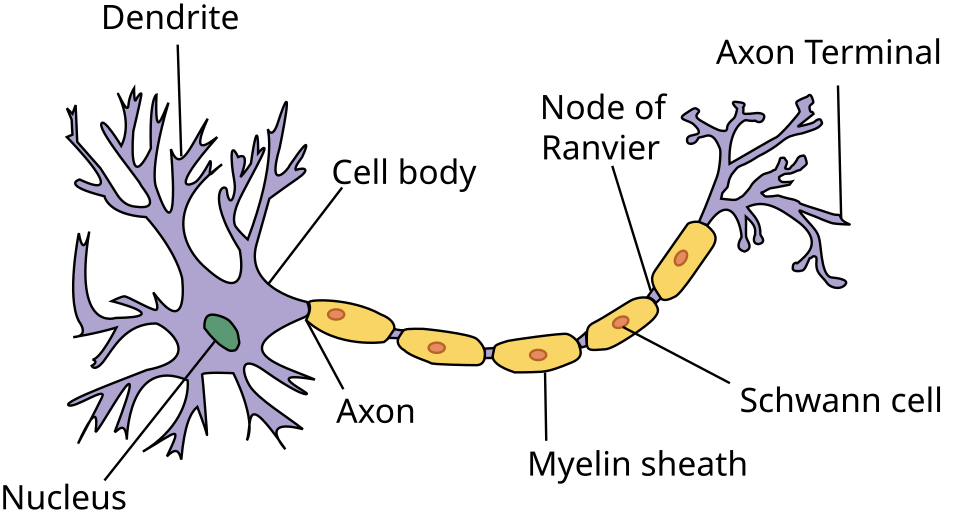

A neuron (or neurone) is a nerve cell which uses electrical impulses to carry out their purpose. Neurons are the basic units of our nervous system. Their purpose in the nervous system is to receive, transmit, and carry electrical impulses called action potentnials.
Neurons have a cell body (soma or cyton), dendrites and an axon. Dendrites and axons are nerve fibers. There are about 86 billion neurons in the human brain. Almost all brain cells are neurons. The human brain has about 16 billion neurons in the cerebral cortex. The neurons are supported by glial cells and astrocytes.
Neurons are connected to one another, but they do not actually touch each other. Instead they have tiny gaps called synapses. These gaps are chemical synapses or electrical synapses which pass the signal from one neuron to the next.
By connection
There are three classes of neurons: motor neurons, sensory neurons and inter neurons.
- Sensory neurons carry information from tissues and organs into the central nervous system
- Motor neurons transport signals from the central nervous system to the effector cells
- Interneurons connect neurons within the central nervous system
By function
- Sensory neurons carry signals from sense organs to the spinal cord and brain
- Relay neurons carry messages between sensory or motor neurons and the central nervous system
- Motor neurons carry signals from the CNS to muscles, motor neurons are connected to the relay neurons. The signal passes between the neurons via synapses. Synapses are microscopic voids between cells where chemicals are released from the axon terminal of one cell to specialized chemical receptors on the dendrite of the receiving cell
Cell division
Mature neurons never divide: that is the general rule. They do not undergo cell division. In most cases, neurons are generated by special types of stem cells. A type of glial cell, called astrocytes, have also been seen to turn into neurons. In humans, neurogenesis (the origin of new nerve cells) largely ceases during adulthood but in two brain areas, the hippocampus and the olfactory bulb, there is strong evidence for substantial numbers of new neurons.
Where this page comes from
The article above is adapted from “Neuron” on Simple English Wikipedia, by its contributors. We removed reference markers, navigation boxes and tables, expanded measurement templates into readable numbers, and kept the prose otherwise intact.
Both sources are published under CC BY-SA 4.0, so this page is published under the same licence. You may share and adapt it, including commercially, as long as you credit the original and keep the same licence.
Worksheets, answer keys and printable layouts elsewhere on K5Print are our own work and are not covered by this licence.