Skull
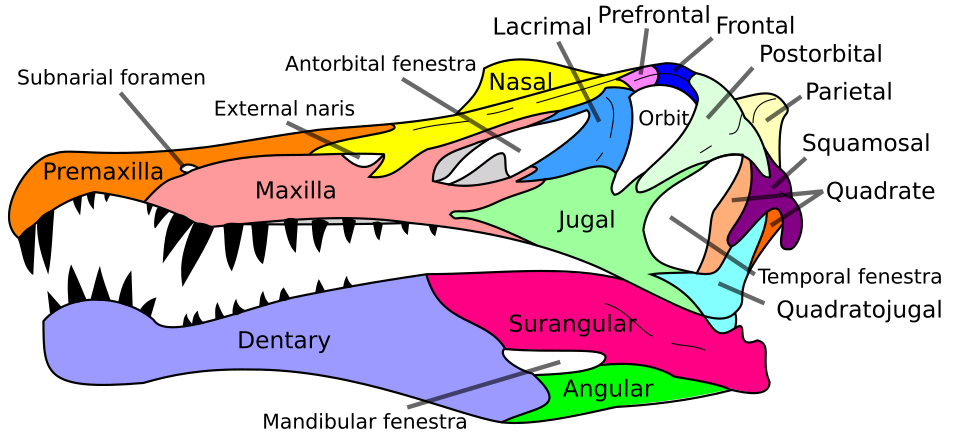

A skull, or cranium, is a set of bones that make up the head of a vertebrate and keep in place all body parts in the head. It supports the structures of the face and forms a protective cavity for the brain.
As well as protecting the brain, the skull fixes the distance between the eyes and between the ears. This allows stereoscopic vision, and helps the brain judge direction and distance of sounds. In some animals, the skull also has a defensive function (e.g. horned ungulates). The frontal bone is where horns are mounted.
The skull is made of a number of joined (fused) flat bones. In humans, the adult skull is normally made up of 28 bones.
Structure
Skulls can be classified based on fenestras which are window or opening in a skull. There are 5 types of fenestras which are:
- Antorbital fenestra
- Mandibular fenestra
- Quadratojugal fenestra
- Subsquamosal fenestra
- Temporal fenestra
Where this page comes from
The article above is adapted from “Skull” on Simple English Wikipedia, by its contributors. We removed reference markers, navigation boxes and tables, expanded measurement templates into readable numbers, and kept the prose otherwise intact.
Both sources are published under CC BY-SA 4.0, so this page is published under the same licence. You may share and adapt it, including commercially, as long as you credit the original and keep the same licence.
Worksheets, answer keys and printable layouts elsewhere on K5Print are our own work and are not covered by this licence.