Small Intestine
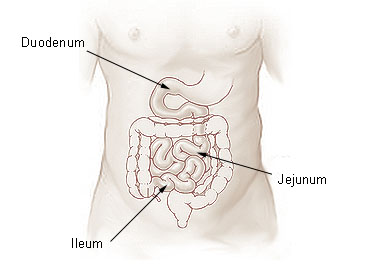

The small intestine is between the stomach and the large intestine, and is where most of the digestion and absorption happen. In humans over five years old, the small intestine is about 7.5 metres long. However, while it is long in length, it is very short in diameter, which is why it is mostly called the ‘small intestine’.
The small intestine has three regions: the duodenum, the jejunum, and the ileum.
The duodenum: receives bile and juice from the pancreas ( and is where most digestion in the small intestine takes place). Secretions limit, or neutralise, the stomach acidity, and enzymes help to digest the food.
The jejunum: the products of digestion (sugars, amino acids, and fatty acids) are absorbed into the bloodstream here.
The ileum: absorbs vitamin B12, bile salts, and any other products of digestion that were not absorbed by the jejunum.
Written for younger readers
Small Intestine, in simpler words
This version comes from Wikijunior, a set of books written for children aged 8 to 11. It is shorter and uses plainer language than the article above.
From Wikijunior: Human Body
The small intestine is a part of the digestive system. It is the most important organ for the digestion of food.
TOC
The small intestine is a long, narrow tube that is all coiled up in the lower part of our abdomen (the part of our body we usually call our “stomach”). It is over 20 feet (6 meters) long! This is the largest part of the digestive system. The only way the small intestine can fit into our bodies is by curling and looping to fit in a small space.
The small intestine is about 20 feet long
The first part of the small intestine is called the duodenum. The middle part is the jejunum. This is where most of the nutrients in food are absorbed into the blood. The last part of the small intestine is called the ileum. This part connects to the large intestine.
The lining of the small intestine is covered with tiny finger-like projections called villi. They look almost like carpet. The villi help the nutrients in food to be absorbed into the blood.
The small intestine is where most digestion takes place. Food is broken down into smaller and smaller particles. Finally, when the particles are small enough, they are absorbed into the blood, and the blood carries the nutrients to all parts of the body.
The small intestine is connected to the stomach. Food that the stomach has begun to digest moves into the small intestine. After it moves through the small intestine, food moves on the large intestine. Like other organs, the small intestine gets oxygen from blood vessels. The blood in the small intestine also carries the nutrients from food to the rest of the body. The circulatory system allows this to happen.
The small intestine gets enzymes from two important glands, called the liver and the pancreas. The liver is the largest organ in our bodies. It makes a liquid called bile that helps digest fat. The bile is stored in another organ called the gall bladder. The pancreas makes a juice that breaks down sugars and starches.
Where this page comes from
The article above is adapted from “Small Intestine” on Simple English Wikipedia, by its contributors. We removed reference markers, navigation boxes and tables, expanded measurement templates into readable numbers, and kept the prose otherwise intact. The simpler version is adapted from Wikijunior on Wikibooks.
Both sources are published under CC BY-SA 4.0, so this page is published under the same licence. You may share and adapt it, including commercially, as long as you credit the original and keep the same licence.
Worksheets, answer keys and printable layouts elsewhere on K5Print are our own work and are not covered by this licence.