Spinal Column
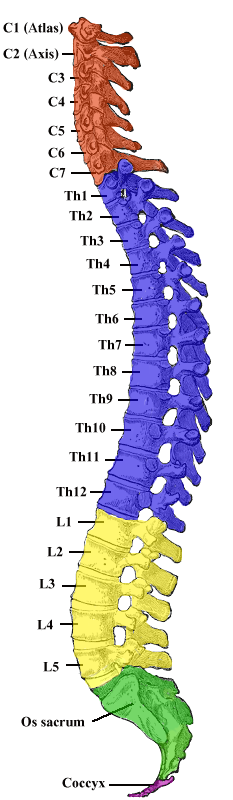

The spine is a column of vertebrae in the back part of the torso (upper body). It is also called the backbone or vertebral column. There is a spinal canal that runs through the length of the spine. Many vertebrates, including mammals, have intervertebral discs separating the vertebrae.
Inside the spinal canal is the spinal cord. Animals that have a spine are called vertebrates, and animals that do not have one are called invertebrates. Humans have a spine so they are vertebrates. Problems with the spine often cause back pain in humans. Back pain has been studied on animals such as dogs.
Regions
The vertebral column has five regions. These regions from top to bottom are:
- Cervical - Shown in red, this region supports the head. It is made up of 7 vertebrae. The first two, called the atlas and axis, connect the spine to the skull.
- Thoracic - Shown in blue, this region supports the ribs. It is made up of 12 vertebrae.
- Lumbar - Shown in yellow, this region is located in the lower back. It is made up of 5 vertebrae.
- Sacral - Shown in green. It is made up of 5 vertebrae that are fused together.
- Coccygeal - Shown in purple. It is made up of 3 to 5 vertebrae.
Spinal canal
The spinal column has an opening called spinal canal and this opening is used for nerves. The part of the central nervous system in the spinal column is called spinal cord.
Written for younger readers
Spinal Column, in simpler words
This version comes from Wikijunior, a set of books written for children aged 8 to 11. It is shorter and uses plainer language than the article above.
From Wikijunior: Human Body
TOC
No, you can not live without a spinal column. It is made up of many vertebrae, which are special types of bones, arranged in a column, so it can also be referred as a vertebral column. In fact, to be a vertebrate, you must have a such a column from the spine in little fish to the huge vertebral column of a giraffe or a blue whale, the largest animal ever known to have lived. Without one, your body would be drastically different; for example, octopuses do not have one.
Most people have the first understanding how it look by looking at fish, since the spine of a fish is its spinal column. In humans and other vertebrates (animals with a vertebral based skeleton) the column cannot be directly viewed from the outside in its totality, but it can be felt and sometimes visually noticeable under the skin on the back of the human torso. It because of this that we also use the word spine to dine any ridge formation. Just put your fingers along your back! If you look at a complete spine, it is a curved column composed of vertebrae.
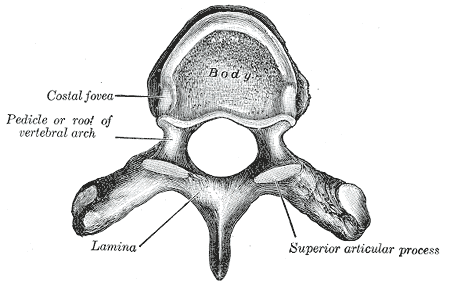
There are 33 vertebrae, divided into seven “cervical”, or neck, vertebrae, twelve “dorsal”, or mid-body, vertebrae, five “lumbar”, or lower back, vertebrae, and five “sacral”, even lower than lumbar, vertebrae, and finally four “coccygeal”, or tail, vertebrae. The vertebrae of each are slightly different, but they all have the same basic parts.
The spinal column supports the most of the body and skull. It protects your nervous system, and deep inside in the vertebras’ bone marrow it generates the components for your body’s defence system and also a bundle of nerve fibres called “spinal cord”. Without connecting to these nerve fibres, your brain can’t tell that part of the body to move. That is why the spinal is so important!
Your spinal column is the principal part of your skeleton, it is connected with the lower tip of your skull and the nerves it supports connect to your brain, thus, connecting with all the other body parts, like a central switchboard. So, in general, the spine is kind of connected to all of your body! Allowing messages to flow and so you to move, bend, kneel, stand up, sit down and all kinds of other cool movements!
The spine is in large part bone. If it is broken, you may not be able to move any part of your body lower than the point of breakage, since the bone protects the “spinal cord”.
Where this page comes from
The article above is adapted from “Spinal Column” on Simple English Wikipedia, by its contributors. We removed reference markers, navigation boxes and tables, expanded measurement templates into readable numbers, and kept the prose otherwise intact. The simpler version is adapted from Wikijunior on Wikibooks.
Both sources are published under CC BY-SA 4.0, so this page is published under the same licence. You may share and adapt it, including commercially, as long as you credit the original and keep the same licence.
Worksheets, answer keys and printable layouts elsewhere on K5Print are our own work and are not covered by this licence.