Stomach
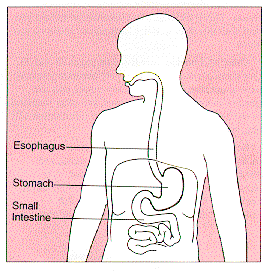

The stomach is part of the digestive system. It is an internal organ between the esophagus and the small intestines.
The stomach is the third stage in the digestive process. It holds food after eating. Food in the stomach then passes to the small intestine, where most of the food’s nutrition is absorbed.
Other words for stomach include belly and tummy.
In humans
The stomach contains hydrochloric acid of pepsin made by stomach cells. As a useful side-effect, the acid kills bacteria in the food. However, its main function is to help the protein-digesting enzymes called proteases work. In general, the food is churned, squeezed and mixed. This prepares it for digestion. The partially digested food is called chyme.
In other mammals
Stomachs of other mammals work differently to human stomachs. Ruminants, for example, have a stomach with multiple compartments. In that system, food goes through the first part of the digestive system twice, and the work of digesting the grass is done by bacteria.
Problems
Stomach acid can cause problems. It can make peptic ulcers worse. It can also cause heartburn: pain in the chest when acid from the stomach refluxes (backs up into) the oesophagus. These can usually be treated by neutralizing the acid.
Vomiting occurs when food goes back up the oesophagus and out the mouth. Vomiting can be a symptom of disease.
Written for younger readers
Stomach, in simpler words
This version comes from Wikijunior, a set of books written for children aged 8 to 11. It is shorter and uses plainer language than the article above.
From Wikijunior: Human Body
TOC
The stomach is a part of the digestive system. It is where food is stored and where digestion continues after food is chewed and swallowed.
Many people think the stomach is near the belly button. However, it is really higher up. The stomach is behind the lower part of the ribs.
The stomach is a bag or pouch made of muscle. The stomach is a j-shaped organ. It is about the size of a grapefruit…. The stomach stretches when it is full of food. It also has an exit and an entrance.
At the top of the stomach is a tube where food comes in from the esophagus. When you swallow, this tube opens so food can go in the stomach.
The stomach is made of muscle. These muscles help to break down food by mashing it into smaller pieces. The muscles also make waves pushing the food further down the digestive track. This is called peristalsis and happens from the esophagus all the way to the large intestine.
The stomach is lined with glands. These special cells make a liquid that is released into the stomach. This liquid is called gastric juice. The gastric juice has acid in it and helps break down or digest food.
The bottom part of the stomach is called the pyloric area. At the bottom of the stomach is another opening. This leads to the small intestine.
One of the most important parts of the stomach (and generally of the digestive system) is the bacterial fauna that populates it. Distinct to the specific environment, and part of a system that produces enzymes necessary to process some foods or optimize what can be extracted from what we ingest. A symbiotic (mutual beneficial) relation that is created and updated from birth, including the milk a baby gets from his mother.
The stomach stores food and begins to digest it. It does this by using its muscles to crush food into smaller pieces. The stomach uses digestive enzymes and acids to break down food.
The stomach does its job without you thinking about it. It is controlled by the nervous system. The nerves help tell you when to feel hungry. They also tell your stomach when to start making more chemicals for digestion.
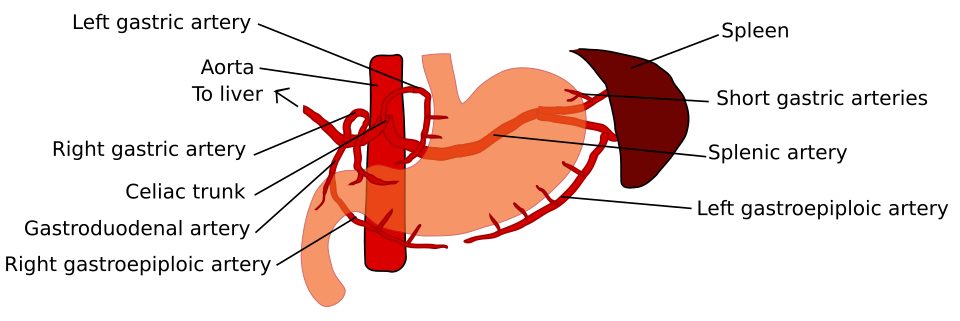
The inner layer of the stomach has blood vessels in it. The blood supplies oxygen to the stomach so it can do its work.
Muscles in the stomach help move food through it. After the stomach has done its work, the food moves on to the small intestine.
Good digestion begins with chewing. Chewing food well and eating slowly is good for your stomach.
Eat when you’re hungry. Don’t eat too much or too little food. Try to eat food that doesn’t have too much fat or sugar. Include vegetables and fruit in your diet. If you eat something that often makes your stomach hurt or feel bad, avoid that food.
Where this page comes from
The article above is adapted from “Stomach” on Simple English Wikipedia, by its contributors. We removed reference markers, navigation boxes and tables, expanded measurement templates into readable numbers, and kept the prose otherwise intact. The simpler version is adapted from Wikijunior on Wikibooks.
Both sources are published under CC BY-SA 4.0, so this page is published under the same licence. You may share and adapt it, including commercially, as long as you credit the original and keep the same licence.
Worksheets, answer keys and printable layouts elsewhere on K5Print are our own work and are not covered by this licence.