Allosaurus

Fast facts
- Phylum
- Chordata
- Genus
- Allosaurus
Scientific name
- Scientific name
- Allosaurus
How to say it in other languages
- Arabic
- ألوصور
- Chinese
- 異特龍屬
- French
- Allosaure
- Hindi
- अल्लोसौरस
- Japanese
- アロサウルス
- Korean
- 알로사우루스
- Portuguese
- Alossauro
- Russian
- Аллозавр
Facts from Wikipedia’s “Allosaurus” page and Wikispecies (CC BY-SA 4.0).
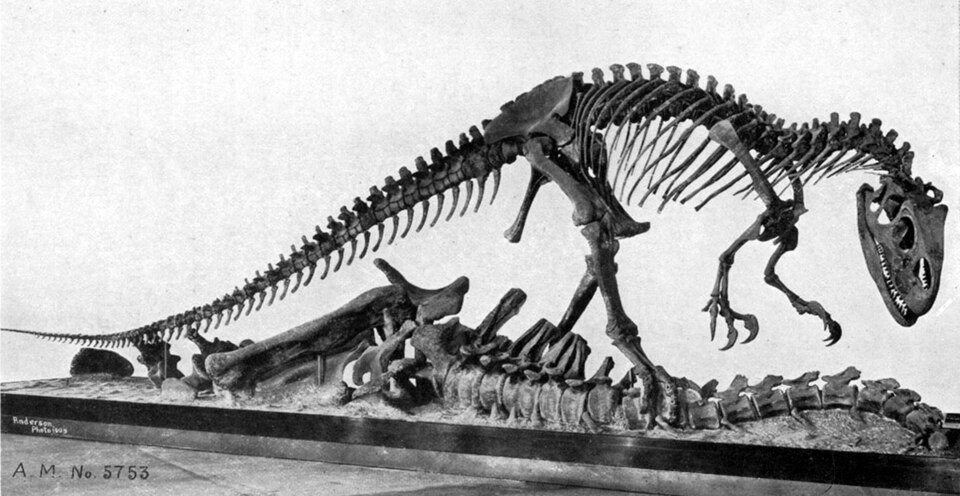
Allosaurus was a large theropod dinosaur from the Jurassic period, a predatory carnivore. Allosaurus averaged 8.5 metres (28 ft) in length, though some remains suggest it could reach over 12 meters (39 ft). Its three-fingered forelimbs were smaller than its large hind legs, and the body was balanced by a long, heavy tail. It weighed 2.3 tons. It is the most common large predator found in the Morrison Formation of Colorado. This formation was laid down 155 to 145 million years ago, in the Jurassic. Allosaurus was at the top of the food chain. It probably preyed on large herbivorous dinosaurs and perhaps even other predators, including Ceratosaurus and Marshosaurus. Potential prey included ornithopods, stegosaurs, and sauropods.
Some paleontologists think Allosaurus had cooperative behavior, and hunted in packs. Others believe they may have been aggressive toward each other. Groups have been found together in the fossil record. This might be evidence of pack behavior, or just the result of lone individuals feeding on the same carcass. Remains of many individuals have been found, including some which are almost complete. Over sixty-nine individuals from one species have been found.
Feeding
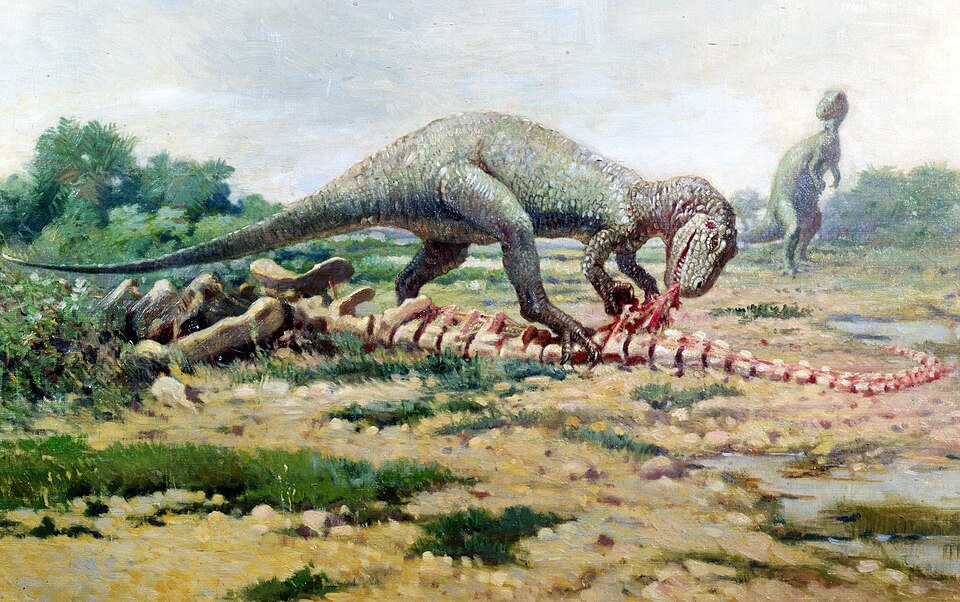
Sauropods, live or dead, seem to be likely candidates of prey. Apatosaurus bones with holes fitting allosaur teeth, and the presence of shed allosaur teeth with Camarasaurus bones have also been found.
There is dramatic evidence for allosaur attacks on Hesperosaurus and Stegosaurus. An Allosaurus tail vertebra has been found with a partially healed puncture which fits a Stegosaurus thagomizer. Also, there is a Hesperosaurus neck plate with a U-shaped wound that correlates well with an Allosaurus snout.
An Allosaurus was probably not a predator of a fully grown Haplocanthosaurus, unless it hunted in packs. It had a modestly sized skull and relatively small teeth, and was greatly outweighed by adult Haplocanthosaurus. Another possibility is that it preferred to hunt juvenile Haplocanthosaurus instead of fully grown ones.
Researchers have made other suggestions. Robert T. Bakker compared the short teeth to serrations on a saw. This saw-like cutting edge runs the length of the upper jaw, and could have been driven into prey. This type of jaw would permit slashing attacks against much larger prey, with the goal of weakening the victim.
Another study showed the skull was very strong but had a relatively small bite force. The authors suggested that Allosaurus used its skull like a hatchet against prey, attacking open-mouthed, slashing flesh with its teeth, and tearing it away without splintering bones, but this is disputed by other scientists.
Different strategies could be used against different prey. The skull was light enough to allow attacks on smaller and more agile ornithopods, but strong enough for high-impact ambush attacks against larger prey like stegosaurs and sauropods.
Their ideas were challenged by other researchers, who found no modern examples of a hatchet attack. They thought it more likely that the skull was strong to absorb stresses from struggling prey.
The original authors noted that Allosaurus itself has no modern equivalent, so the absence of a modern ‘hatchet attacker’ was not significant. They thought the tooth row was well-suited to such an attack, and that articulations (joints) in the skull helped to lessen stress.
Another possibility for handling large prey is that theropods like Allosaurus were flesh grazers that take bites of flesh out of living sauropods such as Cetiosaurus, sufficient to sustain the predator so it did not need to kill the prey outright. This strategy might have allowed the victim to recover and be fed upon again later.
Another idea is that Camptosaurus and Drinker, the most common prey of Allosaurus, could be subdued by it grasping the prey with their forelimbs, and then making bites on the throat to crush the trachea. The forelimbs were strong and capable of restraining prey, and the articulation of the claws suggests that they could have been used to hook things.
The shape of the Allosaurus skull limited binocular vision to 20° of width, slightly less than that of modern crocodilians. As with crocodiles, this may have been enough to judge prey distance and time attacks. The similar width of their field of view suggests that allosaurs, like modern crocodiles, were ambush hunters.
Finally, the top speed of Allosaurus has been estimated at 30 to 55 kilometers per hour (19 to 34 miles per hour).
Cleveland-Lloyd discoveries
The fossil site known as the Cleveland-Lloyd Dinosaur Quarry in Emery County, Utah was known in 1927, but major operations did not begin there until 1960. An effort from nearly 40 institutions got thousands of bones between 1960 and 1965. The quarry is notable for the many Allosaurus remains, the condition of the specimens, and our ignorance of its ancient origin. It is estimated that the remains of at least 46 A. fragilis have been found there, out of at least 73 dinosaurs. The fossils found there are disarticulated (separate) and well-mixed.
Suggestions as to how it arose include animals getting stuck in a bog, to becoming trapped in deep mud, to falling victim to drought-induced mortality around a waterhole, to getting trapped in a spring-fed pond or seep. Regardless of the cause, the great quantity of well-preserved Allosaurus remains means the animal is one of the best-known theropods. Individuals of almost all ages and sizes are found, from less than 1 meter (3.3 ft) to 12 meters (39 ft) long.
Species
There are five species of Allosaurus:
- Allosaurus fragilis
- Allosaurus tendagurensis (named as Epanterias)
- Allosaurus atrox
- Allosaurus europaeus
- Allosaurus jimmadseni
- Allosaurus anax
Media
Allosaurus, like Tarbosaurus, Tyrannosaurus and Torvosaurus, has come to represent the fourth large, carnivorous dinosaur in popular culture.
It is a common dinosaur in museums. A number of museums cooperated in excavations at the Cleveland Lloyd Dinosaur Quarry. By 1976, museums in eight countries on three continents had Cleveland-Lloyd allosaur material or casts. Allosaurus is the official ‘state fossil’ of Utah. Allosaurus is top predator in both Arthur Conan Doyle’s 1912 novel, The Lost World.
Allosaurus was depicted as a species of Tyrannosaurus in the 1956 horror film The Beast of Hollow Mountain, and the 1969 film The Valley of Gwangi. Gwangi is billed as an Allosaurus, though Ray Harryhausen named it as a Tyrannosaurus. Allosaurus appeared in the second episode of the 1999 BBC television series Walking with Dinosaurs and the follow-up special The Ballad of Big Al, which speculated on the life of the ‘Big Al’ specimen, as revealed by the numerous injuries and pathologies in its skeleton.
Written for younger readers
Allosaurus, in simpler words
This version comes from Wikijunior, a set of books written for children aged 8 to 11. It is shorter and uses plainer language than the article above.
From Wikijunior: Dinosaurs
The Allosaurus, meaning “different lizard”, was one of the largest predators of its time.
The Allosaurus was a large carnivorous dinosaur that walked on two legs and had two arms on the front of its body. This dinosaur could grow to be 12 meters long (38 feet) 5 meters tall (16 feet) and weigh up to about 1.4 tons (3086 lbs)! This dinosaur had a very long head, 90cm (3 ft), with many 5 to 10 cm teeth. The Allosaurus did not look like the other dinosaurs that existed at that time. Because of this, the word Allosaurus means “different lizard”.
The Allosaurus is in the theropod (meaning “beast foot”) family. Allosaurus had two arms. Its arms were longer than those of the T.Rex with large wicked claws. The Allosaurus was bipedal.
Allosaurus had 2 crests above its eyes which may have been used for mating display.
Allosaurus were carnivorous dinosaurs. Allosaurus hunted in small groups which allowed them to take down even the largest prey. In the same way as raptors would, only slightly smaller groups. They even ate the gigantic Apatosaurus (which used to be called Brontosaurus) even though the Apatosaurus was more than three times the size of an Allosaurus. The Allosaurus was also likely to have hunted Stegosaurus, and Iguanodonts such as Camptosaurus.
Young baby Allosaurus might have eaten insects like dragonflies and centipedes, and other small animals. When about two years old, Allosaurus might have eaten small dinosaurs (Othnielia, Dryosaurs and so on).
Allosaurs competed for food with ceratosaurs when they first arrived but may have eventually driven the ceratosaurs to extinction. Allosaurus’s teeth were thin and serrated not made to puncture bone but to strip bits of meat off a carcase. Often Allosaurus left pieces of meat on the bone that other predators like Ornithelestes would scavenge.
Allosaurus lived in the Mesozoic era. Meso means middle so Allosaurus lived in the middle era of the age of dinosaurs. They lived in that era’s late Jurassic period, which was about the middle of the Mesozoic, between about 154 and 115 million years ago.
Allosaurus was a very common dinosaur around 135 million years ago. It lived on the land that now makes up the Morrison Formation, covering what is now the central USA and Portugal.
A major discovery was made in Colorado when a rancher named M. P. Felch discovered an almost perfect skeleton of an Allosaurus. They have also been found in Africa, which was connected to North America by a land bridge at the time. There is a site in Utah where the fossils of more than 40 Allosaurus have been found. Some close relatives lived in Asia.
Allosaurus probably lived on the plains and lowlands where groups could hunt easily. It probably had to compete for food against Ceratosaurus and some species of Dilophosaurus. Some allosaurs lived in Europe. There is evidence that Allosaurus lived in or near wetlands. One find in Utah shows that a “predator trap” may have caught plant eating dinosaurs in sticky mud. Allosaurs tried to get an easy snack, but they also were caught and died.
The first fossil of an Allosaurus to be discovered was found in the USA state of Colorado, in 1869. At first, the people who found it thought it was a petrified horse hoof instead of a dinosaur bone. In 1991 a complete Allosaurus skeleton was discovered. This Allosaurus was named “Big Al”. When scientists looked at the skeleton they discovered that “Big Al” was actually an Allosaurus teenager. They also discovered that this young Allosaurus was about 8 meters (26 feet) long! “Big Al” was made famous by a TV programme called The Ballad of Big Al also called Walking with Dinosaurs: Allosaurus. This program showed what Big Al’s life could have been like. They are also one of the most common dinosaurs in museums from the Jurassic time period.
- The colour of their skin.
- How big their hunting groups were. It isn’t even certain that they did hunt in groups, although until recently, most people assumed that they did. They did not hunt in groups or they were rare. Also if one came across another they would fight until they either saw limping or blood. They did not see each other as enemies; it was just natural instinct. Although they hunted dinosaurs that lived in groups they did not or they were like one in a million rare of hunting in groups.
- How much did they eat each day? They ate about 20 pounds per meal so 60 pounds a day.
fi:Wikijunior Dinosaurukset/Allosaurus it:Wikijunior Dinosauri/Allosaurus
Where this page comes from
The article above is adapted from “Allosaurus” on Simple English Wikipedia, by its contributors. We removed reference markers, navigation boxes and tables, expanded measurement templates into readable numbers, and kept the prose otherwise intact. The simpler version is adapted from Wikijunior on Wikibooks.
Both sources are published under CC BY-SA 4.0, so this page is published under the same licence. You may share and adapt it, including commercially, as long as you credit the original and keep the same licence.
Worksheets, answer keys and printable layouts elsewhere on K5Print are our own work and are not covered by this licence.