Apatosaurus

Fast facts
- Phylum
- Chordata
- Genus
- Apatosaurus
Scientific name
- Scientific name
- Apatosaurus
How to say it in other languages
- Chinese
- 迷惑龍
- Russian
- Апатозавр
Facts from Wikipedia’s “Apatosaurus” page and Wikispecies (CC BY-SA 4.0).
Apatosaurus is a sauropod dinosaur which lived in the Upper Jurassic period. It is in the same family as Diplodocus. Brontosaurus was once thought a later name for Apatosaurus, but is now proved to be a separate genus.
Apatosaurus grew as big as 21 meters long, 4.5 meters tall at the hip, and weighed up to 23 metric tons. It ate plants. Its bones have been found in Wyoming, Colorado, Oklahoma, and Utah.
When it was first found, scientists thought that Apatosaurus lived partly under water, as if it could not hold its own weight on dry land. Now they think it lived on dry land, probably in herds.
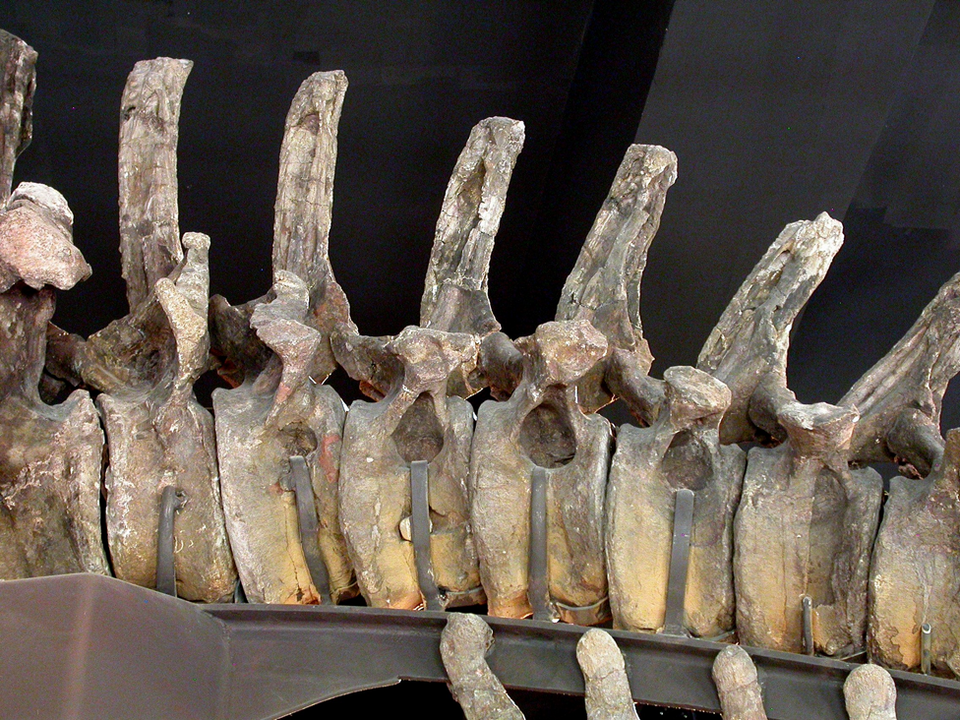
The cervical vertebrae were less elongated and more solid than those of Diplodocus. The bones of the leg were much stockier (despite being longer), implying a more robust animal. The tail was held above the ground during normal locomotion. Like most sauropods, Apatosaurus had only a single large claw on each forelimb, with the first three toes on the hind limb possessing claws.
There are at least two species of Apatosaurus:
- A. ajax was discovered by Othniel Charles Marsh in 1877.
- A. louisae was discovered by William Holland in 1915.
- Another dinosaur species discovered in 1994 was at first named A. yahnahpin, but in 1998, it was renamed Eobrontosaurus yahnahpin.
Lifestyle
It was believed throughout the 19th and early 20th centuries that sauropods like Apatosaurus were too massive to support their own weight on dry land. It was theorized that they lived partly submerged in water, perhaps in swamps. Recent findings do not support this. Sauropods are now thought to have been fully terrestrial animals. A study of diplodocid snouts showed that the square snout, large proportion of pits, and fine, subparallel scratches of the teeth of Apatosaurus suggests it was a ground-height, nonselective browser. It may have eaten ferns, cycads, seed ferns, horsetails, and algae.
Important issues like heat control, metabolic rate and respiration are still unclear. Some scientists state that the heart would have had trouble sustaining sufficient blood pressure to oxygenate the brain. Others suggest that the near-horizontal posture of the head and neck would have eliminated the problem of supplying blood to the brain because it would not have been elevated.
James Farlow calculates that an Apatosaurus-sized dinosaur about 35 t would have had 5.7 t of fermentation contents (food being digested). “The heat of fermentation may have been a significant source of thermoregulatory heat for these reptiles”.
Written for younger readers
Apatosaurus, in simpler words
This version comes from Wikijunior, a set of books written for children aged 8 to 11. It is shorter and uses plainer language than the article above.
From Wikijunior: Dinosaurs
The Apatosaurus, whose name means “deceptive lizard” in Greek, was one of the largest land animals ever. For many years, this dinosaur was sometimes called Brontosaurus.
The Apatosaurus was one of the largest land creatures that have ever lived. They were 20–27 metres in length, 3–5 metres in height, and weighed an enormous 30–35 tons! This is over 6 times heavier than an elephant!
They walked on four legs with a big muscular body, but a much smaller head attached on a long neck. They held their tail up a little above the ground as they moved. The main purpose of this tail was to make sure that the dinosaur would not fall over due to its heavy long neck. It was also used for defence against predators. Their heads were long and narrow. Strangely, apatosaurus’s nostrils were on the top of its head; this is believed to have been so that it could breathe with all but the top of its head underwater, to hide from predators.
They were herbivores — that is, they ate plants. There are two theories about how they used their necks when eating. Until recently, most scientists thought they used their long necks to reach up into trees to get leaves and branches; but recently, some scientists have suggested they used their long necks instead to feed from the ground. They could not chew; most scientists think they swallowed stones called gastroliths to help grind the food in their stomach! Because there were no broad leafed trees, they ate pine needles and ferns. There also was no grass.
They lived in the late Jurassic Period, about 157–146 million years ago. The Jurassic period was warm and humid and had lots of vegetation.
When they were first discovered, scientists believed that because of their large size they could not live on land. So they would have to walk in water with their heads sticking out. Now scientists think that this is not true – no bones were found in any ancient watery places. They most likely lived near river banks where they could find both water and trees. They could not live in the forests, because they were simply too big to walk around in a forest!
Their fossils have been found in Colorado, Oklahoma, Utah, and Wyoming, in the USA, North America.
Professor Othniel Marsh discovered parts of the first fossils of a young Apatosaurus in 1877. The first Apatosaurus skeletons were found without heads. Because of the confusion with the Brontosaurus, the head of Apatosaurus was not conclusively identified until 1972. By this time many examples of the correct head had been found. Apatosaurus means “deceptive lizard,” because its fossils were so similar to those of other sauropods.
- We need to learn how flexible their neck really was, whether they could raise it up high or whether it could only be raised slightly.
- Where and how they really lived, all we have now are just some educated guesses.
- Whether they lived alone or travelled in herds like their close relatives the Diplodocus.
- How they laid their eggs.
Where this page comes from
The article above is adapted from “Apatosaurus” on Simple English Wikipedia, by its contributors. We removed reference markers, navigation boxes and tables, expanded measurement templates into readable numbers, and kept the prose otherwise intact. The simpler version is adapted from Wikijunior on Wikibooks.
Both sources are published under CC BY-SA 4.0, so this page is published under the same licence. You may share and adapt it, including commercially, as long as you credit the original and keep the same licence.
Worksheets, answer keys and printable layouts elsewhere on K5Print are our own work and are not covered by this licence.