Brachiopod

Fast facts
- Phylum
- Brachiopoda
Scientific name
- Scientific name
- Brachiopoda
How to say it in other languages
- Chinese
- 腕足动物门
- French
- Brachiopodes
- German
- Armfüßer
- Japanese
- 腕足動物門
- Portuguese
- braquiópodes
- Russian
- Плеченогие
Facts from Wikipedia’s “Brachiopod” page and Wikispecies (CC BY-SA 4.0).
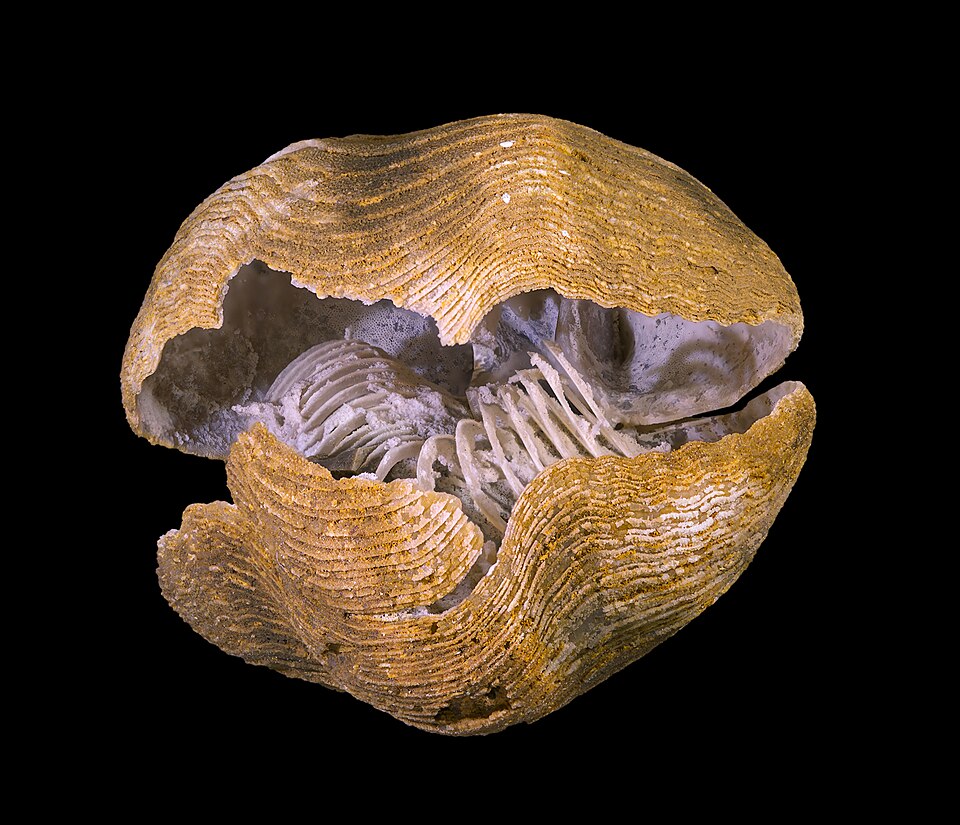
Brachiopods are a phylum of small marine shellfish, sometimes called lampshells. They are not common today, but in the Palaeozoic they were one of the most common types. They lived near the shore (littoral zone), but now they have been pushed into deeper water by competition from bivalve molluscs.
At their peak in the Palaeozoic era the brachiopods occupied a number of marine ecological niches. They were among the most abundant filter-feeders and reef-builders. Many sat on the sea floor, but some swam in the jet-propulsion style of scallops. Brachiopod fossils have been useful indicators of climate changes during the Paleozoic era.
They do look rather like bivalves, but their internal organisation is quite different. Their mostly calcium carbonate shells or “valves” have upper and lower surfaces, unlike the left and right arrangement in bivalve molluscs. Brachiopod valves are hinged at the rear end. The front can be opened for feeding or closed for protection.
Two major groups are recognized, articulate and inarticulate. Articulate brachiopods have toothed hinges and simple opening and closing muscles, while inarticulate brachiopods have untoothed hinges and a more complex system of muscles used to fit the two halves together. In a typical brachiopod a stalk-like pedicle goes from an opening in one of the valves (the pedicle valve). It attaches the animal to the seabed but clear of silt that would block the opening.
Brachiopods have a huge fossil record going back to the Cambrian. They were much reduced by the two main extinction events, the P/Tr and K/T. Bivalve molluscs took over their inshore habitats in the Mesozoic, and since then the brachiopods have been confined to deeper water, except for a handful of species. There are about 100 to 350 species living; the fossil species number 12,000.
Lingula, one of the oldest genera of brachiopods, has survived from the earliest Ordovician to the present day. The various species look very similar, and the genus is a good example of a living fossil.
Brachiopod classification is being debated by invertebrate palaeontologists.
Image gallery
File:Brachiopod valves and pedicle (articulate) 01.png|An articulate brachiopod File:LingulaanatinaAA.JPG|Modern Lingula anatina, very much alive File:Abyssal Brachiopod 00153.jpg|An Upper Ordovician articulate brachiopod
Where this page comes from
The article above is adapted from “Brachiopod” on Simple English Wikipedia, by its contributors. We removed reference markers, navigation boxes and tables, expanded measurement templates into readable numbers, and kept the prose otherwise intact.
Both sources are published under CC BY-SA 4.0, so this page is published under the same licence. You may share and adapt it, including commercially, as long as you credit the original and keep the same licence.
Worksheets, answer keys and printable layouts elsewhere on K5Print are our own work and are not covered by this licence.