Edmontosaurus

Fast facts
- Genus
- Edmontosaurus
- Species
- E. regalis T. regalis
Scientific name
- Scientific name
- Edmontosaurus
How to say it in other languages
- Chinese
- 埃德蒙頓龍
Facts from Wikipedia’s “Edmontosaurus” page and Wikispecies (CC BY-SA 4.0).
Edmontosaurus is a basal duck-billed dinosaur from the latest Cretaceous stage. It had short arms, a long, pointed tail, three-toed, hoofed feet, and mitten-like hands. Its head was flat and sloping with a wide, toothless beak, cheek pouches, and hundreds of closely-packed cheek teeth that ground up its food. It is the same animal as Anatotitan. There are two species, and the animal has been called by several other names in the past.''
Edmontosaurus was named from a fossil found in the Horseshoe Canyon Formation, in Alberta, Canada. Many Edmontosaurus fossils have been found, in Alberta, and Alaska, Wyoming, Montana and New Jersey in the USA. Two mummified Edmontosaurus fossils were found in Wyoming.''
The distribution of its fossils suggests that it preferred coasts and coastal plains. It could move on two legs and on four. Because it is known from several bone beds, Edmontosaurus is thought to have lived in groups. It may have been migratory.
Skeleton
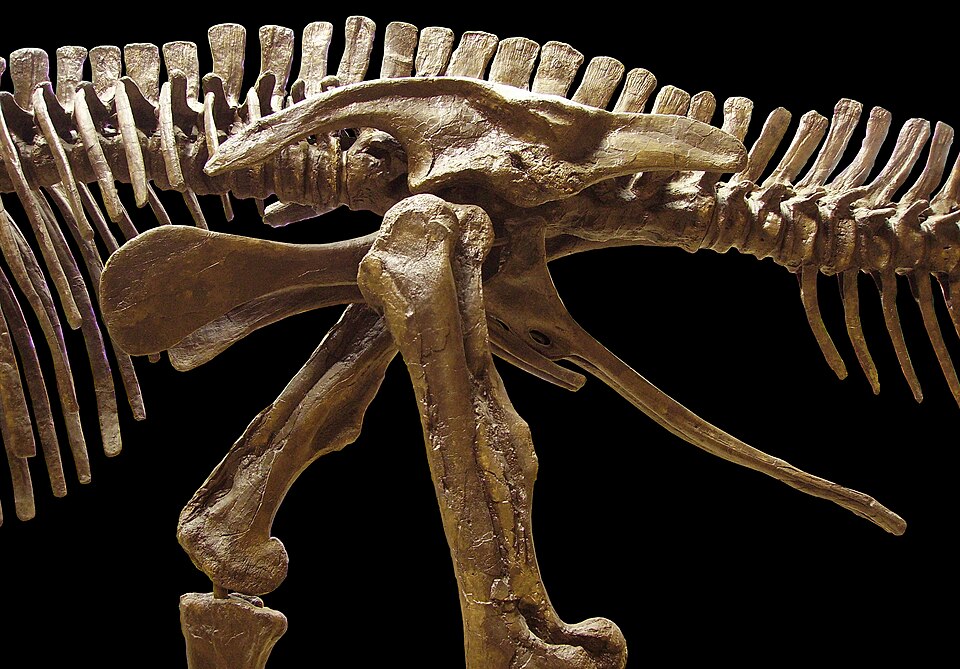
Most of the back and tail was lined by bony tendons arranged in a lattice along the neural spines of the vertebrae. This made the back and part of the tail “ramrod” straight. The ossified tendons strengthened the vertebral column against gravitational stress. It was a large animal with a horizontal vertebral column otherwise supported mostly by the hind legs and hips.
Feeding
As a hadrosaurid, Edmontosaurus was a large terrestrial herbivore. Its teeth were continually replaced and packed into dental batteries that contained hundreds of teeth, only a relative handful of which were in use at any time. It used its broad beak to cut loose food, perhaps by cropping, or by closing the jaws in a clamshell-like manner over twigs and branches and then stripping off the more nutritious leaves and shoots. Edmontosaurus and most other ornithischians probably had cheek-like structures, muscular or non-muscular. The function of the cheeks was to keep food in the mouth. The animal’s feeding range would have been from ground level to about 4 metres (13 ft) above.
Written for younger readers
Edmontosaurus, in simpler words
This version comes from Wikijunior, a set of books written for children aged 8 to 11. It is shorter and uses plainer language than the article above.
From Wikijunior: Dinosaurs
Edmontosaurus was a hadrosaur, or a duck-billed dinosaur
They were large quadruped hadrosaurs. They had front legs similar to a horse’s and had rigid, straight tails.
They ate plants and shrubs.
They lived at the time of the K-T extinction, during the Cretaceous time period of the Mesozoic. This was about 65 million years ago.
Early depictions showed hadrosaurs swimming in swamps and eating sea grass. However, we now know that hadrosaurs were land-dwelling dinosaurs. They lived in what is now the following areas: Alberta, Canada; Alaska; Wyoming; New Jersey; Montana.
Edmontosaurus were discovered in the year 1917, from a fossil in Edmonton Rock Formation, which is located in Alberta, Canada. They were named by a man named Lawrence M. Lambe, who the hadrosaur Lambeosaurus was named after
- Where they actually lived
- Their speed (since only one badly wethered footprint has ever been found but has now been referred to Wichhelmipus)
Where this page comes from
The article above is adapted from “Edmontosaurus” on Simple English Wikipedia, by its contributors. We removed reference markers, navigation boxes and tables, expanded measurement templates into readable numbers, and kept the prose otherwise intact. The simpler version is adapted from Wikijunior on Wikibooks.
Both sources are published under CC BY-SA 4.0, so this page is published under the same licence. You may share and adapt it, including commercially, as long as you credit the original and keep the same licence.
Worksheets, answer keys and printable layouts elsewhere on K5Print are our own work and are not covered by this licence.