Extinction
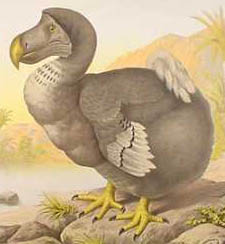

Extinction is when a species of animal, plant, or other organisms are no longer living or dies. Extinction is one of the major features of evolution.
All species become extinct sooner or later. The end of a species may happen for many reasons. It may be caused by habitat loss or by being overhunted, or by a major extinction event. An example of an animal that is now extinct is the Dodo, from over-hunting. Another quite different way for a species to end is by species-splitting, known as cladogenesis. The species living today probably were not living in the Cambrian period, but their ancestors were.
Notable extinct animal species include the non-avian dinosaurs, the saber-toothed cats, the dodo, the mammoths, ground sloths, the thylacine, the trilobites and the golden toad.
Endangered species are those which may become extinct. A report from Kew Gardens suggests that one fifth of plant species may be at risk of extinction. Fossil species sometimes reappear millions of years after they were thought to be extinct. These cases are called Lazarus taxa. Humans are to blame due to cutting down animals’ natural habitat such as forests.
Duration of species
The average duration of species varies according to the groups studied. A study of benthic (deep water) foraminifera showed an average of 16 million years if they lived above 200 metres, but 25my if they lived below 200 metres. On the other hand, the average survival time for mammalian species over the past 20my has been 2.33my.
It is estimated that 99.9% of all species that have ever lived are now extinct. More than half of the plants and animals that have become extinct in the last 200 years have been in Australia. There the arrival of Europeans with (accidentally or deliberately) introduced species has damaged the native biota. Especially, the introduction of eutherian mammals has caused the extinction of many marsupial forms.
Duration of higher groups
Naturally, higher categories such as genera, families, orders, classes and phyla last longer, because they are composed of more species. As far as we know, no phylum has gone completely extinct since the Cambrian, but quite a few classes went extinct in one or other of the ‘big five’ extinction events. Examples of higher categories of animal now extinct are: placoderm fish, trilobites, ammonites, pelycosaurs, non-avian dinosaurs, pterosaurs, ichthyosaurs and plesiosaurs.
Reasons
Darwin thought that most extinctions occurred because some organisms became more effective, and replaced their less advanced competitors. No doubt that does occur, but the view now is that environmental change is more important. Organisms become adapted to the environments they live in. The environment certainly does change, and sometimes quite dramatically. When it does, some organisms can adapt to the changes. Others cannot.
The Earth’s environment can stay rather stable for long periods of time. Then the rate of extinction is usually quite low. Then changes occur, sometimes quite rapidly. In these times the rate of extinction can be much higher. The rate of extinction is therefore a useful thing to measure.
Written for younger readers
Extinction, in simpler words
This version comes from Wikijunior, a set of books written for children aged 8 to 11. It is shorter and uses plainer language than the article above.
From Wikijunior: Dinosaurs
Extinction is the process which happens when a type of animals or plants dies out. This means that all of them die and none survive. Species become extinct when they are no longer able to get what they need to live such as food, water, or shelter. This can also happen when the weather is too hot or too cold for a long time.
As long as there has been life, extinction has happened. 99.9% of all species that ever lived on earth have become extinct! Extinction still happens today, a group of animals which scientists are afraid will become extinct are called endangered.
All the big dinosaurs became extinct at the end of Cretaceous period about 65 million years ago, but no-one knows for sure why. To find out more see Wikijunior Dinosaurs/K-T Event.
Many paleontologists today believe that one group of dinosaurs survived and is alive today. We call them birds. Many people don’t think about them as dinosaurs because they have feathers and can fly. But there are a lot of things about birds that still look like a dinosaur. They have feet with scales and claws, they lay eggs, and they walk on their two back legs like a T-Rex.
Where this page comes from
The article above is adapted from “Extinction” on Simple English Wikipedia, by its contributors. We removed reference markers, navigation boxes and tables, expanded measurement templates into readable numbers, and kept the prose otherwise intact. The simpler version is adapted from Wikijunior on Wikibooks.
Both sources are published under CC BY-SA 4.0, so this page is published under the same licence. You may share and adapt it, including commercially, as long as you credit the original and keep the same licence.
Worksheets, answer keys and printable layouts elsewhere on K5Print are our own work and are not covered by this licence.