Fossils
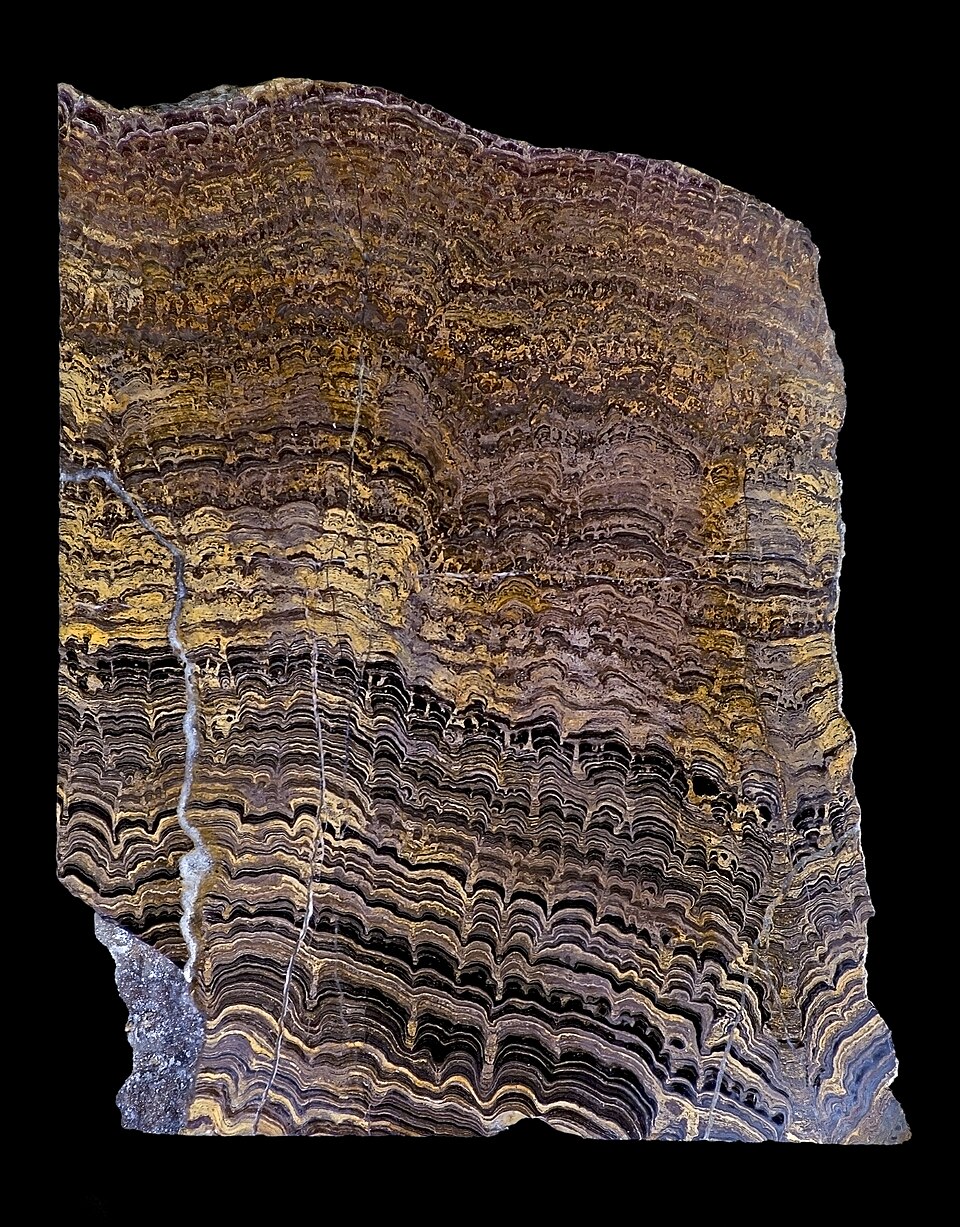

A fossil is the remains or trace of an ancient living thing.
Composition
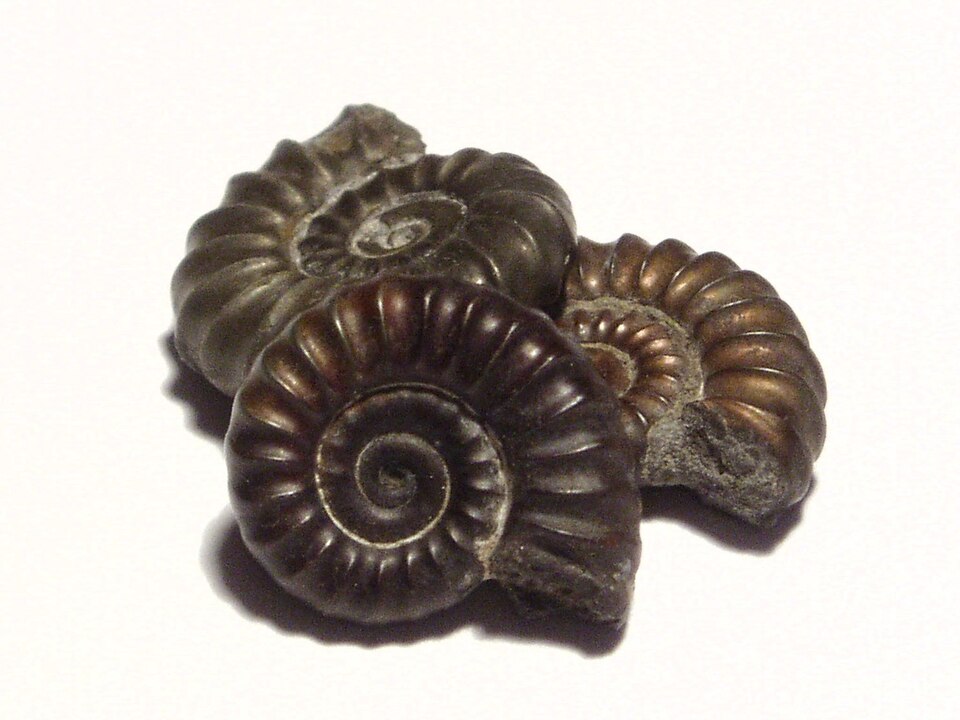
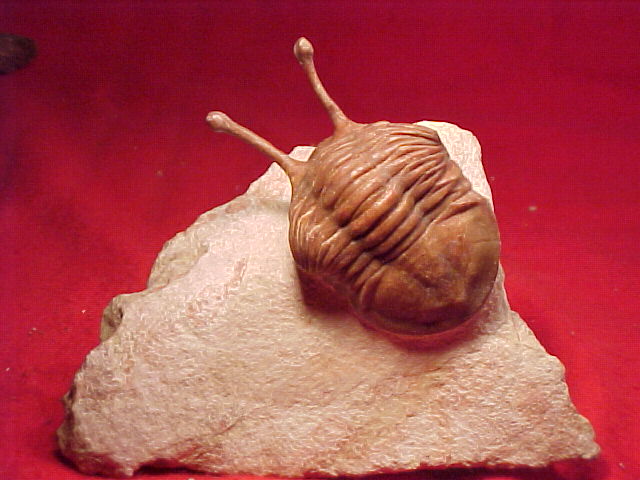
Fossils of animals, plants, or protists occur in sedimentary rock. In a typical fossil, the body form is retained, but the original molecules that made up the body have been replaced by some inorganic material, such as calcium carbonate (CaCO 3 ) or silica (SiO 2 ).
The fossil feels like, and is, made of rock. It has been mineralised or petrified (literally, turned into rock). A fossil may also be an imprint or impression of a living thing remaining in the fossilised mud of a long-gone age. It takes about 10,000 years for fossils to form. Fossils are most commonly found in sedimentary rocks.
Examples
The parts of an organism that fossilize well are the hard parts, not the soft parts. The most common fossils are those of organisms that have hard parts. The hard, calcitic shells of molluscs (such as clams and snails) and of now-rare brachiopods – also known as lampshells – are examples.
These sea-dwelling shellfish have produced many fossiliferous (fossil-bearing) chalky layers of limestone in the earth. Soft-bodied organisms can fossilise in special circumstances: the Ediacaran biota is a good example.
The best-known fossils for the general public are those of the giant, prehistoric dinosaurs. The fossilized bones and fossilized tracks of these huge, ancient reptiles can be seen in many museums of natural history and earth science.
Academic
The study of fossils by geologists and biologists is known as paleontology. If the study puts living things in their ecological context it is called paleobiology. Examples of fossils include bones, shells, exoskeletons, stone imprints of animals or microbes, objects preserved in amber, hair, petrified wood, oil, coal, and DNA remnants. A very famous palaeontologist is Mary Anning she is from the United Kingdom and found fossil remains on the Jurassic Coast.
Applications
People have found many uses for fossils. Some fossils are found and sold. Some rocks, such as limestone, are mostly just masses of small fossils and are used as construction materials and for other purposes. Some fossils are used as a marker to determine formation. Some fossils are used as a source of fuel and called fossil fuel.
Preservation
There are some sites where fossils have been found with remarkable details, or in large numbers. Palaeontologists call these sites by the German term Lagerstätten. The La Brea tar pits in Los Angeles, California, is such a place. So are the Solnhofen limestone quarries in Bavaria. In the Earth’s structure a very important place for fossils is the Burgess Shale. It is known for its many important fossil discoveries.
Types
Microscopic, or very tiny’’, fossils are called “microfossils”. Larger, macroscopic’’ fossils — such as those of seashells and mammals — are called “macrofossils”. Sometimes natural stones look like fossilized organisms, but they are not fossils at all. Rather, they are called “pseudofossils”.
Although most fossils are formed from the hard parts of organisms, there are also indirect signs of prehistoric life. Examples such as a worm’s trail or an animal’s footprint are quite common. These are known as trace fossils. Fossilized excrement, faeces or dung is known as a coprolite. A chemical trace of prehistoric organisms is called a chemofossil. Objects made by prehistoric people are called artifacts but these are not fossils.
Even when the remains of soft-bodied animals are gone, there may be impressions, molds or carbon traces which remain permanently. So, in special cases, we can see fossils of even small, soft invertebrate animals. Sometimes a fossil is produced because of dryness (desiccation), freezing, or pine resin.
Mummified animals, ice-covered wooly mammoths, and insect-filled amber are examples of such fossils. Living fossils, however, are not fossils at all. Instead, they are modern-day organisms which look like their prehistoric ancestors of many millions of years ago. The ginkgo tree, the coelacanth and the horseshoe crab are good examples.
Early mentions
Many pre-scientific peoples noticed fossils, but not all thought they were the remains of living things. Perhaps the first to leave a record of his thought was the Ancient Greek philosopher Xenophanes (about 570 BC –470 BC ). p. 387 His ideas were reported by later writers:
These ideas were rediscovered in the 17th century in Europe. Nicolas Steno in the Netherlands and Robert Hooke at the Royal Society in London both wrote and gave lectures about fossils. In the 18th century fossil-collecting began, and serious thinking on geology began to make progress. In the 19th century geology became a modern science, and fossils played a part in the theory of evolution.
Written for younger readers
Fossils, in simpler words
This version comes from Wikijunior, a set of books written for children aged 8 to 11. It is shorter and uses plainer language than the article above.
From Wikijunior: Dinosaurs
A fossil is the remains of an animal or plant that was once alive but is now dead. When the remains of an animal or plant become a fossil it is called fossilization.
To show you how dinosaurs became fossils, here is a normal fossilization:
- The dinosaur dies and is washed away in a flood. The body is buried in sediment (mud or sand) and eventually the body is covered.
- The soft parts of the body are destroyed leaving only bones. Minerals from the sediment soak into the bones. Very slowly, minerals start to replace the bone. This turns the bones into stone.
- Over millions of years, parts of the rock on the surface wear away. Eventually, the fossil skeleton comes to the surface and is discovered.
Fossils have been found all over the world. Places where many fossils are found are sometimes called ‘fossil hotspots’. Famous ones include:
- Ghost Ranch, La Brea Tar Pits and Morrison Formation in the U.S.A.
- Burgess Shale in Canada.
- Messel Shale in Germany.
- The Gobi Desert in Asia.
- The Isle of Wight and London Clay in the U.K.
- The Jurassic Coast in Dorset, U.K.
- Dinosaur Cove in Australia.
Trace fossils are fossils that are not of the actual body, trace fossils include:
- Fossilized footprints.
- Fossilized eggshells.
- Fossilized nests.
- Fossilized droppings, these are called coprolites.
- Fossilized skeletons of animals.
- Fossilized plants.
It is unlikely that you will find a fossil but it could happen! If you think you’ve found a fossil then take it to a local museum or college and they can examine and tell you what it is. If you’re really, really lucky it might be a new species of dinosaur. They could name it after you! However you should never go around digging up the ground with spades and shovels. Leave it to the experts! When you are an adult you can do this without experts but make sure you check with the police to make sure digging up dinosaur bone without experts is legal in your state/country
Where this page comes from
The article above is adapted from “Fossils” on Simple English Wikipedia, by its contributors. We removed reference markers, navigation boxes and tables, expanded measurement templates into readable numbers, and kept the prose otherwise intact. The simpler version is adapted from Wikijunior on Wikibooks.
Both sources are published under CC BY-SA 4.0, so this page is published under the same licence. You may share and adapt it, including commercially, as long as you credit the original and keep the same licence.
Worksheets, answer keys and printable layouts elsewhere on K5Print are our own work and are not covered by this licence.