Iguanodon

Fast facts
- Genus
- Iguanodon
Scientific name
- Scientific name
- Iguanodon
How to say it in other languages
- Chinese
- 禽龙
- Japanese
- イグアノドン
- Spanish
- Iguanodonte
Facts from Wikipedia’s “Iguanodon” page and Wikispecies (CC BY-SA 4.0).
Iguanodon is a genus of ornithopod dinosaur from the Lower Cretaceous period in Europe, North America, Africa and Asia. It lived 125/126 million years ago (mya).
Discovered in 1822 and described three years later by English geologist Gideon Mantell, Iguanodon was the second dinosaur formally named, after Megalosaurus. Together with Megalosaurus and Hylaeosaurus, it was one of the three genera originally used to define the Dinosauria.
A large, bulky herbivore, Iguanodon is thought by some to be in the same family as the duck-billed hadrosaurs. The taxonomy of the genus continues to be a topic of study as new species are named or long-standing ones reassigned to other genera.
Scientific understanding of Iguanodon has evolved over time. New information is got from the fossils. Researchers have made suggestions about the living animal, including feeding, movement, and social behaviour. As one of the first scientifically known dinosaurs, Iguanodon is well known.
Species
There are at least two species recognised:
- I. bernissartensis, described by George Albert Boulenger in 1881, is the type species for the genus. This species is best known for the many skeletons discovered in a coal mine in Bernissart, Belgium in 1878. The coal dates to the earliest Cretaceous period. 36 adult skeletons were excavated at this site, a coal mine. This is by far the largest find of this species. The species is large and strong.
- I. galvensis, described in 2015, is based on adult and juvenile remains found in deposits in Teruel, Spain, dating to about 126 mya.
Posture and movement
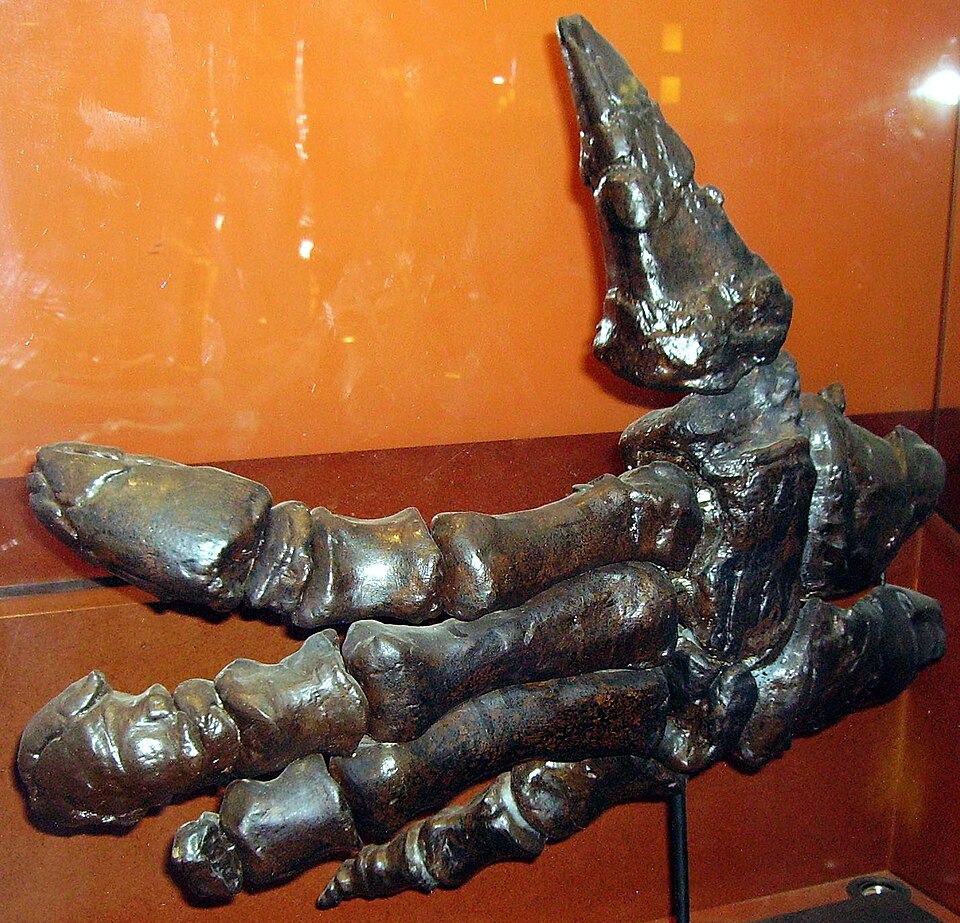
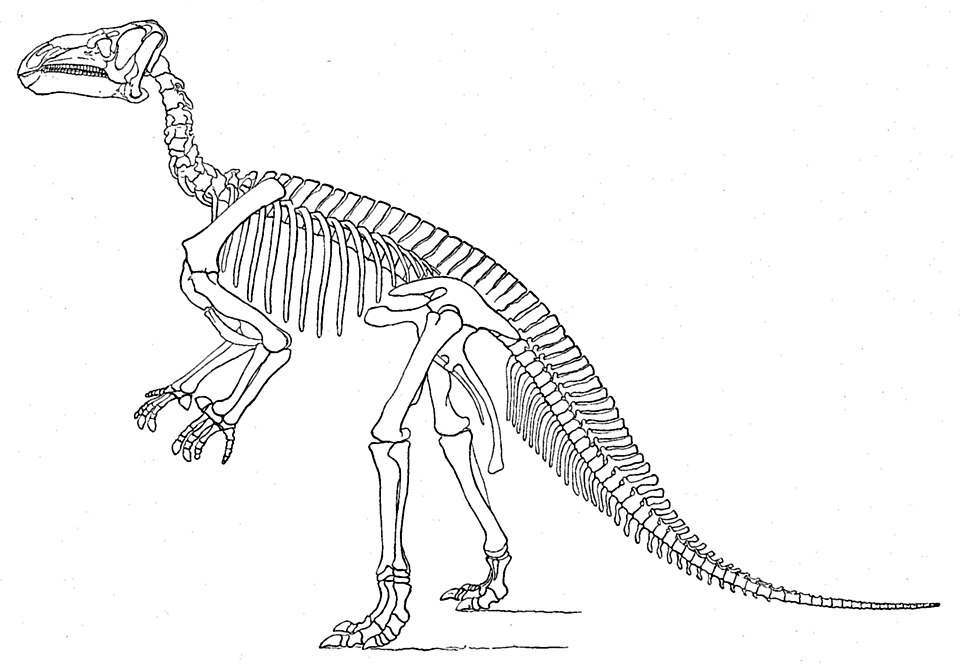
Because its front limbs were shorter than the hindlimbs, Mantell guessed it could move on two legs, as opposed to Owen, who thought it was quadrupedal. As it happens, it probably used both modes. Slow walking would be done on all fours, and faster running on the hind legs. Either way, the position of the body would be more horizontal than upright, with the tail held above the ground by its ossified (bony) ligaments (they can be clearly seen on the skeleton). It would defend itself against predators on its hind legs, using its strong front arms and dagger-like thumbs as weapons.
Eating
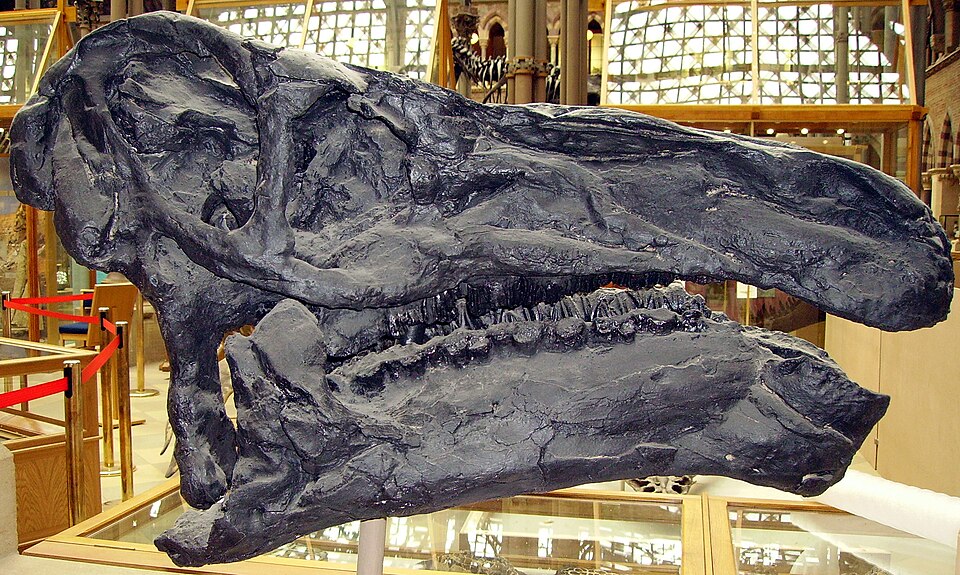
The teeth were close-set grinding teeth suitable for a browser. it is believed that, as with most other ornithischians, Iguanodon had some sort of cheek-like structure, muscular or non-muscular, to keep food in the mouth.
Written for younger readers
Iguanodon, in simpler words
This version comes from Wikijunior, a set of books written for children aged 8 to 11. It is shorter and uses plainer language than the article above.
From Wikijunior: Dinosaurs
Iguanodon was once the one of the common dinosaurs. It was also one of the earliest dinosaurs to be discovered and named. Its name means Iguana Tooth in Greek.
Iguanodon was a big dinosaur. It grew to be thirty feet long, 9,000 pounds (3-4 tons), and had a bulky body. Its neck was long and it had a long tail and a beak. The mouth had teeth in the cheeks toward the back and a sharp beak at the front. Iguanodon usually walked on four legs, but could stand on two if it wanted to reach high. It had four fingers and a bony cone-shaped spike/thumb, which was used for stabbing things trying to harm the Iguanodon.
Iguanodon was a plant eater. It ate cyads and conifers as well as early flowering plants. It used its teeth to chew its food.
Iguanodon lived between 130 and 65 million years ago.
Everywhere! Its habitats were: beaches, plains, forests, mountains, deserts and swamps. It lived in North and South America, Asia, Europe, Australia, Belgium, Spain and England.
A single Iguanodon tooth was discovered in 1822, one of the earliest dinosaur discoveries. The dinosaur was named Iguanodon in 1825 by Dr. Gideon Mantell, because its teeth were similar to the modern day iguana.
Iguanodon had a large spike on both of their hands, where our thumb would be. Originally, it was thought to go on the Iguanodon’s nose, like a rhino horn. Later it was discovered that the spike actually goes on the hand. But what was it used for? Some say it could have been used to defend against attacking predators. Others say that the spike was used in fights when two rival Iguanodon met.
What the spike was used for
The colour of skin
How it was so common and adaptable.
it:Wikijunior Dinosauri/Iguanodon
Where this page comes from
The article above is adapted from “Iguanodon” on Simple English Wikipedia, by its contributors. We removed reference markers, navigation boxes and tables, expanded measurement templates into readable numbers, and kept the prose otherwise intact. The simpler version is adapted from Wikijunior on Wikibooks.
Both sources are published under CC BY-SA 4.0, so this page is published under the same licence. You may share and adapt it, including commercially, as long as you credit the original and keep the same licence.
Worksheets, answer keys and printable layouts elsewhere on K5Print are our own work and are not covered by this licence.