Megalosaurus

Fast facts
- Genus
- Megalosaurus
- Species
- bucklandii
Megalosaurus was a large meat-eating theropod dinosaur of the Middle Jurassic of Europe. It was found in 1824, and was the earliest dinosaur named. In 1827, Gideon Mantell included Megalosaurus in his geological survey of southeastern England. He gave the species its name, Megalosaurus bucklandii.
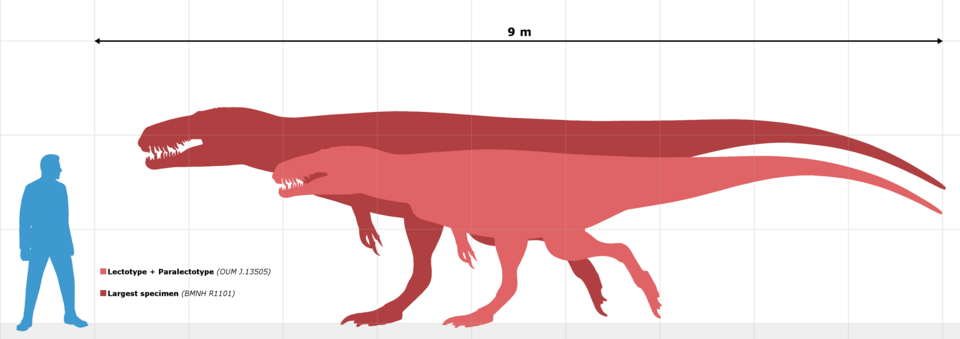
Because a complete skeleton of it has never been found, much is still unclear about its build. The first naturalists who investigated Megalosaurus thought it was a gigantic lizard of twenty metres length. In 1842 Richard Owen concluded that it was no longer than nine metres, standing on upright legs as a quadruped.
Later it was realised that all theropods were bipedal. Today is known that the early proto-dinosaurs in the late Middle Triassic were also bipedal. Certainly Eoraptor, from 231.4 million years ago, was bipedal. That means the dinosaurs were bipedal from the start (primatively bipedal). Only the heavier sauropods and armoured dinosaurs became quadrupedal, standing on all four legs.
Where this page comes from
The article above is adapted from “Megalosaurus” on Simple English Wikipedia, by its contributors. We removed reference markers, navigation boxes and tables, expanded measurement templates into readable numbers, and kept the prose otherwise intact.
Both sources are published under CC BY-SA 4.0, so this page is published under the same licence. You may share and adapt it, including commercially, as long as you credit the original and keep the same licence.
Worksheets, answer keys and printable layouts elsewhere on K5Print are our own work and are not covered by this licence.