Smilodon

Fast facts
- Genus
- †Smilodon
Scientific name
- Scientific name
- Smilodon
- Kingdom
- Animalia
- Phylum
- Chordata
- Class
- Mammalia
- Order
- Carnivora
- Family
- Felidae
How to say it in other languages
- Arabic
- سميلودون
- Chinese
- 劍齒虎
- Dutch
- Sabeltandtijger
- French
- Tigre à dents de sabre
- German
- Smilodon
- Italian
- Smilodonte
- Japanese
- スミロドン
- Korean
- 검치호랑이
- Portuguese
- Tigre dentes de sabre
- Russian
- Смилодон
- Spanish
- Smilodón
Facts from Wikipedia’s “Smilodon” page and Wikispecies (CC BY-SA 4.0).
Smilodon is an extinct genus of saber-toothed cat.
Smilodon species
There were three Smilodon species.
S. gracilis
Smilodon gracilis (or S. fragilis) was the ancestral, smaller species (2.5 to 0.5 million years ago).
S. populator
Smilodon populator (1 mya to 10 kya) was a large, heavy species from eastern South America. It was 1.2 m high at the shoulder, and 2.1 m (83 in) long on average. With an estimated weight of 220 to 400 kg, it was among the heaviest known felids. Its upper canine teeth reached 28 cm (11 in) and protruded up to 17 cm (6.7 in) out of the upper jaw.
S. fatalis
Smilodon fatalis (or S. californicus; 1.6 mya to 10,000 years ago) was the famous cat known from the Rancho La Brea tar pits in Los Angeles. The tar, a bit like asphalt, has yielded about a million bones from late Pleistocene mammals. Of these, around 162,000 bones are from Smilodon, representing perhaps 1200 individuals.
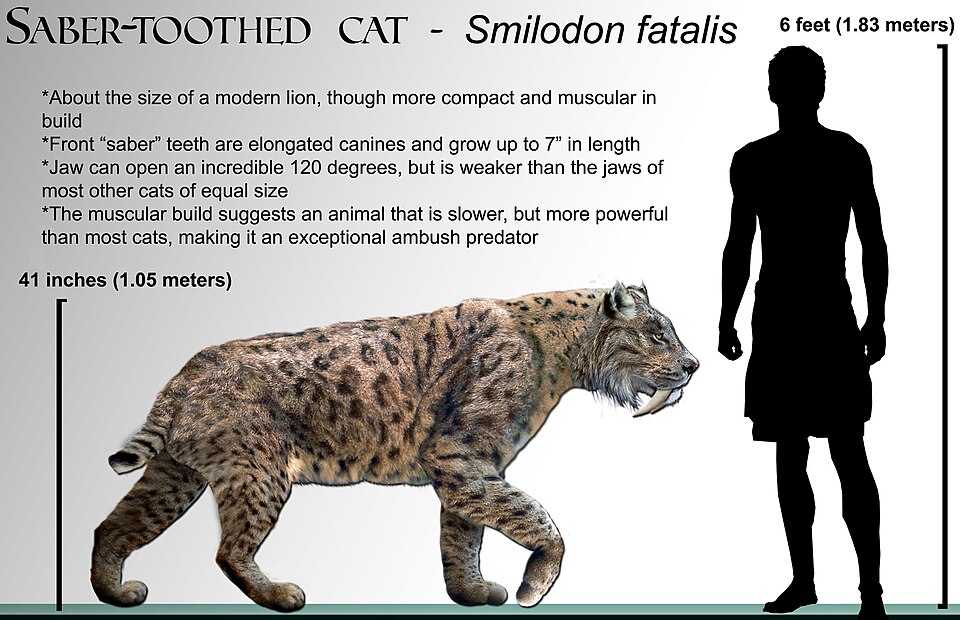
The cat was about the size of a female lion, but weighed more, perhaps 200 kg. It was about 1 metre tall at the shoulders.
Teeth and jaws
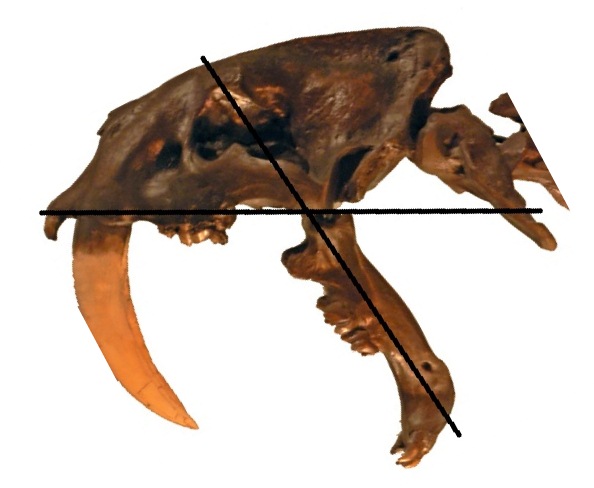
Smilodon is most famous for its relatively long canine teeth. It had the longest teeth of all the saber-toothed cats, at about 28 cm (11 in) long in the largest species, S. populator. The teeth of S. fatalis reached their full size in 18 months at a growth rate of 7 mm/month.
These canine teeth were slender and had fine serrations. They were fragile and could not have bitten into bone. Therefore, the cats did not use their long teeth to take down prey. Only when their prey was subdued did they use their teeth.
Method of attack
The front limbs on these cats were longer and stronger than modern cats. Based on that, and its teeth, its method of attack probably differed from modern cats’. An educated guess would be: they were ambush predators, which clung on round the neck of their prey, and slashed at the underside of the throat. This contrasts with the method of the modern lion, which brings down its prey by weight of numbers, and clamps its jaws over the prey’s nose and mouth. The prey dies of suffocation.
Smilodon’s gape could have reached almost 120 degrees, while that of the modern lion reaches 65 degrees. This makes the gape wide enough to allow Smilodon to slash the throats of their victims without closing their jaws in a bite.
Smilodon’s niche was closer to a leopard’s, which is also an ambush predator. They both need cover to get close to prey.
Smilodon had relatively short legs and a short, bobbed tail. Its front legs were especially powerful. Its body was adapted for springing onto prey, but it was not a very fast runner.
Fauna and flora in Smilodon’s environment
During the last ice age, there were many possible prey species from the La Brea location: mammoths, bison, horse, camel, ground sloth, pronghorn, tapir, deer, elk and others. Most of these were extinct by 5,000 to 10,000 years ago. The pressures of a major climate change and human hunting were thought to be the main causes.
There was more plant cover at that time. Juniper, oaks, ragweeds, cedars, redwoods, sagebrush, sycamore, thistle and walnut grew in the environs. Smilodon survived so long as its prey had vegetation.
Where this page comes from
The article above is adapted from “Smilodon” on Simple English Wikipedia, by its contributors. We removed reference markers, navigation boxes and tables, expanded measurement templates into readable numbers, and kept the prose otherwise intact.
Both sources are published under CC BY-SA 4.0, so this page is published under the same licence. You may share and adapt it, including commercially, as long as you credit the original and keep the same licence.
Worksheets, answer keys and printable layouts elsewhere on K5Print are our own work and are not covered by this licence.