Spinosaurus

Scientific name
- Scientific name
- Spinosaurus
How to say it in other languages
- Chinese
- 棘龍属
- Japanese
- スピノサウルス
- Korean
- 스피노사우루스
- Portuguese
- Espinossauro
Facts from Wikipedia’s “Spinosaurus” page and Wikispecies (CC BY-SA 4.0).
Spinosaurus was a huge semi-aquatic dinosaur from the Cretaceous, that lived 112 to 93.5 million years ago. The type species is Spinosaurus aegyptiacus, who coexisted with the megatheropod Carcharodontosaurus. Another species, S. maroccanus, is a possible second species in the genus that lived in Morocco, Africa and coexisted with the S. aegyptiacus. But some paleontologists suggest that S. maroccanus is junior synonym of S. aegyptiacus or the controversial Spinosaurid known as Sigilmassasaurus. It was one of the largest, and the longest, of all known terrestrial carnivores, weighing up to 6.5–8.1 metric tons (8.3 shorts tons) in body mass. The rather short hind limbs, it is assumed, allowed easier walking on muddy surfaces. The nostrils on top of its crocodile-like head presumably let it submerge its snout into waterways to catch fish, similar to a heron The same researchers suggest it was longer and heavier than Tyrannosaurus rex.
Spinosaurus bones were first discovered in Egypt in 1912 by German paleontologist Ernst Stromer in 1915. Two species, S. aegyptiacus and S. marocannus which is most likely invalid.Spinosaurus looked like Baryonyx, except it was larger and more heavily built. Six specimens of Spinosaurus have been uncovered. The first fossils were destroyed in Munich, during World War II, in a 1944 strategic bombing raid by the Royal Air Force.
A second species was recently found, Spinosaurus mirabilis, which was smaller. Spinosaurus mirabilis had a weird crest on its head that looked like a scimitar.
A note on classification: The material also supports the monophyly of the Spinosaurinae and the separation of Spinosaurus and Irritator.
Description
99-93.5 million years ago, the Sahara Desert was wet. Animals included the pterosaur Alanqa, types of giant crocodylomorphs, and theropod predators close to the size of T. rex. The largest predator was Spinosaurus. In the past, it was thought that Spinosaurus aegyptiacus was bipedal. By 2014, some scientists believed that Spinosaurus aegyptiacus was quadrupedal because it is front-heavy. But later research suggests it could walk bipedally.
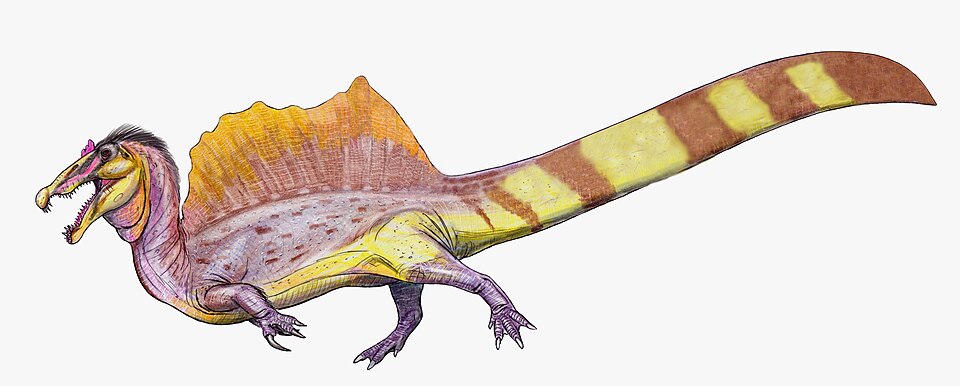
Spinosaurus was longer than Tyrannosaurus. Estimates published in 2005, 2007, and 2008 suggested that it was between 15 metres (50 ft) in length and 7 to 20.9 tonnes (7.7 to 23.0 short tons) in weight. A new estimate published in 2014 and based on a more complete specimen, supported the earlier research, finding that Spinosaurus could reach lengths of over 15 m (49 ft). However in 2022 a study by Paul Sereno and colleauges said that Spinosaurus would reach a maximum body length and weight of 14 meters and 7.4 metric tonnes respectively. It had a two meter high sail on its back like Dimetrodon. Several uses have been suggested for this sail, such as to help control its body temperature but this is considered not likely by current scientific research, as a way to attract a mate, for species reognition and to intimidate or frighten enemies. It was most likely used for the latter 3 purposes. It lived in what is now the Sahara Desert, but which then was mangrove forests alongside shoreline conditions, tidal flats and channels.
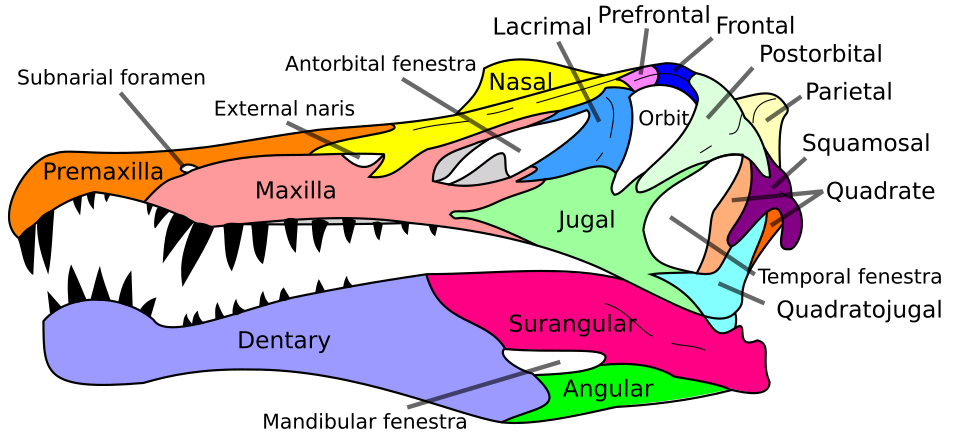
The skull of Spinosaurus was long and narrow like that of a modern orinoco crocodile. Spinosaurus is known to have eaten fish. Evidence suggests that it lived like a giant heron, standing in water and quickly biting at fish.
Media
It was featured as the main dinosaur in the 2001 film Jurassic Park III where it fights and kills a T-Rex. It has also appeared on postage stamps in several countries, and many toy companies have made models of Spinosaurus.
Written for younger readers
Spinosaurus, in simpler words
This version comes from Wikijunior, a set of books written for children aged 8 to 11. It is shorter and uses plainer language than the article above.
From Wikijunior: Dinosaurs
Spinosaurus is a very big theropod (meat-eating dinosaur) that lived during the Early Cretaceous period in North Africa. It is the longest theropod found so far. It is known for the tall sail/hump on its back and its croc-like face.
Spinosaurus was about 15 metres (45 ft) long and 4 metres tall, with the sail adding another 2 metres. According to scientists, it could’ve weighed between 5 and 17 tons, more likely the former. Its backbones had long projections called neural spines. The spines could have supported a sail of skin or a fatty hump, like a camel. Some possible functions of the spine sail could have been controlling body temperature (thermoregulation), and display — either to intimidate rivals or to attract mates. Its skull was 6 feet long and shaped like a crocodile’s, with one little crest at the top, between the eyes. Its mouth had a notch at the tip, giving it a hook-like appearance.
Spinosaurus was a predator that lived near and in water. Its croc-like snout was tipped with tiny holes and pits which contained nerves, so it could sense the water pressure. Its teeth were neither curved and blade-like as in ../Allosaurus/ or the raptors, nor thick and banana-shaped as in ../Tyrannosaurus/, instead being smooth, straight and cone-shaped: perfect for impaling and holding fish. Its claws were curved for slashing and for stabbing small animals. Evidence for a fish-eating diet include a barb from a giant sawfish stuck in a jaw of a Spinosaurus. Other creatures that may were part of its diet include turtles, fish, small dinosaurs and even large crocodiles!
Spinosaurus lived 112 to 93 million years ago during the Early Cretaceous. It was the top predator in its region, alongside Carcharodontosaurus.
Spinosaurus lived in a habitat that may have been humid, like a swamp, where it could hunt coelacants, sawfish, groupers and ambush small crocodiles. Its fossils have been found in Egypt and Morocco, with possibly a similar dinosaur called Oxalaia found in South America.
The first fossils of this creature were found in 1916 by a German paleontologist called Ernst Stromer. The fossils were displayed in a museum in Munich, Germany. Unfortunately, the Allied Forces bombed the museum during World War I, resulting in everything being destroyed. All that was left was a sketch of the animal’s skeleton, so little was known about it. However, all was not lost.
In 2014, more complete remains were found, painting a better picture of this weird creature. A replica of the complete skeleton is on display in the National Geographic Museum, with a life-sized 3D printed statue standing outside the building.
- What color were they? The sail might have been brightly coloured to attract a female, or scare predators.
- Could it run?
- Was it really the biggest predator? Spinosaurus lived with the giant theropod Carcharodontosaurus and may have encountered it now and then.
Where this page comes from
The article above is adapted from “Spinosaurus” on Simple English Wikipedia, by its contributors. We removed reference markers, navigation boxes and tables, expanded measurement templates into readable numbers, and kept the prose otherwise intact. The simpler version is adapted from Wikijunior on Wikibooks.
Both sources are published under CC BY-SA 4.0, so this page is published under the same licence. You may share and adapt it, including commercially, as long as you credit the original and keep the same licence.
Worksheets, answer keys and printable layouts elsewhere on K5Print are our own work and are not covered by this licence.