Stegosaurus

Fast facts
- Phylum
- Chordata
- Genus
- Stegosaurus
Scientific name
- Scientific name
- Stegosaurus
How to say it in other languages
- Chinese
- 劍龍屬
- French
- Stégosaure
- Japanese
- ステゴサウルス
- Portuguese
- Estegossauro
Facts from Wikipedia’s “Stegosaurus” page and Wikispecies (CC BY-SA 4.0).
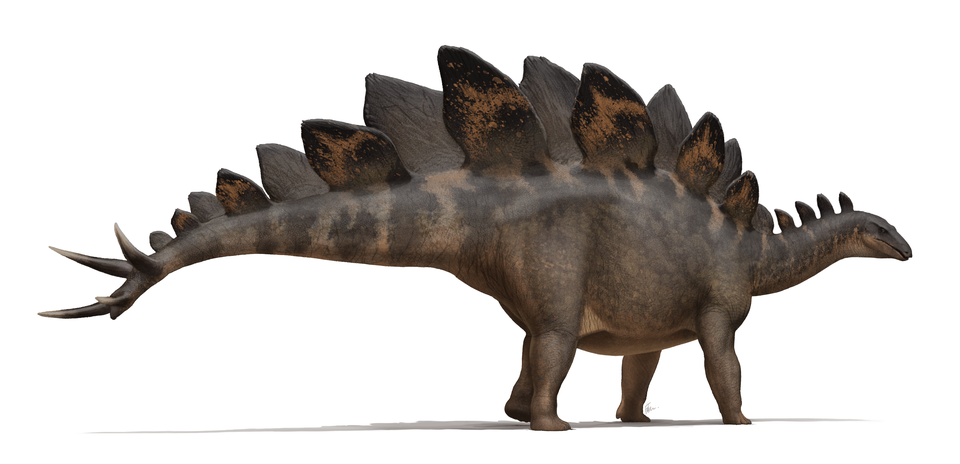
Stegosaurus (meaning “roof-lizard”) was a type of plant-eating dinosaur which lived in what is now western North America.
Stegosaurus lived in the Upper Jurassic period around 155 to 145 million years ago. It is one of the most easily recognized dinosaurs, with its distinctive double row of kite-shaped plates on its back, and the long spikes on its tail. The armor was necessary as it lived with such meat-eaters as Allosaurus and Ceratosaurus.
Discovery and species
Stegosaurus was originally named by Othniel Charles Marsh in 1877, from fossils found near Morrison, Colorado. These first bones became the first species of Stegosaur named: Stegosaurus armatus.
Several different Stegosaurus species have been found.
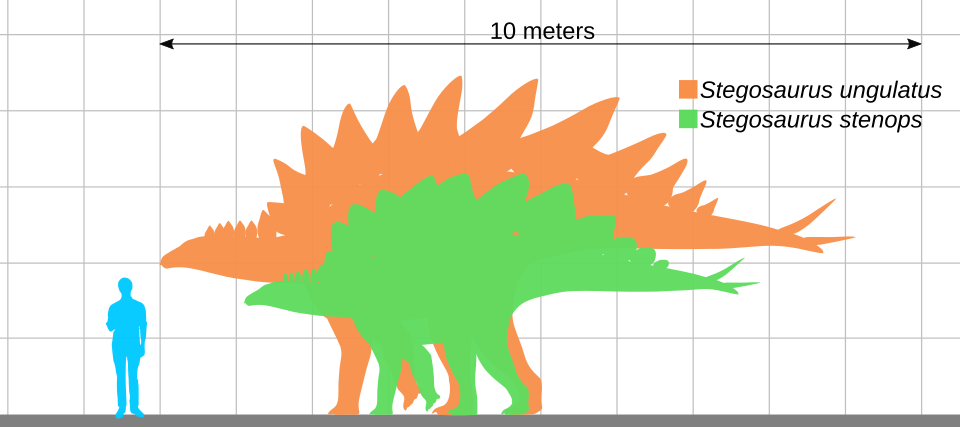
- Stegosaurus armatus: This was the first type of Stegosaurus to be found. Over thirty different skeletons have been discovered by scientists. This type had four tail spikes and small plates. At 9 meters (30 ft), it was the longest species of Stegosaurus.
- Stegosaurus stenops: Named by Marsh in 1887, it was discovered near Cañon City, Colorado, in 1886. This is the best known species of Stegosaurus, mainly because its fossils make at least one complete skeleton. It had large, broad plates and four tail spikes. S. stenops is known from at least 50 partial skeletons of both adults and juveniles, one complete skull and four partial skulls. It was shorter than S. armatus, at 7 m (23 ft).
- Stegosaurus longispinus: This type of Stegosaur is known from one incomplete skeleton. S. longispinus had a set of very long tail spines. Like S. stenops, it grew to 7 m (23 ft) in length.
- S. ungulatus: Named by Marsh in 1879 from remains recovered at Como Bluff, Wyoming, it is only known from a few backbones and armor plates. It is probably the same as S. armatus.
- S. sulcatus: This is another partial skeleton. It is probably the same as S. armatus.
- S. duplex: This animal is probably the same as S. armatus. It was also named by Marsh in 1887,. Its fossils were found in 1879 by Edward Ashley at Como Bluff, Wyoming.
- ?S. seeleyanus: Probably the same as S. armatus.
- ?S. (Diracodon) laticeps: Named by Marsh in 1881 from some jawbone fragments.
Paleobiology
Stegosaurus was the largest stegosaur, reaching up to 12 m (39.4 ft) in length and weighing up to 5,000 kg (5.5 short tons). However, 7 to 9 m was a more usual length.
Skull
The skull of Stegosaurus was long and narrow. Because of its short front legs, its head was close to the ground, probably no higher than 1 m (3.3 ft). It ate low-growing plants because of this. It had no front teeth, but it did have a horn-covered beak. Stegosaurian chewing teeth were small and triangular and did little grinding as they lacked wear surfaces.
Unlike most dinosaurs, it did not have a lacuna (hole) in its skull between the nose and eye.
Nervous system
It has often been said that the Stegosaurus brain was the size of a walnut. Actually, it had a brain several times the size of a walnut. The bundle of nerves near the base of the tail that controlled reflexes in the back of the body was larger than the brain and is sometimes said to be a “second brain”. These issues are discussed in Dinosaur brains and intelligence.
Posture
Stegosaurus had very short forelimbs in relation to its hind legs. The back legs each had three short toes, while the front legs had five toes. All four limbs were supported by pads behind the toes.
Classification
Stegosaurus was a member of the Thyreophora, or armored dinosaurs, a family of dinosaurs which includes the ankylosaurs.
Popular culture
Stegosaurus has been declared the State Dinosaur of Colorado. It has also appeared in many movies and TV shows.
Written for younger readers
Stegosaurus, in simpler words
This version comes from Wikijunior, a set of books written for children aged 8 to 11. It is shorter and uses plainer language than the article above.
From Wikijunior: Dinosaurs
Stegosaurus is Greek for “plated lizard”; this name is given to the dinosaur due to a heavy armour of plates down its back. It is also sometimes known as one of the dumbest dinosaurs, because it had a very small brain compared to its large body.
An average Stegosaurus was about 12 m (40 ft) long and about 2.75 m (9 ft) tall. Stegosaurus weighed about 2,000 kg or 6,800 pounds (around 2 tons!) Stegosaurus’s front feet each had five toes and there were three toes on each back foot. The feet resembled gigantic horse hoofs and the people who first discovered them actually thought they might have come from giant horses!
The most prominent feature of a Stegosaurus was the row of plates running down its back, along the spine. These plates could be larger than 75 cm in height! It was once thought that they were used as protection against predators such as the Allosaurus, but in fact they were not solid bone and would have been easy to break. They were covered with thin skin and lots of blood vessels.
Nobody knows for sure what the back plates were used for, but many scientists now believe that they were used for temperature control – to gather heat from the surroundings. They would have been used like solar panels. When the animal needed to warm up, it would stand with its side toward the sun. The thin skin and many blood vessels covering the plates would soak up the heat of the sun. When the Stegosaurus got too hot, it could stand in the shade, or turn itself to face the sun (or face away from it). Then the blood vessels could be cooled. Another theory is that the plates could “blush”, filling up with blood; the now-red plates could be used to attract a mate, or scare enemies.
For defence Stegosaurus did have four (or eight) heavy spikes on its tail, which could be used to hit attackers.
Stegosaurus’s mouth was shaped a bit like a beak and had no teeth in the front – probably for snipping plants.
Stegosaurus was a herbivore, meaning it ate plants. It mainly liked to browse plants near the ground, because they were the easiest to reach with its short neck. They were plants such as ferns, mosses, cycads and baby evergreen trees, which contained little nutrition. Most of them were only 3–4 feet high. Stegosaurus may have been able to rear up on its hind legs for short periods of time to browse plants that were otherwise out of reach.
Due to plants having little nutrition in each bite, the Stegosaurus had to eat a lot. It would spend most of its day eating.
They lived during the late Jurassic period about 156–145 million years ago.
They lived in subtropical parts in the USA, but there were also stegosaurus living in other parts of the world including Africa, China, Mongolia and Europe.
Stegosaurus fossils have been found in the US states of Colorado, Utah and Wyoming.
The first Stegosaurus fossil was found in Colorado, USA, in 1876 by M. P. Felch. It was named in 1877 by Othniel C. Marsh.
The most complete Stegosaurus fossil ever found was nicknamed “Spike”. It was discovered in Colorado, USA, by Bryan Small, Tim Seeber and Kenneth Carpenter in 1992.
- We would like to know why “Stegosaurus” had the big bony plates on its back. Did they cool Stegosaurus? Did it use them to show off? Or to protect itself? We don’t know.
- Stegosaurus’s back plates were not solid – they were filled with long hollow tubes or tunnels. What were they for?
- Stegosaurus had cousins, known as Stegosaurs. Some of the cousins lived in herds (like cows and horses do today), and some did not. We would like to know whether Stegosaurus lived in herds, or whether it lived mostly alone.
- Stegosaurus had a very small brain. Scientists used to think a structure near its hip was a second brain, perhaps to help control its tail and hind legs. Now they think it might be a “glycogen body”, which is something birds have and is related to storing energy, although they’re not sure quite what it does even in birds. We would like to know for sure.
it:Wikijuinor Dinosauri/Stegosaurus

Where this page comes from
The article above is adapted from “Stegosaurus” on Simple English Wikipedia, by its contributors. We removed reference markers, navigation boxes and tables, expanded measurement templates into readable numbers, and kept the prose otherwise intact. The simpler version is adapted from Wikijunior on Wikibooks.
Both sources are published under CC BY-SA 4.0, so this page is published under the same licence. You may share and adapt it, including commercially, as long as you credit the original and keep the same licence.
Worksheets, answer keys and printable layouts elsewhere on K5Print are our own work and are not covered by this licence.