Triceratops

Scientific name
- Scientific name
- Triceratops
How to say it in other languages
- Arabic
- التَرَيسِيرَاتوپس
- Chinese
- 三角龍
- Japanese
- トリケラトプス
- Russian
- Трицератопсы
Facts from Wikipedia’s “Triceratops” page and Wikispecies (CC BY-SA 4.0).
Triceratops was a huge herbivorous ceratopsid dinosaur from the late Cretaceous. Its name means three horned face which it gets from having three horns on its head. They were mainly found in North America. As adults, they grew up to 9 m (30 ft) long by 3 m (9.8 ft) tall, and probably weighed around 12 t (26,000 lb). Fully-grown, their skull was enormous (two meters long and nearly a meter wide).
Triceratops was a low browser with a bony beak in front of its jaws. The jaws had close-set grinding teeth. Its defense had to stand up to attacks from taller theropods, hence the bony shield which covered its neck. Holes made by teeth have been found on the bony frill behind the horns, and on the sacrum (the part of the spine above the pelvis).
Many fossils of Triceratops have been collected since the genus was first described in 1889. There is at least one complete individual skeleton. Paleontologist John Scannella observed: “It is hard to walk out into the Hell Creek Formation and not stumble upon a Triceratops weathering out of a hillside”. Forty-seven complete or partial skulls were discovered in just that area during the decade 2000–2010. Specimens showing life stages from hatchling to adult have been found.
Size
Individual Triceratops were about 7.9 to 9.0 m (26.0–29.5 ft) in length, 2.9 to 3.0 m (9.5–9.8 ft) in height, and 6.1–12.0 tonnes (13,000–26,000 lb) in weight.
Skull
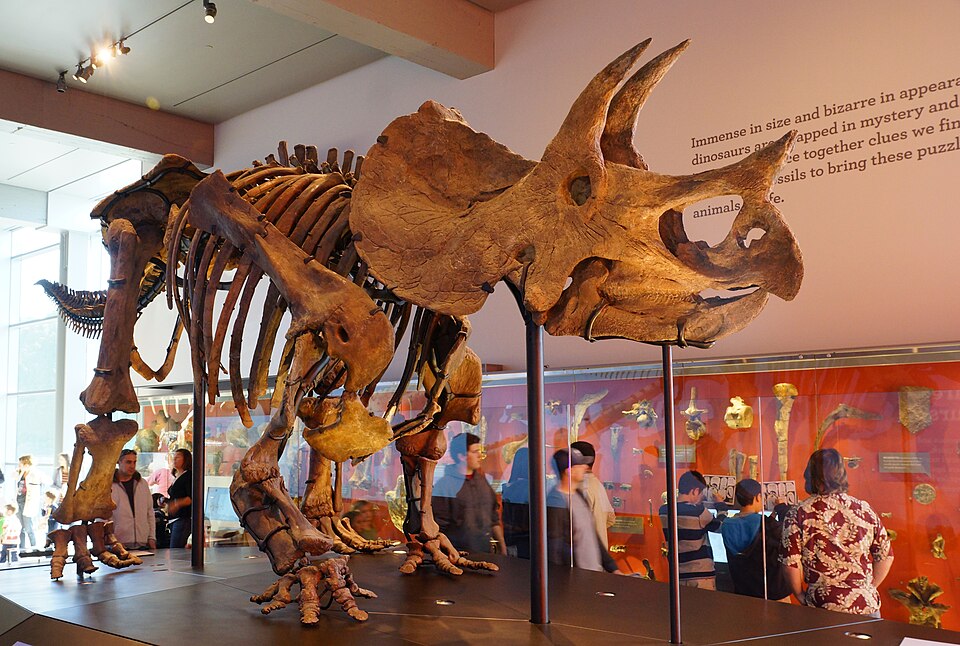
The most distinctive feature is their large skull, among the largest of all land animals. The largest known skull (specimen BYU 12183) is estimated to have been 2.5 metres (8.2 ft) in length when complete, and could reach almost a third of the length of the entire animal. It bore a single horn on the snout, above the nostrils, and a pair of horns approximately 1 m (3 ft) long, with one above each eye. Most other ceratopsids had large holes (fenestrae) in their frills, while those of Triceratops were noticeably solid.
Limbs
Triceratops species were sturdy, with strong limbs and short three-hoofed hands and four-hoofed feet.
The posture of these dinosaurs has long been the subject of some debate. Originally, it was believed that the front legs of the animal had to be sprawling at angles from the thorax, in order to better bear the weight of the head. This stance can be seen in paintings by Charles Knight and Rudolph Zallinger. However, evidence of trackways, and reconstructions of skeletons show that Triceratops and other ceratopsids had an upright stance during normal locomotion, with the elbows flexed and slightly bowed out. The stance was intermediate between fully upright and fully sprawling, similar the modern rhinoceros.
Paleobiology
Although Triceratops are commonly portrayed as herd animals, there is little evidence that they lived in herds.
In 2012, a group of three Triceratops in relatively complete condition, each of varying sizes from a full-grown adult to a small juvenile, were found in Wyoming, near Newcastle. The remains are currently under excavation by paleontologist Peter Larson and a team from the Black Hills Institute. It is believed that the animals were traveling as a family unit, but it remains unknown if the group consists of a mated pair and their offspring, or two females and a juvenile they were caring for. The remains also show signs of predation or scavenging from Tyrannosaurus, particularly on the largest specimen, with the bones of the front limbs showing breakage and puncture wounds from Tyrannosaurus teeth.
For many years, Triceratops finds were known only from solitary individuals. These remains are very common: one palaeontologist reported having seen 200 specimens of T. prorsus in the Hell Creek Formation of Montana, U.S. Similarly, Barnum Brown claimed to have seen over 500 skulls in the field. Triceratops teeth, horn fragments, frill fragments, and other skull fragments are abundant fossils in the latest Upper Cretaceous of western North America. It was the most dominant herbivore of the time. In 1986, Robert Bakker estimated it as making up 5/6ths of the large dinosaur fauna at the end of the Cretaceous.
Triceratops was one of the last ceratopsian genera to appear before the Cretaceous–Paleogene extinction event. The related Torosaurus, and the more distantly related diminutive Leptoceratops, were also present, though their remains are rarely found.
Dentition and diet
Triceratops were herbivorous, and because of their low head, their primary food was probably low growth, although they may have been able to knock down taller plants with their horns, beak, and bulk. The jaws were tipped with a deep, narrow beak, good for grasping and plucking.
Triceratops teeth were arranged in groups called batteries, of 36 to 40 tooth columns, in each side of each jaw with 3 to 5 stacked teeth per column, depending on the size of the animal. This gives a range of 432 to 800 teeth, of which only a fraction were in use at any given time (tooth replacement was continuous and occurred throughout the life of the animal). The great size and numerous teeth of Triceratops suggests that they ate large volumes of fibrous plant material, such as palms and cycads.
Functions of the horns and frill
There has been much speculation over the functions of Triceratops’ head adornments. The two main theories have revolved around use in combat, or display in courtship, with the latter thought now to be the most likely primary function.
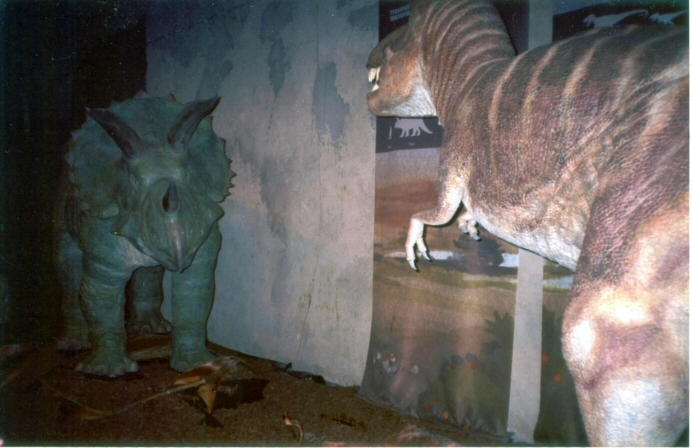
Triceratops were long thought to have used their horns and frills in combat with predators such as Tyrannosaurus. The idea was discussed first in 1917 and again 70 years later by Robert Bakker. There is evidence that Tyrannosaurus did have aggressive head-on encounters with Triceratops, based on partially healed tyrannosaur tooth marks on a Triceratops brow horn and squamosal; the bitten horn is also broken, with new bone growth after the break. Since the Triceratops wounds healed, the Triceratops survived the encounter. Tyrannosaurus is also known to have fed on Triceratops. Evidence for this includes a heavily tooth-scored Triceratops ilium and sacrum.
In addition to combat with predators using horns, Triceratops are classically shown engaging each other in combat with horns locked. While studies show that such activity would be feasible, if unlike that of present-day horned animals, there is disagreement about whether they did so.
The large frill also may have helped to increase body area to regulate body temperature. A similar theory has been proposed regarding the plates of Stegosaurus, although this use alone would not account for the bizarre and extravagant variation seen in different members of the Ceratopsidae. This observation is highly suggestive of what is now believed to be the primary function, display.
The theory of their use in sexual display was first proposed by Davitashvili in 1961 and has gained increasing acceptance since. Evidence that visual display was important, either in courtship or in other social behavior, can be seen in the fact that horned dinosaurs differ markedly in their adornments, making each species highly distinctive. Also, modern living creatures with such displays of horns and adornments use them in similar behavior. A 2006 study of the smallest Triceratops skull, ascertained to be a juvenile, shows the frill and horns developed at a very early age, predating sexual development and thus probably important for visual communication and species recognition in general.
Paleopathology
One skull, assigned to Triceratops, has a hole in the jugal bone. It looks like a puncture wound sustained while the animal was still alive. This is supported by signs of healing that are present in the bone around the supposed wound. When examined closely, the hole in the bone has a diameter that is very similar to diameter of the distal end of a Triceratops horn. This is evidence of competition between individual dinosaurs.
Written for younger readers
Triceratops, in simpler words
This version comes from Wikijunior, a set of books written for children aged 8 to 11. It is shorter and uses plainer language than the article above.
From Wikijunior: Dinosaurs
The body of the Triceratops was big and round, planted on top of short sturdy legs. It was 8 meters long, about 3 meters tall and weighed somewhere between 6 and 12 tons (the size of an elephant).
Triceratops means “Three Horned Face” in Greek. It is called that because it had three horns – two above its eyes and one on its nose. Triceratops horns could be up to 115 cm (45 inches) long. It had a big frill that extended up above the head.
The horns were used for defense, against such enemies as the Tyrannosaurus. When threatened, the Triceratops would stand and fight. Its sharp horns would act as spears and cause a lot of damage. It also had a powerful bite.
Scientists do not all agree on what its head frill was used for. Some say it could have been a defense – like a shield, to protect its body. Some say it was used to give a warning to members of the herd by changing colour. Many now believe the horns and frill were used for social behavior and communication between different Triceratops individuals. For example, two bull Triceratops used the horns and frill in fights over territory or mates, the same way bovids and antelopes do today.
The Triceratops was a herbivore — a plant-eater — that fed close to the ground. We know this because it had flat teeth that are good for chopping up vegetation, and its massive head would have been difficult to lift high in the air. Unlike any animal today, the Triceratops had a beak in front of its mouth and teeth in the back. The beak would have a hard covering like a parrot beak.
A triceratops’ teeth would have been able to crush not only leaves but even very tough branches and roots. Some scientists think Triceratops ate cycads, which are a type of plant that was common in the Cretaceous. These plants look like a small palm tree with a crown of sharp, spiky leaves. A Triceratops could have used its strong beak to strip off the leaves before eating the trunk. Other scientists argue that these plants are very poisonous so it is unlikely that any dinosaur ate them, even though today the sloth and other animals like the parrot (a descendant of the dinosaurs) can eat poisonous leaves or fruit.
Triceratops, like any animal that eats tough foods, had to be big: they needed to process the food very slowly because it took a long time to digest, requiring a long digestive tract. This is evident in how, for instance, an elephant can digest a tree branch, or a cow can digest hay, but a human cannot.
Triceratops lived in the late Cretaceous period, around 66 to 68 million years ago. The climate was warm and dry and there were numerous volcanoes.
Triceratops lived in the North American continent. Remains have been found in the United States (USA) states of Colorado, Montana, North and South Dakota, and Wyoming, and in the Canadian provinces of Alberta and Saskatchewan. There is evidence that they were a herding animal. They lived in groups like buffalo or bison.
The first Triceratops was discovered in 1887, in Colorado, USA. Since then many of their fossils have been found with Tyrannosaurus tooth marks!
- What their head frill was used for. - Some people believed that the Triceratops babies were hunted by smaller meat eaters and the adult used their frills to protect their young.
- If they were really hunted by T.Rex. it:Wikijunior Dinosauri/Triceratops

Where this page comes from
The article above is adapted from “Triceratops” on Simple English Wikipedia, by its contributors. We removed reference markers, navigation boxes and tables, expanded measurement templates into readable numbers, and kept the prose otherwise intact. The simpler version is adapted from Wikijunior on Wikibooks.
Both sources are published under CC BY-SA 4.0, so this page is published under the same licence. You may share and adapt it, including commercially, as long as you credit the original and keep the same licence.
Worksheets, answer keys and printable layouts elsewhere on K5Print are our own work and are not covered by this licence.