Trilobite

Fast facts
- Phylum
- Arthropoda
Scientific name
- Scientific name
- Trilobita
How to say it in other languages
- Dutch
- Trilobieten
- French
- Trilobite
- Japanese
- 三葉虫綱
- Korean
- 삼엽충강(三葉蟲綱)
- Russian
- Трилобиты
- Spanish
- Trilobites
Facts from Wikipedia’s “Trilobite” page and Wikispecies (CC BY-SA 4.0).
Trilobites (“three lobes”) are extinct arthropods. They were the first animals known to have eyes, although some were secondarily blind. They were very numerous during the early Palaeozoic era.
Their distribution was worldwide, but only in salt water environments. They disappeared in the Permian–Triassic extinction event.
Trilobites had many lifestyles. Some moved over the sea floor as predators, scavengers, or filter feeders. Some swam, feeding on plankton. Most ecological niche s of modern marine arthropods are seen in trilobites.
Their bodies were divided into three parts: the head (cephalon), the thorax (chest) made of up to 30 segments, and the tail (pygidium). Underneath, and rarely preserved, are three pairs of legs for the head. There are paired legs for each pleural groove.
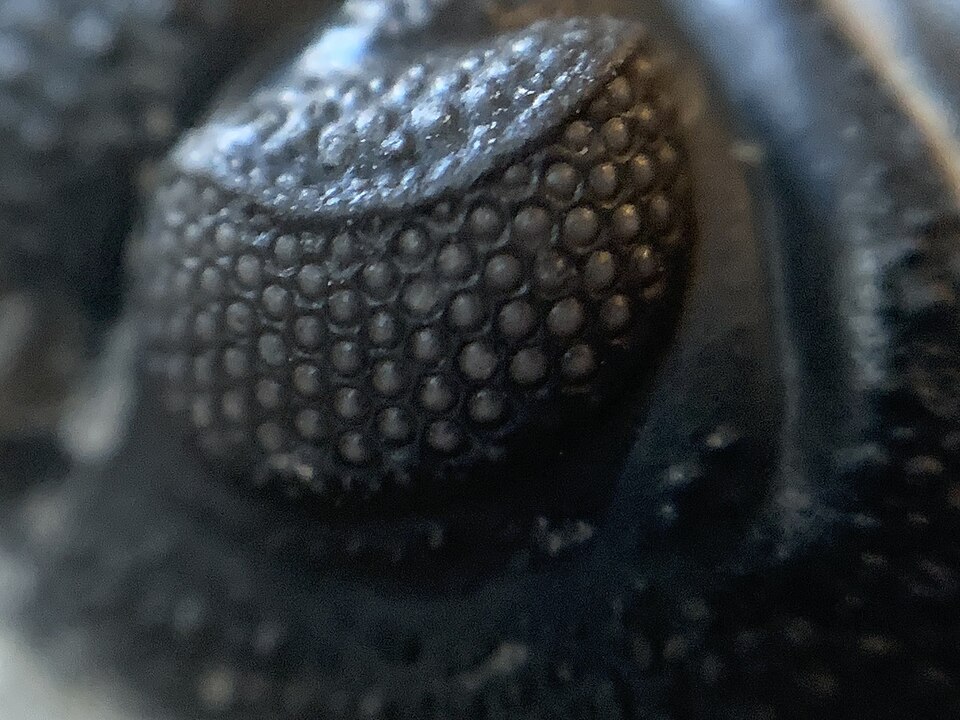
Trilobites are the earliest known animal to have vision. The earliest trilobites had complex, compound eyes with lenses made of calcite. Some trilobites had small eyes or no eyes at all, and probably lived in dark or muddy environments.
Trilobites ranged in length from 1 millimetre to 72 centimetres, with a typical size range of 3–10 cm. The world’s largest trilobite, Isotelus rex, was found in 1998 by Canadian scientists on the shores of Hudson Bay.
Image:SilurianTrilobite.jpg|Dalmanites limulurus from Silurian age rocks of New York, U.S.A. Image:Asaphus.jpg|Asaphus lepidurus from Middle Ordovician rocks near St. Petersburg, Russia. Image:Asaphiscuswheelerii.jpg|Asaphiscus wheeleri from Cambrian rocks of Millard Co., Utah, U.S.A.
Trilobites appeared some 600 million years ago during the Cambrian period. They belonged (probably) to the phylum Arthropoda. This phylum includes the most successful (78%) of all animal life forms, including crabs, centipedes, spiders, shrimps and insects. The trilobites, living in shallow seas, flourished as swimmers, crawlers and burrowers for some 350 million years. Over time, they evolved rapidly into a wide variety of strange and beautiful forms.
Discovery
They were first pictured some 25,000 years ago in a France cave. Two specimens were found in a Cro-magnon settlement, at a site called “La Grotte du Trilobite”. One was found with a hole drilled into it and worn as an adornment. Others have been found in the tombs of Egypt, Greece and Rome. Trilobite fossils were sold on the street of 15th Century Europe and collected by Thomas Jefferson and Benjamin Franklin.
Where this page comes from
The article above is adapted from “Trilobite” on Simple English Wikipedia, by its contributors. We removed reference markers, navigation boxes and tables, expanded measurement templates into readable numbers, and kept the prose otherwise intact.
Both sources are published under CC BY-SA 4.0, so this page is published under the same licence. You may share and adapt it, including commercially, as long as you credit the original and keep the same licence.
Worksheets, answer keys and printable layouts elsewhere on K5Print are our own work and are not covered by this licence.