Tyrannosaurus

Scientific name
- Scientific name
- Tyrannosaurus
How to say it in other languages
- Arabic
- تيرانوصور
- Chinese
- 暴龍屬
- French
- Tyrannosaure
- Japanese
- ティラノサウルス属
- Korean
- 티라노사우루스
- Portuguese
- Tiranossauro
- Russian
- Тираннозавр
- Spanish
- Tiranosaurio
Facts from Wikipedia’s “Tyrannosaurus” page and Wikispecies (CC BY-SA 4.0).
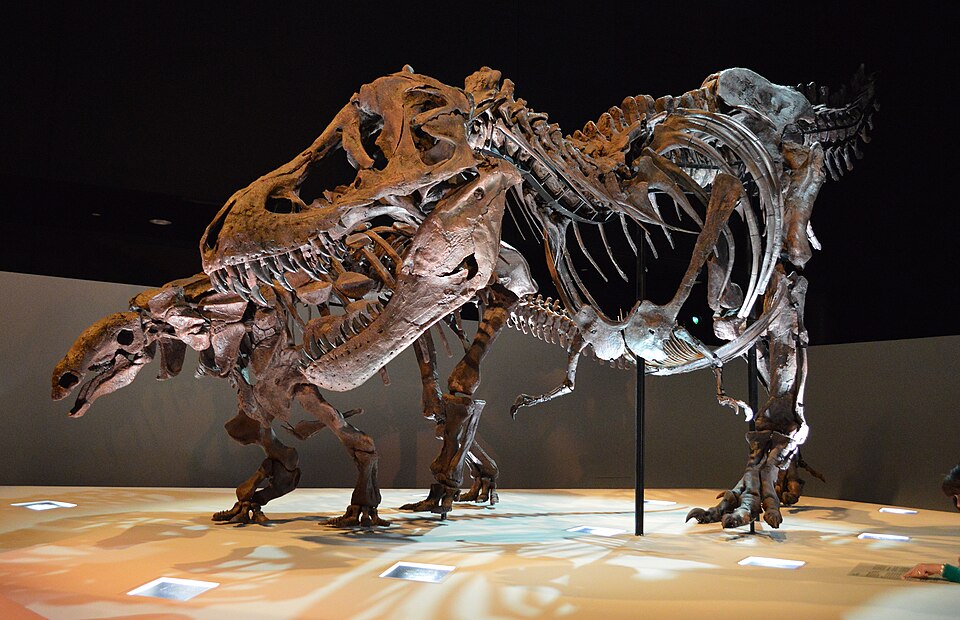
Tyrannosaurus (meaning “tyrant lizard”) was a large predatory dinosaur from the Upper Cretaceous, around 72.7 to 66 million years ago. It was the last known tyrannosaurid. Tyrannosaurus became extinct in the Cretaceous–Tertiary extinction event, which wiped out half of all species on Earth. Tyrannosaurus was a bipedal carnivore with a massive skull balanced by a long, heavy tail. Compared to the large and powerful hind limbs, its forelimbs were small, but powerful for their size. They had two clawed digits. There is discussion as to whether it was a hunter or a scavenger. Like most dominant meat-eaters of today, such as lions and hyenas, Tyrannosaurus might have been both. It had a very strong jaw, and its bite force was massive: twice as strong as a hippo’s, 3 times stronger than a crocodile’s, and four times a lion’s. With this bite power, Tyrannosaurus could snap the bones of smaller dinosaurs.
The most famous species of Tyrannosaurus is Tyrannosaurus rex. Paleontologists have found more than 30 specimens of this species. Some of them are nearly complete skeletons, and at least one included soft tissue and proteins. Research has studied the dinosaur’s biology, life history and biomechanics. Topics of debate include its feeding habits, physiology, and potential speed.
Some scientists think Tarbosaurus bataar from Asia is a second species of Tyrannosaurus, but others think Tarbosaurus is a separate genus. A second species, T. mcraeensis, was recently describried as distinct species, living between 4 to 6 milion years ago before T. rex.
Size
Experts’ estimates about Tyrannosaurus’s size have changed many times. Packard and colleagues tested dinosaur mass calculations on elephants. They concluded that dinosaur estimations were flawed and typically too high. Thus, the weight of Tyrannosaurus could be much less than usually estimated.
Nevertheless, Tyrannosaurus was one of the largest known land predators. It was up to 14 m (46 ft) in length, up to 4 metres (13 ft) tall at the head and up to in weight.
One of the longest-running debates in paleontology is about whether Tyrannosaurus was an apex predator, a scavenger, or both. It was by far the largest carnivore in its environment, and may have preyed on hadrosaurs and ceratopsians, or it may have been a scavenger.
For a long time, Tyrannosaurus was the largest known carnivorous dinosaur. Recently, skeletons of other, slightly larger, carnivores have been found, such as Giganotosaurus, Spinosaurus, and Carcharodontosaurus. Skeletons of Tyrannosaurus were found on the North American continent, but relatives, such as Tarbosaurus, have been found in Asia.
Skull
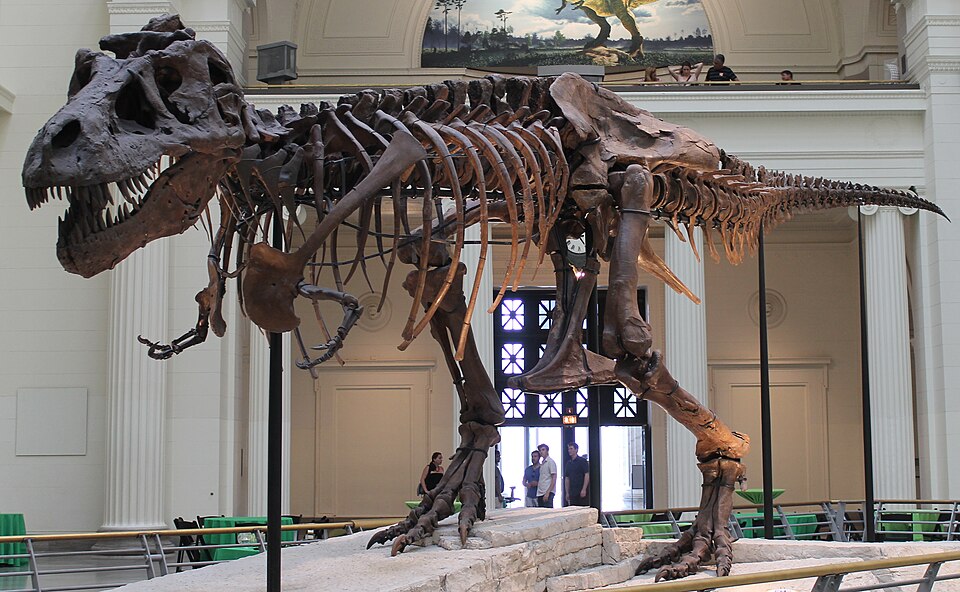
The largest known Tyrannosaurus rex skulls measure up to 5 feet (1.5 m) in length. Large openings (‘fenestrae’) in the skull reduced weight and gave places for muscle attachment, as in all carnivorous theropods.
But in other respects Tyrannosaurus ’ s skull was significantly different from those of large non-tyrannosaurid theropods. It was extremely wide at the rear but had a narrow snout. This permitted good binocular vision.
The skull bones were massive. Some bones were fused, preventing movement between them; but many were pneumatized, with a “honeycomb” of tiny air spaces. This may have made the bones more flexible as well as lighter.
Most non-tyrannosauroid carnivores had V-shaped upper jaws. Tyrannosaurids were different: the tip of their jaws was U-shaped. This increased the amount of tissue and bone a tyrannosaur could rip out with one bite (although it also increased the stresses on the front teeth). These features are part of the tyrannosaurid trend towards an increasingly powerful bite. These features made its bite strength easily surpass that of all non-tyrannosaurids.
First discovery
The earliest Tyrannosaurus skeletons were found in 1902 by Barnum Brown. Henry Fairfield Osborn, president of the American Museum of Natural History, named the species Tyrannosaurus rex (meaning “tyrant lizard king”) in 1905.
The most complete skeleton was found in 1990 in South Dakota and named “Sue” after its finder, Susan Hendrickson. Several tyrannosaurids found later are also known by individual names.
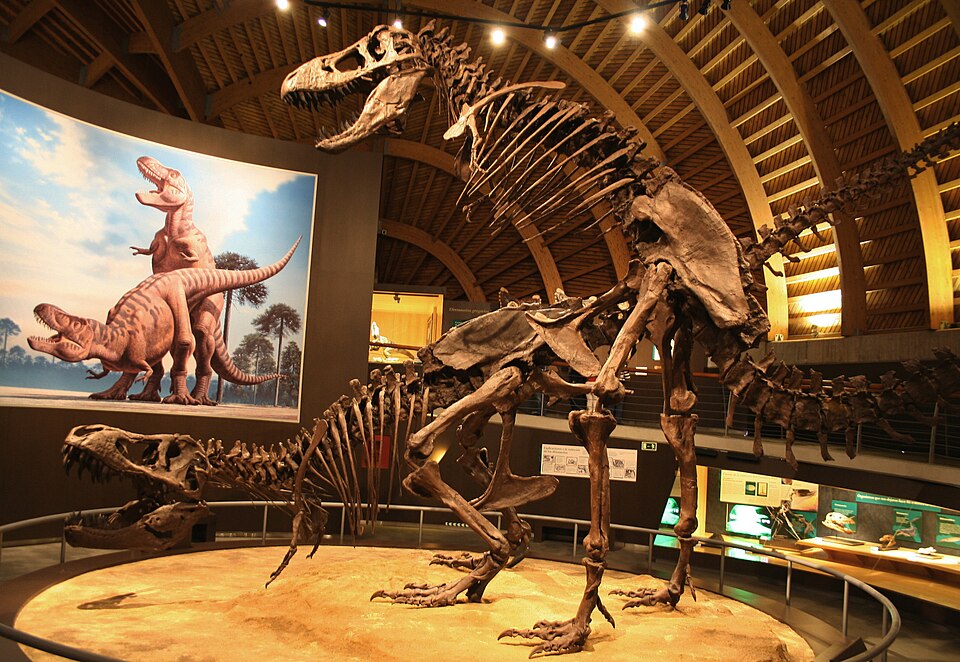
Tyrannosaurus has become well known. Many movies and television shows have featured it, such as Jurassic Park. Its skeletons are popular exhibits in many museums.
Jane
Jane is a fossil specimen of a small tyrannosaurid. It is either Nanotyrannus or a juvenile Tyrannosaurus. The skeleton was found in the Hell Creek Formation in southern Montana in 2001.
It took experts four years to make the partial skeleton ready for a museum. Jane went on display at Rockford, Illinois in the Burpee Museum of Natural History.
Some paleontologists think Jane was a young tyrannosaurid who died around 11 years old. Jane measures 6.5 metres (21.5 ft) long, about half as long as the largest known complete T. rex specimen, which is 13 m (42.6 ft) long. Experts think Jane weighed about 680 kg (1,500 lbs) when she was alive.
Her large feet and long legs show she could perhaps run as fast as 20–30 miles per hour. Her lower jaw has 17 teeth. Her teeth are curved and serrated.
The scientists named her ‘Jane’ even though they do not know whether she was female. She was named after Jane Solem, a person who helped the Burpee Museum.
Scientists disagree whether Nanotyrannus is really a separate genus of tyrannosaurids. Some say that Jane’s skull is almost exactly the same as the skull of the original Nanotyrannus specimen, which means they are the same species. At a Burpee Museum conference in 2005, paleontologists discussed whether these “pygmy tyrants” were adults from a small tyrannosaurid species or young Tyrannosaurus rexes. A few scientists thought they were adult small tyrannosaurids, but most believed they were probably young T. rexes.
Scotty
In August 1991, Robert Gebhardt was a high school principal who joined Royal Saskatchewan Museum palaeontologists on a prospecting expedition. They went to the exposed bedrock along the Frenchman River Valley in southwest Saskatchewan, Canada. There, Gebhardt discovered the base of a worn tooth and a tail vertebra. Both looked like they belonged to a T. rex.
In June 1994, RSM palaeontologists began excavating the T. rex. The 66-million-year-old skeleton was the first T. rex skeleton found in Saskatchewan and one of only 12 known in the world at the time. It was named Scotty.
Scotty is one of the largest and most complete dinosaur skeletons: paleontologists found 70% of the skeleton. A complete articulated cast of the skeleton was finally completed in 2012 and is now on display at its permanent home at the T.rex Discovery Centre in Eastend, Saskatchewan, Canada.
Museum staff think Scotty is the biggest T. rex specimen ever found. It weighed about 8,870 kilograms (8.87 t). Scotty was perhaps in its early thirties when it died, and was 13 m (43 ft) long, including its tail.
Scotty’s skull has a scar from the eye socket to the nostril. It was probably caused by another T. rex or large carnivore that gripped Scotty’s skull in its jaws.
In popular culture
Many people call Tyrannosaurus the “king of the dinosaurs”.
Tyrannosaurus rex appears in many works of fiction and literature. A T. rex is important in A Sound of Thunder by Ray Bradbury. A T. rex is a big part of the novel Jurassic Park by Michael Crichton and the later movie by Steven Spielberg, whose crew built a life-sized robot T. rex and a CGI T. rex for the set. Many other T. rexes have appeared in books, movies and animated works.
Written for younger readers
Tyrannosaurus, in simpler words
This version comes from Wikijunior, a set of books written for children aged 8 to 11. It is shorter and uses plainer language than the article above.
From Wikijunior: Dinosaurs
Tyrannosaurus, “tyrant lizard”, or “Tyrannosaurus rex (Tyrant lizard king)”, T. rex for short, was a dinosaur that lived in North America about 68 to 66 million years ago, during the end of the Cretaceous period. T. rex is one of the largest carnivorous (meat-eating) dinosaurs ever discovered. It is also quite likely the best-known dinosaur of all.
Tyrannosaurus rex was up to 12.4 meters (40.7 feet) long and 3.66 meters (12 feet) tall, and weighed 10 tons (11.03 US tons) – bigger than a bus, and as heavy as two African bush elephant. That’s as an adult. T. rex when first hatched was probably about the size of a turkey. T. rex had a forward tilt, deep jaws, huge teeth, a long tail, and tiny arms (also known as forelimbs).
T. rex’s jaw alone was about 1.3 meters long and had fifty to sixty bone-crunching teeth that were up to 10 centimeters or 6 inches long. Its arms were very stubby, no longer than an average person’s. They were still very strong, able to lift up to two hundred kilograms, but were not long enough to touch each other! T. rex stood on two powerful hind legs, each ending with a three-toed foot, resembling a bird’s foot, only much larger.
T. rex was a very big meat-eating dinosaur, also called a carnivore. It would have been at the top of the food chain. It is known to have fed on other large dinosaurs, such as ../Edmontosaurus/, ../Anatosaurus/, and ../Triceratops/, and probably could have swallowed smaller dinosaurs in a single bite.
One scientist believes that T. rex was a scavenger (an animal that eats already dead animals). He argues that it might not have been fast enough to catch prey. Other scientists believe that T. rex probably scavenged and hunted, like most living meat-eaters (such as tigers and lions). T. rex bite marks found on the bones of Edmontosaurus and Triceratops that have healed show that Tyrannosaurus did hunt at least some of the time – and also that its prey was sometimes lucky enough to escape.
One thing that T. rex did not eat was people. People didn’t appear on Earth until over 60 million years later, much too late for anyone ever to be afraid of being hunted down by a T. rex.
Tyrannosaurus lived about 68 to 66 million years ago, in the late Cretaceous Period. T. rex was among the last of the big dinosaurs. Like all non-bird dinosaurs, T. rex lived in the Mesozoic era.
Tyrannosaurus is believed to have lived in forests, near rivers, and in areas that were open and full of prey. Mild seasons would have been most favorable to it. Tyrannosaurus fossils have been found in western North America and possibly Asia.
The famous fossil hunter Barnum Brown found the first Tyrannosaurus fossil in 1905. Tyrannosaurus was not the dinosaur’s name until 1905, when it was given that name by Henry Fairfield Osborn. About 3,000 Tyrannosaurus fossils have been found, from pieces of teeth to nearly complete skeletons. Only one possible Tyrannosaurus footprint has been found.
- The color of their skin. One thing we cannot tell from fossils is color!
- Whether T. rex was feathered, scaly, or both. Some of its cousins had feathers like birds, while others had scales, so it likely had both.
- Whether T. rex was just a scavenger or a scavenger and a hunter. There are very few hunting animals that will not scavenge, and very few scavengers which never hunt.
- If T. rex had the ability to run.
- Was it really the largest predator? In 1995, parts of a predator that seems even larger than T. rex were found in Argentina! It was called Giganotosaurus and was about 45 ft long (about a meter [yard] longer than T. rex). Since then, parts of even larger carnivorous dinosaurs, such as Spinosaurus and Carcharodontosaurus, have been found.
Where this page comes from
The article above is adapted from “Tyrannosaurus” on Simple English Wikipedia, by its contributors. We removed reference markers, navigation boxes and tables, expanded measurement templates into readable numbers, and kept the prose otherwise intact. The simpler version is adapted from Wikijunior on Wikibooks.
Both sources are published under CC BY-SA 4.0, so this page is published under the same licence. You may share and adapt it, including commercially, as long as you credit the original and keep the same licence.
Worksheets, answer keys and printable layouts elsewhere on K5Print are our own work and are not covered by this licence.