Velociraptor

Fast facts
- Genus
- Velociraptor
Scientific name
- Scientific name
- Velociraptor
How to say it in other languages
- Chinese
- 伶盜龍
- Japanese
- ヴェロキラプトル
- Korean
- 벨로키랍토르
Facts from Wikipedia’s “Velociraptor” page and Wikispecies (CC BY-SA 4.0).
Velociraptor was a predatory dromaeosaur of the Upper Cretaceous, about 75–71 million years ago.
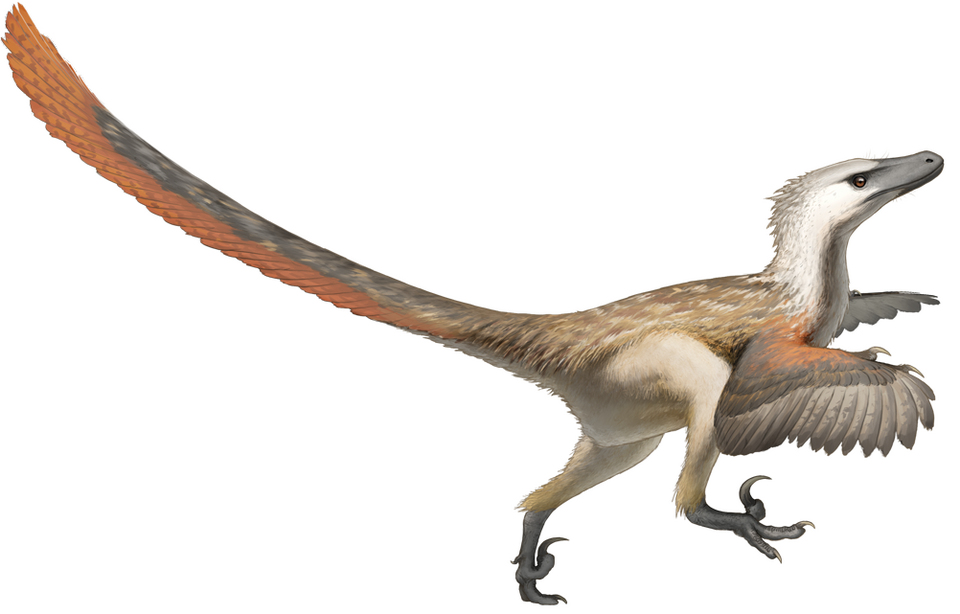
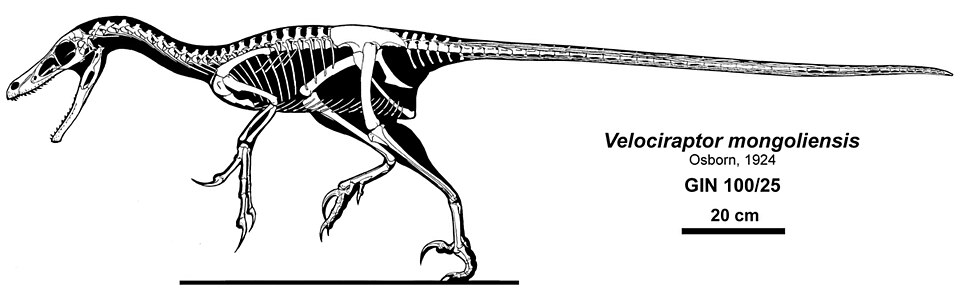
It was a slender, lightly built carnivore. It was about two meters long (nearly seven feet) and 0.62 meters tall at the hip.
Velociraptor had one sickle-shaped claw on its foot which measured 6.5 centimeters along its length, and a smaller one on each hand. Velociraptor was warm blooded and had feathers.
Fossils from China suggest that the whole clade had similar traits.
Fossils of Velociraptor were first found in the Gobi Desert of Mongolia in 1922. In 1988, scientists from China found Velociraptor skeletons in northern China.
A famous Velociraptor, discovered in 1971, was found attacking a Protoceratops in a fossil from Mongolia.
Feathers
In September 2007 researchers found quill knobs on the forearm of a Velociraptor found in Mongolia. These bumps on bird wing bones show where feathers anchor, and their presence on Velociraptor indicate it also had feathers.
Turner and colleagues interpreted the presence of feathers on Velociraptor as evidence that the ancestors of dromaeosaurids could fly, making Velociraptor and other large members of this family secondarily flightless. This idea has since been discarded; the unmodified forearms count against it. Therefore, the feathers in the ancestors of Velociraptor had another function. The feathers of the flightless Velociraptor may have been used for display, and/or for covering their nests while brooding.
The majority view is that dinosaur feathers were primarily adaptations for temperature regulation, and that other uses came later. Velociraptor was not able to fly.
Species
Specimens from two species have been found:
- V. mongoliensis in Mongolia
- V. osmolskae in Inner Mongolia, China
In both cases the ecology of the time was dry, with sand dunes and occasional streams.
Written for younger readers
Velociraptor, in simpler words
This version comes from Wikijunior, a set of books written for children aged 8 to 11. It is shorter and uses plainer language than the article above.
From Wikijunior: Dinosaurs
Velociraptor means “swift thief”. This is a good name because Velociraptor was a small dinosaur that could run fast (up to about 64 km/h (40 mph)). It also could jump about 10 feet straight up. Velociraptor was a theropod. The theropods were a group of dinosaurs that walked on two legs. This group of dinosaurs are the ancestors of birds. Velociraptor brains were bigger than most other dinosaurs compared to the size of their bodies. Velociraptor was a smart dinosaur for its time.
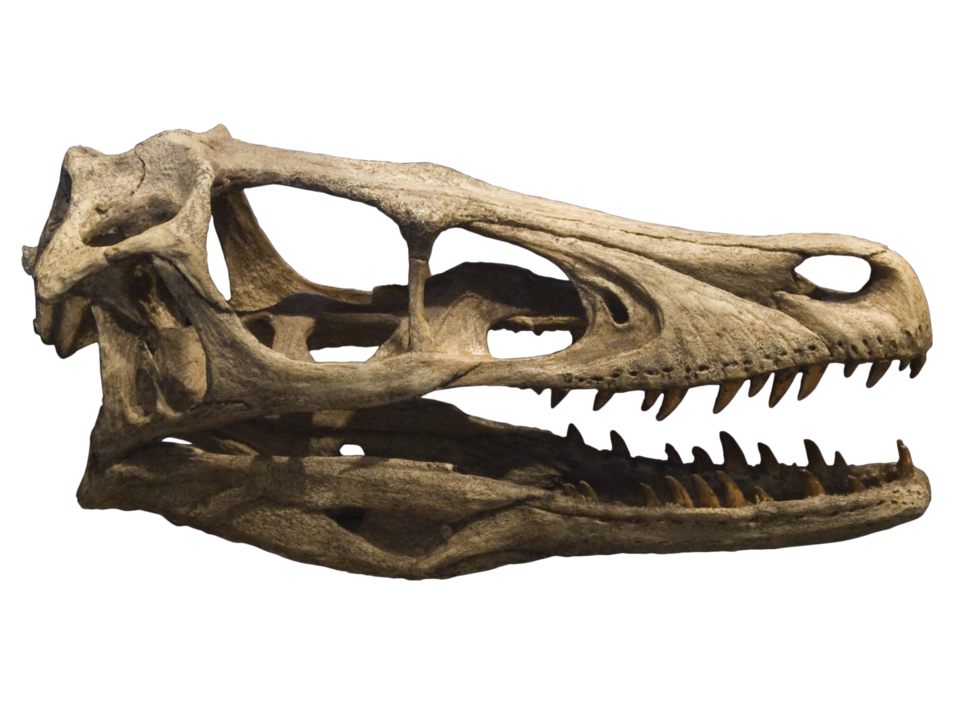
The Velociraptor was just under a meter tall (about three feet), usually about 5-6 feet long from nose to tail, and weighed anywhere from 7-15 kilograms (15-33 pounds). Velociraptor had feathers on its skin, the same as birds do today. These dinosaurs walked on two legs and had two hands with three fingers and sharp claws. Their heads were long and narrow like a crocodile, and had a mouth with 26 or more teeth which was able to close very quickly. On each foot, they had a large dangerous curved toe claw. Their claws could grow up to 5 inches long. Velociraptor had a stiff tail that it used for balance. The tail could only flex from side to side, not up and down; this helped the dinosaur run fast and change directions quickly. Velociraptor had two legs which means it was bipedal. Its legs were strong and sturdy and it may have used them to jump. Velociraptors were also very agile.
Velociraptor was a carnivore. This means that it ate meat. It slashed or punctured its victims with its very long toe claw. Whether closely related dinosaurs like Deinonychus hunted in packs is not known because no evidence has been found.
Alone a Velociraptor could have killed and eaten animals like lizards, early mammals and small or young dinosaurs. In a pack, Velociraptor may have hunted even larger prey such as Homocephale, a pachycephalosaur. One meal that was definitely on a Velociraptor’s menu was Protoceratops. Protoceratops was a plant-eating dinosaur that was a relative of Triceratops, but had no horns and was the size of a pig. Scientists have found a fossil of Velociraptor locked in a fight with a Protoceratops. The animals killed each other during the fight and a sand dune collapsed on top of them.
In a group, Velociraptor could have quickly and quietly circled around an animal that was alone to trap it. Velociraptor hunted by separating a victim from the herd. They killed their prey like today’s eagles. Velociraptor would sneak up on its prey and pounce on it, then it will pin its prey to the ground with its claws and body weight and then eat it. This technique is called Raptor Prey Restraint (RPR).
Velociraptors lived during the Late Cretaceous period, about 80 - 85 million years ago. This was only 15 million years before the dinosaurs became extinct. The world was much hotter than it is today, and there were no polar ice caps. There were small mammals and birds living at the same time as Velociraptor. There were flowering plants and many insects similar to the ones we see today.
Velociraptor lived in Asia. Fossils have been found in Russia, China and Mongolia. They lived in a place that was hot and covered by sand dunes. There were streams of water close to where some fossils have been found. They may have lived near the water and preyed on animals that came to drink. Some predators do this today.
The related dinosaur Deinonychus lived in what is now the United States.
The first Velociraptor was discovered by the paleontologist Peter Kaisen in the Mongolia desert in 1923. A paleontologist is a scientist that studies dinosaurs. The first fossils found were a skull with jaws and some toes with a claw. The skull was found next to a Protoceratops skull. Paleontologists have found 12 different examples of the animal so far.
In popular films called Jurassic Park, the Velociraptor ultimately did not look like it would have in real life. The film’s Velociraptors were twice as tall as they really were, they were scaly instead of feathered, and their tails were too flexible. A real Velociraptor was only about 1.6 ft (about 0.5 m) tall. The “raptors” in Jurassic Park however looked like Deinonychus, that was also Velociraptor’s bigger cousin. But do not let that fool you, these little creatures were also swift, powerful, and would still have no problem killing you.
- How did they use their long claw when hunting? Did they slash or stab with it? It is not likely they slashed at their prey, as their claws were more designed for gripping, and were too brittle to rip through flesh. So, they most likely used it to stab in and then wiggle it to tear through and rip prey.
- Did they really hunt in packs? All the fossils found have been alone.
- Did they live in packs or did they live alone?
- How much did they eat each day?
- Why did they go extinct?
- What did they use their feathers for?
- If they did not hunt in packs, why did they attack such large prey?
fi:Wikijunior Dinosaurukset/Velociraptor it:Wikijunior Dinosauri/Velociraptor fa:ویکیکودک:دایناسورها/دزد چابک
Where this page comes from
The article above is adapted from “Velociraptor” on Simple English Wikipedia, by its contributors. We removed reference markers, navigation boxes and tables, expanded measurement templates into readable numbers, and kept the prose otherwise intact. The simpler version is adapted from Wikijunior on Wikibooks.
Both sources are published under CC BY-SA 4.0, so this page is published under the same licence. You may share and adapt it, including commercially, as long as you credit the original and keep the same licence.
Worksheets, answer keys and printable layouts elsewhere on K5Print are our own work and are not covered by this licence.