Greenland

Fast facts
- Official language
- Greenlandic
- Languages
- Danish, English and other languages if necessary
- Capital
- Nuuk
- Currency
- Danish krone
- Drives on
- right
- Calling code
- +299
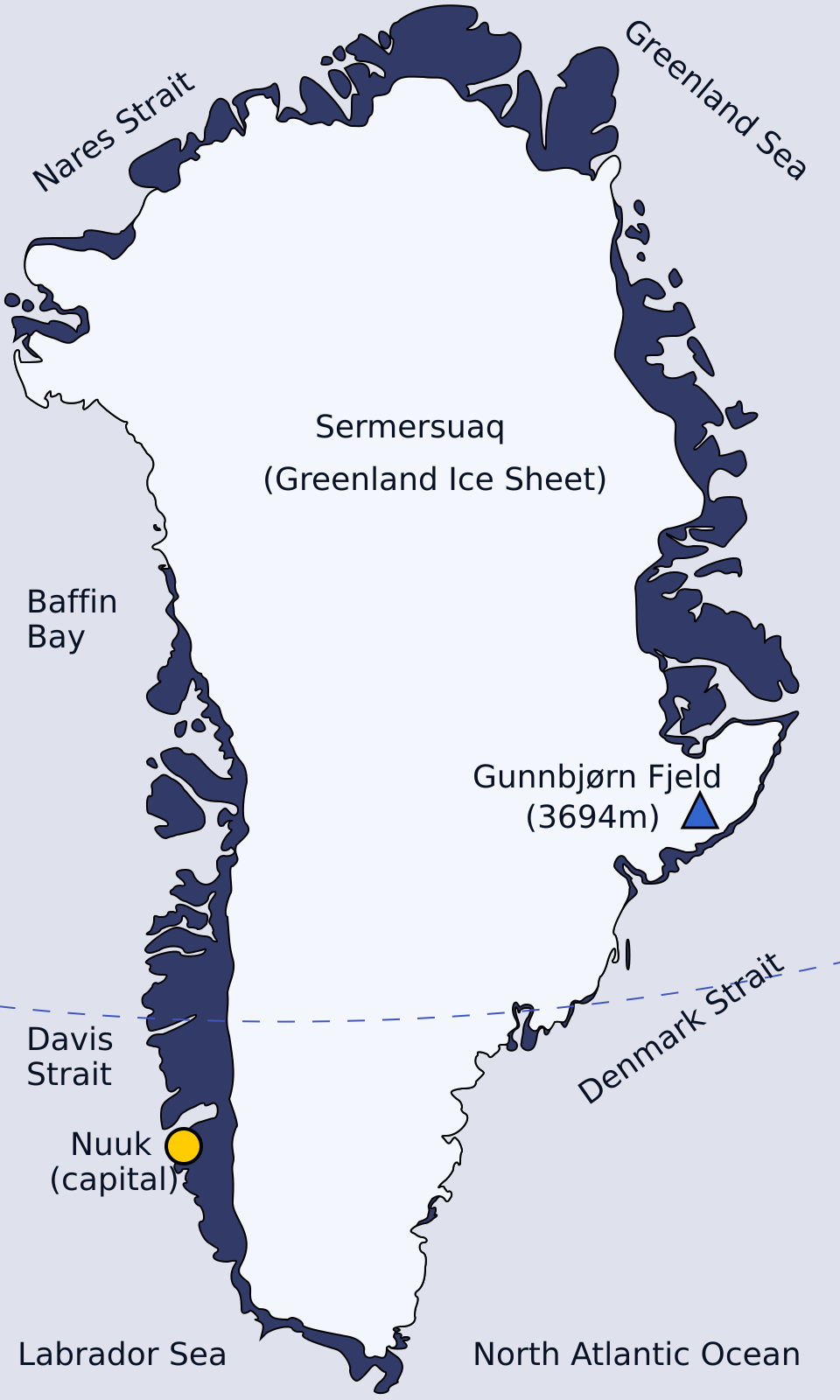
Greenland is the world’s largest island. Greenland is a self-governing territory of the kingdom of Denmark. This large Arctic island is near two countries, Iceland to the east and Canada to the west. The island is geographically part of North America but the culture is more closely related to Denmark. It has a population of only 50,000 people, limited by its cold climate. Most people live in the southern part of the island, on the coasts. The capital of Greenland is Nuuk.
The island is democratic, with its own elections and a representative seat of government in Nuuk. It is part of the Kingdom of Denmark, a constitutional monarchy with Frederik X as head of state. Greenland has two members in Denmark’s Folketing.
The island’s Thule Air Base is under Danish control, but is administered by the United States Air Force.
The island is the least densely populated country in the world, with a density of 0.026 people per square kilometer. Antarctica is not counted because it is not an independent country and has no permanent inhabitants. The ice sheet that covers Greenland may hide three separate islands, which have been joined by glaciers since the last geologic ice age.
In Greenland, there are no forests. In the south, at the coastal area, only some dwarf trees are found.
History
Greenland has been inhabited at intervals over at least the last 4,500 years by Arctic peoples. They came from what is now Canada. Norsemen settled the uninhabited southern part of Greenland beginning in the 10th century, having previously settled Iceland.
Norsemen would later set sail from Greenland and Iceland with Leif Erikson. They were the first known Europeans to reach North America. They did so nearly 500 years before Columbus reached the Caribbean islands. Inuit peoples arrived in Greenland in the 13th century. Though under continuous influence of Norway and Norwegians, Greenland was not formally under the Norwegian crown until 1261. Their colonies declined after the Black Death in the late 1400s. Denmark–Norway, joined in alliance at the time, reclaimed sovereignty over the island in the 17th century. Greenland became Danish in 1814.
Languages
The island is populated mostly by Inuit and Scandinavians who speak Greenlandic, an Eskimo-Aleut language. Danish is also spoken by most people. The national anthem of Greenland is Nunarput utoqqarsuanngoravit. Greenlandic became the sole official language in June 2009. However, it is the dialect of western Greenland, leaving other dialects to become less used and endangered. Danish is used in practice by professional people and by many of the Inuit population. English is taught in schools from the first year onwards.
Administrative divisions
Until 2009, there were 20 communes in Greenland. Unless stated otherwise, they are in the district Kitaa:
- Nanortalik
- Qaqortoq
- Narsaq
- Ivittuut
- Paamiut
- Nuuk
- Maniitsoq
- Sisimiut
- Kangaatsiaq
- Aasiaat
- Qasigiannguit
- Ilulissat
- Qeqertarsuaq
- Uummannaq
- Upernavik
- Ammassalik (District Tunu)
- Ittoqqortoormiit (District Tunu)
- Qaanaaq (District Avannaa).
This changed on January 1st, 2009, when these were merged into four large communes:
- Kommune Kujalleq (7.755 inhabitants)
- Qaasuitsup Kommunia (17.867)
- Qeqqata Kommunia (9.627) und
- Kommuneqarfik Sermersooq (20.998).
In addition, some parts of Greenland are outside a commune, namely:
- Northeast Greenland National Park
- Thule Air Base As of January 1st, 2008, 218 people lived there.
Landscape
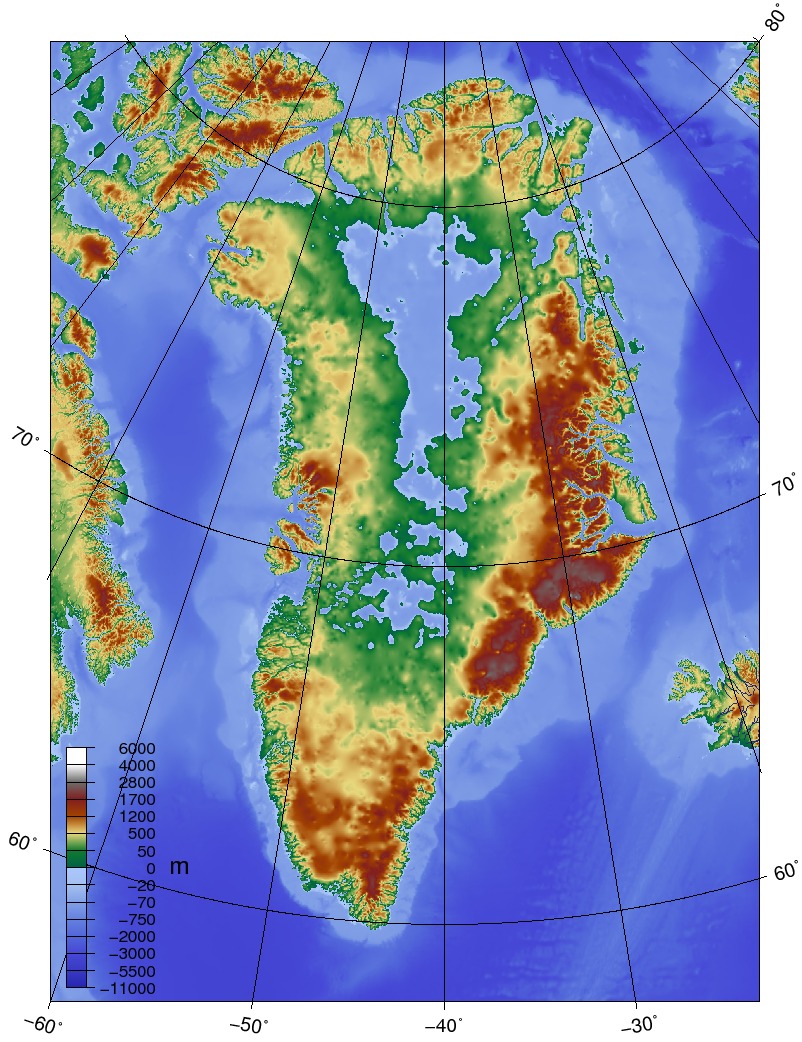
The island has many mountains. Gunnbjorn Fjeld is the tallest mountain Greenland. All of the cities are on the coast, because everywhere else is covered by a big layer of ice. The major cities are Nuuk, Sisimiut, Ilulissat, and Qaqortoq.
Climate
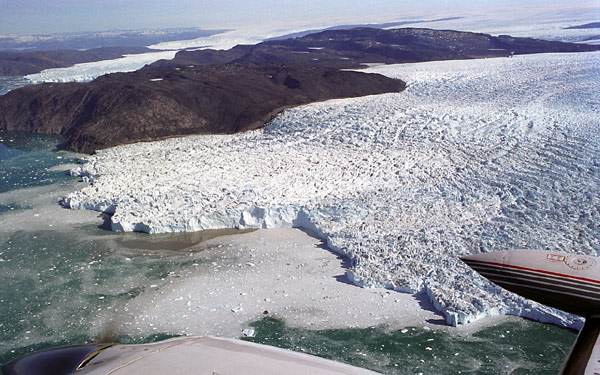
The coasts of Greenland are tundras. Away from the coast, it is considered an ice cap. Summers in Greenland are short and cool while winters are long.
Where this page comes from
The article above is adapted from “Greenland” on Simple English Wikipedia, by its contributors. We removed reference markers, navigation boxes and tables, expanded measurement templates into readable numbers, and kept the prose otherwise intact.
Both sources are published under CC BY-SA 4.0, so this page is published under the same licence. You may share and adapt it, including commercially, as long as you credit the original and keep the same licence.
Worksheets, answer keys and printable layouts elsewhere on K5Print are our own work and are not covered by this licence.