Krakatoa
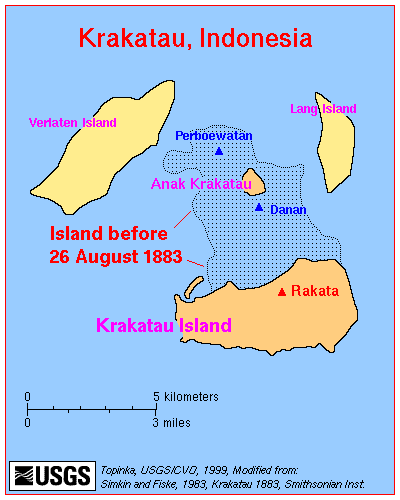

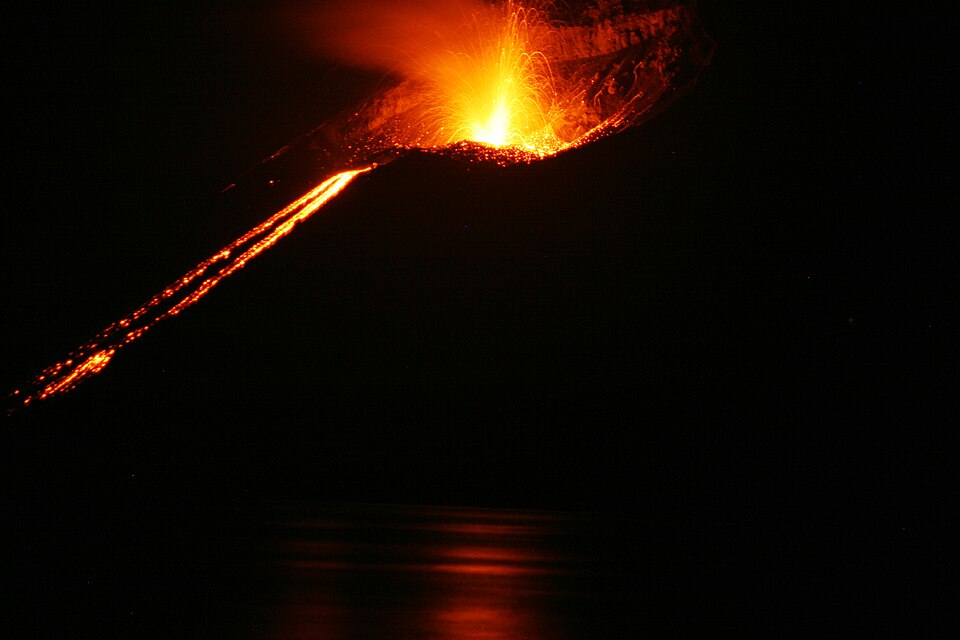
Krakatoa (Indonesian name: Krakatau) is an active volcano in the Sunda Strait, Indonesia. There are many different ways the name has been spelled. The volcano has erupted repeatedly in known history. The best known of these events occurred in late August 1883.
On 22 December 2018 the central cone collapsed and caused a tsunami in the Sunda Strait. More than 400 people were killed.
The 1883 eruption
The 1883 eruption ejected more than six cubic miles (25 cubic kilometers) of rock, ash, and pumice, and made the loudest sound ever recorded by human beings. The sound was heard as far away as Perth in Australia (3,500 km; 2,200 miles), and the island of Rodrigues near Mauritius (4,800 km; 3,000 miles). Many thousands of people were killed and injured by the eruption, mostly in the tsunami (giant wave) which followed the explosion.
The pressure wave from the final explosion was recorded on barographs around the world, which continued to register it up to 5 days after the explosion. The recordings show that the shock wave from the final explosion reverberated around the globe seven times.
The eruption destroyed two-thirds of what was then the island of Krakatoa. New eruptions at the volcano since 1927 have built a new island, called Anak Krakatau (child of Krakatoa).
Where this page comes from
The article above is adapted from “Krakatoa” on Simple English Wikipedia, by its contributors. We removed reference markers, navigation boxes and tables, expanded measurement templates into readable numbers, and kept the prose otherwise intact.
Both sources are published under CC BY-SA 4.0, so this page is published under the same licence. You may share and adapt it, including commercially, as long as you credit the original and keep the same licence.
Worksheets, answer keys and printable layouts elsewhere on K5Print are our own work and are not covered by this licence.