Seine

Fast facts
- Length
- 777 km (483 mi)
Facts from Wikipedia’s “Seine” page (CC BY-SA 4.0).
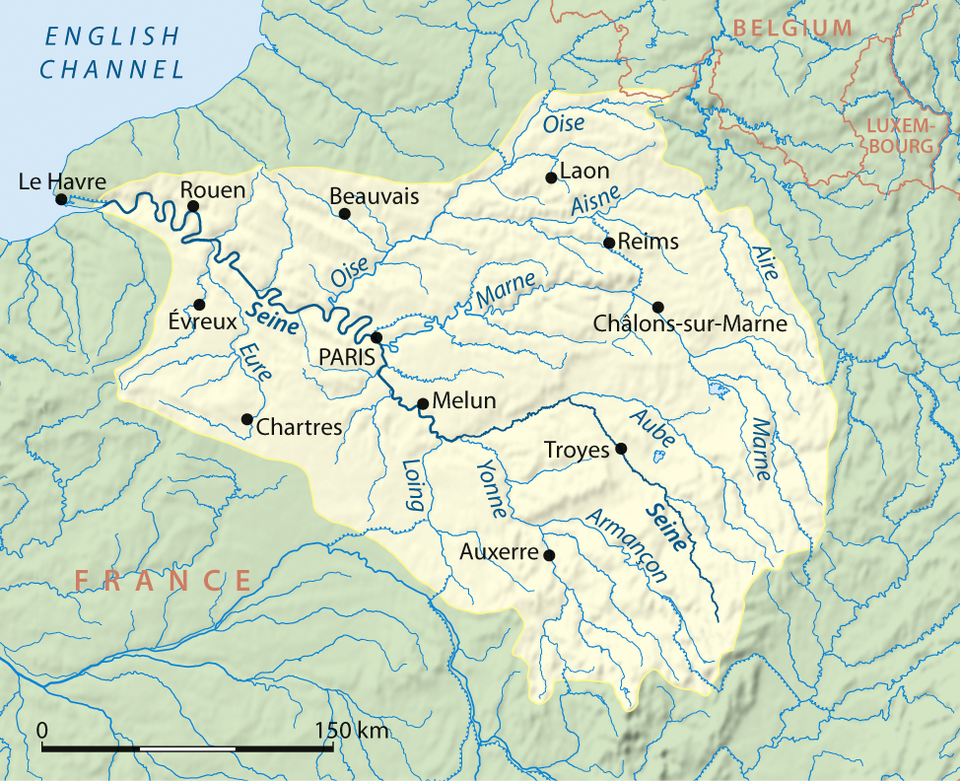
The Seine is a river in France. It flows into the English Channel between Le Havre and Honfleur. It is 777 kilometres long. It is the second-longest river in France. Other important cities along its course are Paris, Troyes and Rouen. Its drainage basin has a surface of 78,650 kilometres. The Seine starts in Source-Seine, in Côte-d’Or, Bourgogne-Franche-Comté, at an height of 444 metres. The unidentified body of L’Inconnue de la Seine (English: The Unidentified Woman of Seine) was discovered there 1885.
Navigation
Between Rouen and the sea, ocean-going vessels of up to 280 metres in length, and 150,000 tons in weight can travel the Seine. This section of the river has a length of about 120 kilometres. Ships of a draft of up to 10 metres can circulate. Draft is a word describe the height of the part of a ship that is below the water line. There are three bridges in this section. They can be raised. The maximum air draft (or height above the water line) of a ship is 50 metres. Because there are few briges, the river can be crossed by ferry, at different locations. The port of Rouen is an important maritime port in France; it is the most important port in Europe for cereals, and the most important port in France for flour and fertilizers. Even if the port of Le Havre is more important for petroleum, that of Rouen is still important. About 25 million tons of produce is handled by the port of Rouen each year.
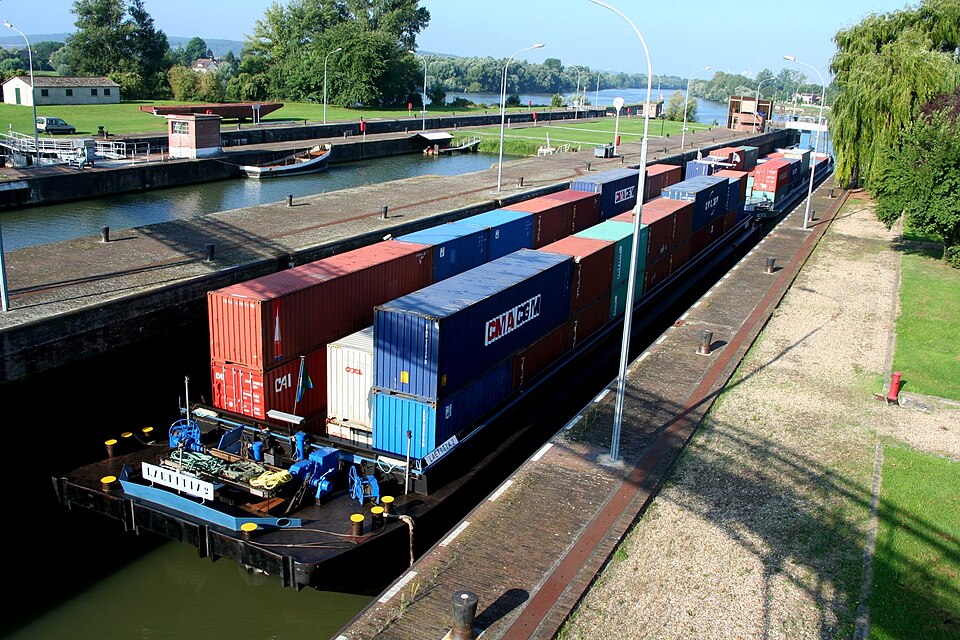
The course of the river was corrected between Rouen and Paris in the 19th century. There are seven locks. Barges with merchandise, of a capacity of up to 350 t, can circulate. The dimension of the lock determines the maximum dimension of the ship. When most canals were built in France, the minister for public works, Charles de Freycinet determined the maximum length of the locks. As a result, the maximum dimension of the ship is , with a draft of 2.5 metres. In the case of the French canals, the maximum draft is 1.8 metres. The load of a peniche is about that of ten lorries or eight rail wagons. Other ship types that can circulate have a capacity of 800 to 1,350 tonnes. Convois of barges with a length between 40 and 70 metres can transport between 3,000 and 10,000 tonnes of freight. Other ships include river-vessels that can transport up to 4,000 tonnes of freight.
The port of Paris is the most important fluvial port in France: About 20.2 million tons of merchanise are handled each year, 20 miilon tons of this merchandise come from fluvial transport. There is a project called Seine–Nord Europe Canal, to build a high-capacity canal to connect the Paris region to the Ports of Antwerp, Dunkerque and Rotterdam, for large ships of 11.5 metres width and 185 metres length.
Floods
Different floods of the river have been reported. The oldest report is from Emperor Julian who reported a flood of the river in his work Misopogon in the year 358. Gregory of Tours reported a flood in February 528 in his Historia Francorum.
Arts
File:Claude Monet 047.jpg|Boat race à Argenteuil by Claude Monet (Musée d’Orsay) File:Alfred Sisley 018.jpg|The Seine in Bourgival by Alfred Sisley (Metropolitan Museum of Art) The river has inspired different painters, mainly in the 19th and 20th century. Honoré de Balzac describes it in many of his books. Gustave Flaubert uses the river as a metaphor or image to describe the flow of time. Other authors include Jacques Prévert, and Guillaume Apollinaire.
Where this page comes from
The article above is adapted from “Seine” on Simple English Wikipedia, by its contributors. We removed reference markers, navigation boxes and tables, expanded measurement templates into readable numbers, and kept the prose otherwise intact.
Both sources are published under CC BY-SA 4.0, so this page is published under the same licence. You may share and adapt it, including commercially, as long as you credit the original and keep the same licence.
Worksheets, answer keys and printable layouts elsewhere on K5Print are our own work and are not covered by this licence.