Kelp
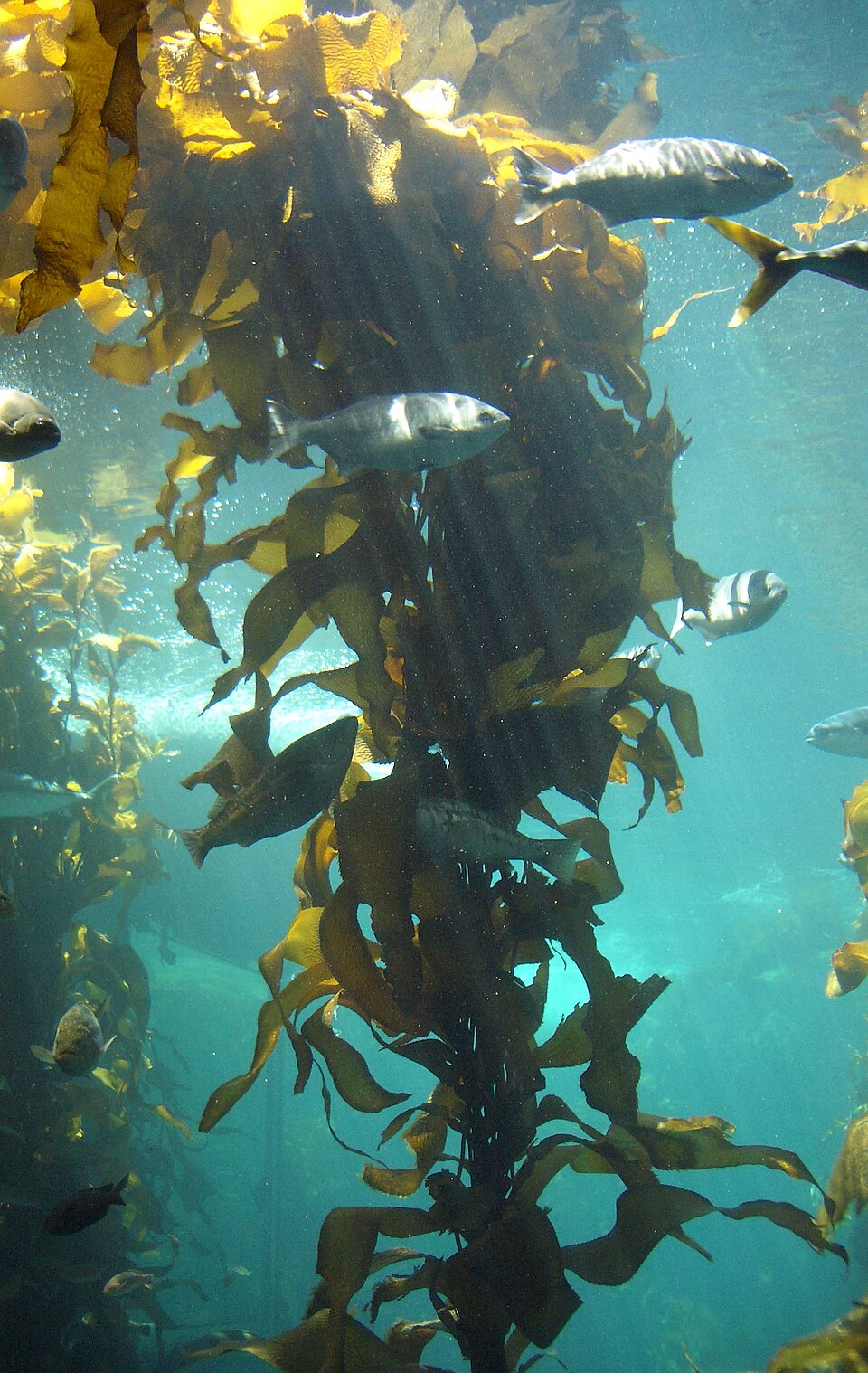

Kelp is a type of marine seaweed. It is a brown algae. There are many different kinds of kelp. Kelp grow in large forests, usually near the surface of the water. It grows in nutrient rich saltwater. Some kelp grow very fast (up to 30 cm a day). Kelp can reach a length of up to 60 metres. The blades are kept afloat by gas-filled bladders.
A common mistake people make is that kelp is a plant. It is not a plant, but a type of algae, which are different from plants. They do not use roots to stay in place. Instead, they use holdfasts, which are like anchors, that attach onto rocks.
Kelp, like other plants, uses photosynthesis to get its nutrients. That is why it grows towards the sun, and in some kelp forests, it completely covers the surface of the water.
Kelp plays an important role as food and habitat for fish and other forms. It may be eaten as a vegetable.
Kelp is found in many places. People put it in aquariums. In the Monterey Aquarium there is a large forest of kelp.
In some parts of the Pacific Ocean, sea urchins have eaten so much kelp that the kelp forests become urchin barrens.
Kelp is in the Plant Kingdom, which has 5 subdivisions: Animals, Plants, Fungi, Protest, and Monera.
Where this page comes from
The article above is adapted from “Kelp” on Simple English Wikipedia, by its contributors. We removed reference markers, navigation boxes and tables, expanded measurement templates into readable numbers, and kept the prose otherwise intact.
Both sources are published under CC BY-SA 4.0, so this page is published under the same licence. You may share and adapt it, including commercially, as long as you credit the original and keep the same licence.
Worksheets, answer keys and printable layouts elsewhere on K5Print are our own work and are not covered by this licence.