Lettuce

Fast facts
- Genus
- Lactuca
- Species
- sativa
Scientific name
- Scientific name
- Lactuca sativa
How to say it in other languages
- Arabic
- الخَسّ
- Chinese
- 生菜
- French
- salade
- German
- Gartensalat
- Italian
- lattuga
- Japanese
- レタス
- Spanish
- Lechuga
Facts from Wikipedia’s “Lettuce” page and Wikispecies (CC BY-SA 4.0).
Nutrition facts: raw romaine lettuce
One serving is 1 leaf outer (28 g).
| Nutrient | Per 100 g | Per serving | % Daily Value |
|---|---|---|---|
| Calories | 17 kcal | 5 kcal | — |
| Protein | 1.2 g | 0.3 g | 1% |
| Total fat | 0.3 g | 0.1 g | — |
| Carbohydrate | 3.3 g | 0.9 g | — |
| Fiber | 2.1 g | 0.6 g | 2% |
| Sugars | 1.2 g | 0.3 g | — |
| Vitamin C | 4.0 mg | 1.1 mg | 1% |
| Vitamin A | 436 µg | 122 µg | 14% |
| Calcium | 33 mg | 9 mg | 1% |
| Iron | 1.0 mg | 0.3 mg | 2% |
| Potassium | 247 mg | 69 mg | 1% |
| Sodium | 8 mg | 2 mg | — |
One serving has about 14% of the Daily Value for vitamin A.
Data: USDA FoodData Central (public domain, CC0) — “Lettuce, cos or romaine, raw”. Percent Daily Values use the FDA’s reference amounts for labels.
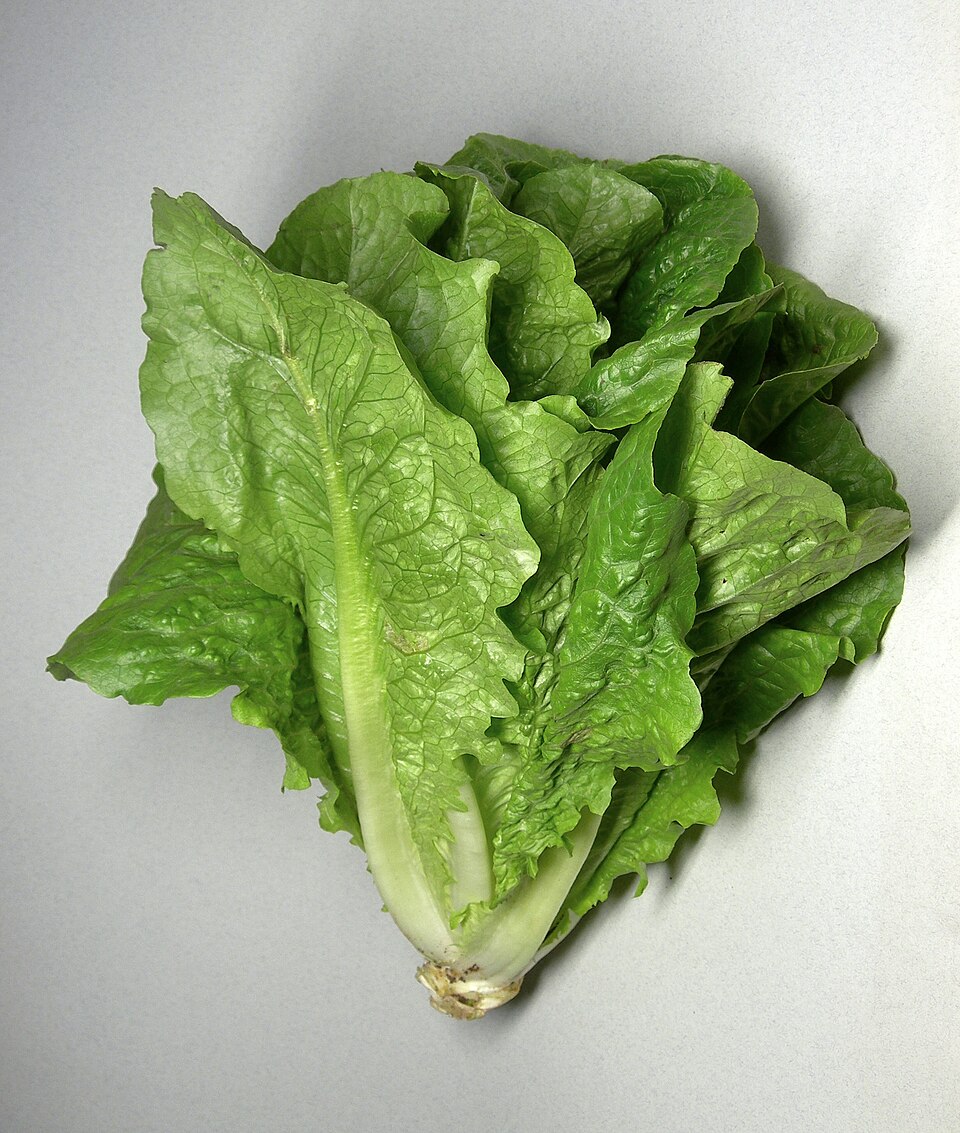
Lettuce is a vegetable as well as an annual plant. Both the stems and the leaves can be eaten. It is of the Asteraceae family.
Growing lettuce
Lettuce can be grown in many parts of the world, including Europe, Asia, and North America, in temperate climates. It will turn more bitter tasting in hot weather. You can grow lettuce during winter in a greenhouse.
Eating lettuce
In some countries, it is often eaten cold and raw, in salads, hamburgers, tacos, sandwiches, and many other dishes. In some places, including China, lettuce is eaten cooked. Lettuce contains very little energy or nutrients.
Kinds of lettuce
Most lettuce leaves are green, but some are red. Most lettuce leaves taste bitter. Some kinds of lettuce grow in a head shape like cabbage, while the leaves of some kinds grow more loosely.
The five main cultivars are: green leaf, red leaf, cos, crisphead, and stem lettuce.
Common varieties are Romaine, iceberg, and butter lettuce.
The name of the plant in English, lettuce, and in Latin, lactuca, come from lactis, the Latin word for milk, because the juice of the plant looks like milk.
History of lettuce
Wild lettuce plants were eaten by the Romans and Egyptians. The ancient Greeks were among the first people to grow lettuce as a crop. It was one of the first plants brought to the New World by Christopher Columbus.
Where this page comes from
The article above is adapted from “Lettuce” on Simple English Wikipedia, by its contributors. We removed reference markers, navigation boxes and tables, expanded measurement templates into readable numbers, and kept the prose otherwise intact.
Both sources are published under CC BY-SA 4.0, so this page is published under the same licence. You may share and adapt it, including commercially, as long as you credit the original and keep the same licence.
Worksheets, answer keys and printable layouts elsewhere on K5Print are our own work and are not covered by this licence.