Oregano

Fast facts
- Genus
- Origanum
- Species
- O. vulgare
Scientific name
- Scientific name
- Origanum vulgare
How to say it in other languages
- Arabic
- مردقوش شائع
- Chinese
- 牛至
- Dutch
- Wilde Marjolein
- French
- Origan
- German
- Gewöhnlicher Dost
- Japanese
- オレガノ
- Korean
- 오레가노
- Portuguese
- orégano
- Russian
- Душица обыкновенная
- Spanish
- orégano
Facts from Wikipedia’s “Oregano” page and Wikispecies (CC BY-SA 4.0).
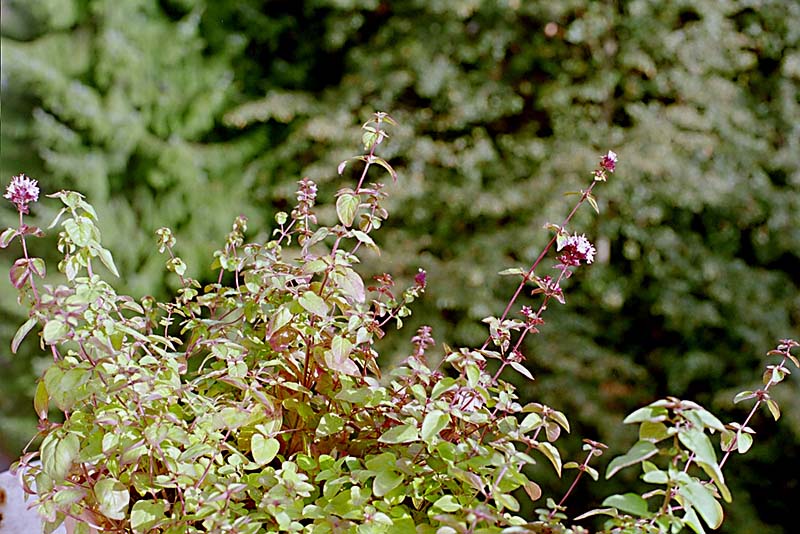
Oregano (Origanum vulgare), also known as wild marjoram, is a species of Origanum. It is native to Europe, the Mediterranean region and southern and central Asia. It is a perennial herb. It can grow to 20–80 cm tall. Its leaves are opposite each other. They are 1–4 cm long. The flowers are purple. They can grow 3–4 mm long. The name of the plant comes from the Greek origanon [ὀρίγανον]: oros [ὄρος] “mountain” and the verb ganousthai [γανοῦσθαι] “delight in”.
Growing oregano for cooking
The subspecies of oregano Origanum vulgare hirtum is an important herb. It is used for cooking, especially in Turkish cuisine and Italian cuisines. The leaves are used for cooking.
Oregano is often used for tomato sauces, fried vegetables and grilled meat. Together with basil, it adds much to the special character of many Italian dishes.
Oregano is an ingredient needed for Turkish cuisine. It adds flavour to the Turkish choban salad. It can be used separately. It can also be added to the lemon-olive oil sauce that goes with almost every fish or meat barbecues and some casseroles.
Oregano has an aromatic, warm and slightly bitter taste. The taste varies in intensity; good quality is so strong that it almost numbs the tongue, but the cultivars adapted to colder climates have often unsatisfactory flavour. The influence of climate, season and soil on the composition of the essential oil is bigger than the difference between the various species.
The related species Origanum onites (Turkey, Asia Minor) and O. heracleoticum (Italy, Balkan peninsula, West Asia) have similar flavours. A closely related plant is marjoram from Asia Minor. That plant has a completely different taste. This is because phenolic compounds are missing in its essential oil. Some breeds show a flavour intermediate between oregano and marjoram. The Oregano plant is also commonly found in the mediterranean region, and the black sea.
Where this page comes from
The article above is adapted from “Oregano” on Simple English Wikipedia, by its contributors. We removed reference markers, navigation boxes and tables, expanded measurement templates into readable numbers, and kept the prose otherwise intact.
Both sources are published under CC BY-SA 4.0, so this page is published under the same licence. You may share and adapt it, including commercially, as long as you credit the original and keep the same licence.
Worksheets, answer keys and printable layouts elsewhere on K5Print are our own work and are not covered by this licence.