Raspberry

Nutrition facts: raw raspberries
One serving is 10 raspberries (19 g).
| Nutrient | Per 100 g | Per serving | % Daily Value |
|---|---|---|---|
| Calories | 52 kcal | 10 kcal | — |
| Protein | 1.2 g | 0.2 g | — |
| Total fat | 0.7 g | 0.1 g | — |
| Carbohydrate | 11.9 g | 2.3 g | 1% |
| Fiber | 6.5 g | 1.2 g | 4% |
| Sugars | 4.4 g | 0.8 g | — |
| Vitamin C | 26.2 mg | 5.0 mg | 6% |
| Vitamin A | 2 µg | 0 µg | — |
| Calcium | 25 mg | 5 mg | — |
| Iron | 0.7 mg | 0.1 mg | 1% |
| Potassium | 151 mg | 29 mg | 1% |
| Sodium | 1 mg | 0 mg | — |
Data: USDA FoodData Central (public domain, CC0) — “Raspberries, raw”. Percent Daily Values use the FDA’s reference amounts for labels.
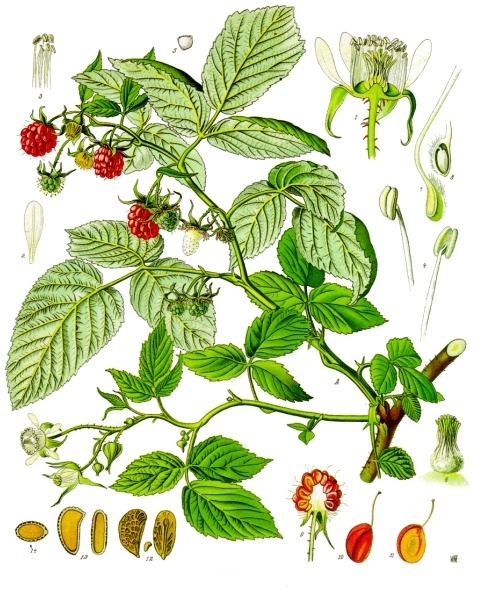
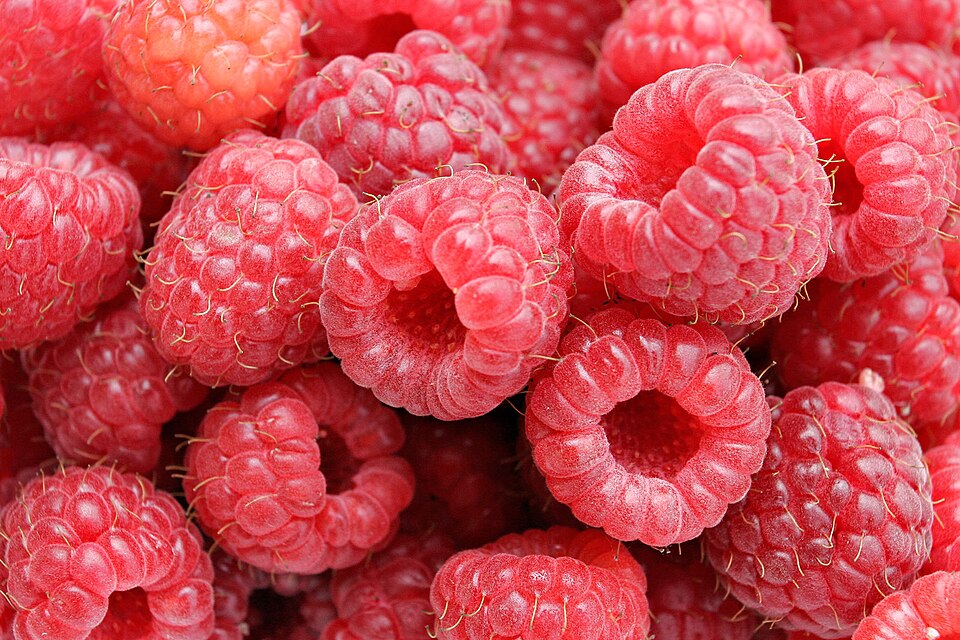
A raspberry is an aggregate fruit, meaning it has many parts joined together. It is similar to a blackberry, but the fruit is hollow on the inside. There are many different species of raspberry plants, but only a few of them have fruit that are sold in stores. Leaves of the raspberry plant are also used fresh or dried in herbal teas. The raspberry is red when ripe, and is also a source of nectar for juices. Raspberries are a popular fruit in some parts of the world.
Plants
A raspberry plant typically grows in fields or in forest clearings where fire or wood-cutting has produced open space. As a cultivated plant in moist temperate regions, it is easy to grow. It has a tendency to spread unless cut back.
Two types of raspberry plants can be bought in stores: the older summer-bearing type and double- or “ever”-bearing plants. Raspberry plants make stalks each year. The fruit grows on these stalks. These stalks last for 2 years. Both the summer and everbearing plants create the fruit in the summer of the second year of the stalk. The stalks of the everbearing plant also creates fruit in the fall of the first year.
Species
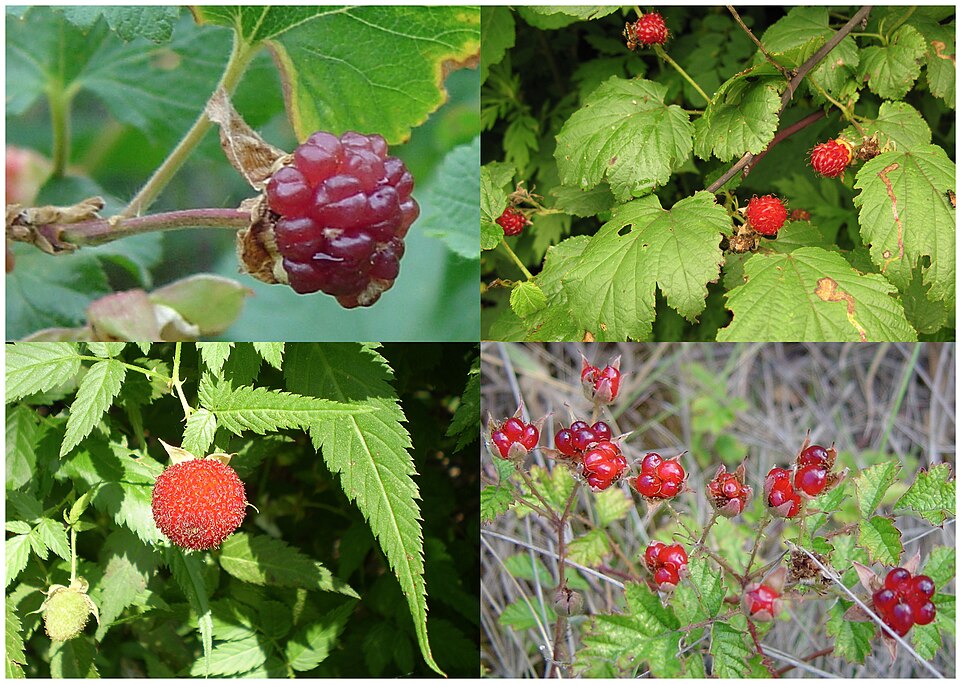
The raspberry fruit that are sold in stores come from plants that are hybrids between two species, Rubus idaeus, European red raspberry, and Rubus strigosus, American red raspberry. Fruit from Rubus occidentalis, black raspberry, are sometimes available, and hybrids with red fruit exist. These three species are in the same subgenus, Rubus subgenus Idaeobatus.
Other raspberry species in Rubus subgenus Idaeobatus include:
- Rubus crataegifolius (Korean raspberry)
- Rubus gunnianus (Tasmanian alpine raspberry)
- Rubus leucodermis (Whitebark or Western raspberry, Blue raspberry, Black raspberry)
- Rubus parvifolius (Australian native raspberry)
- Rubus phoenicolasius (Wine raspberry or Wineberry)
- Rubus rosifolius (West Indian raspberry)
- Rubus ellipticus (Yellow Himalayan Raspberry)
- Rubus strigosus (American raspberry)
Other raspberry species that are not in Rubus subgenus Idaeobatus include:
- Rubus arcticus (Arctic raspberry)
- Rubus deliciosus (Boulder raspberry)
- Rubus nivalis (Snow raspberry)
- Rubus odoratus (Native Flowering raspberry)
- Rubus sieboldii (Molucca raspberry)
Where this page comes from
The article above is adapted from “Raspberry” on Simple English Wikipedia, by its contributors. We removed reference markers, navigation boxes and tables, expanded measurement templates into readable numbers, and kept the prose otherwise intact.
Both sources are published under CC BY-SA 4.0, so this page is published under the same licence. You may share and adapt it, including commercially, as long as you credit the original and keep the same licence.
Worksheets, answer keys and printable layouts elsewhere on K5Print are our own work and are not covered by this licence.