Alabama

Fast facts
- Languages
- 2010 * English 95.1% * Spanish 3.1%
Facts from Wikipedia’s “Alabama” page (CC BY-SA 4.0).
Alabama ( ) is a state in the United States. Its capital city is Montgomery. The largest city is Huntsville. It became a state in 1819. Native American tribes such as Cherokee, Chickasaw, Choctaw, and Creek first lived in Alabama.
Geography
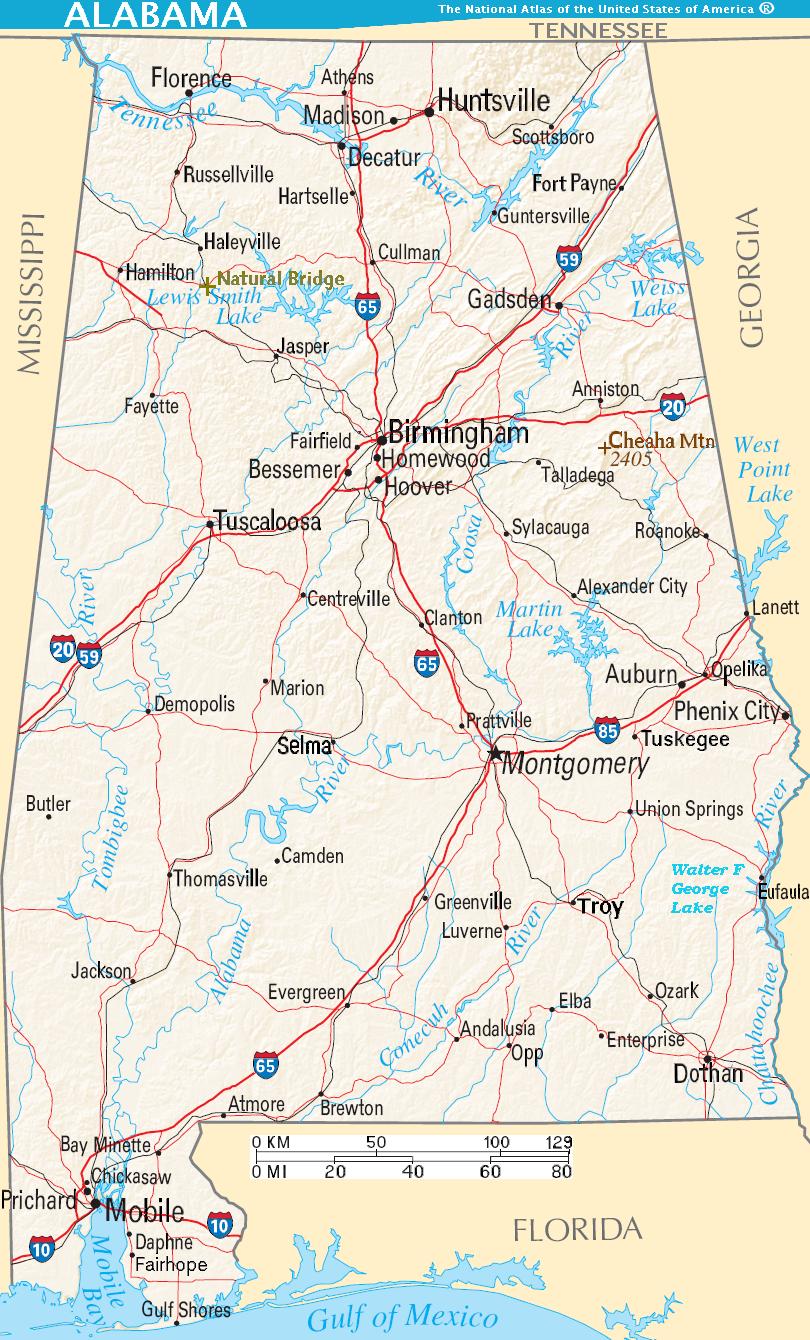
Alabama is the thirty-first largest state in the United States with of total area. 3.18% of the area is water, making Alabama twenty-third in the amount of surface water, also giving it the second-largest inland waterway system in the United States. About three-fifths of the land area is a plain with a general downward slope towards the Mississippi River and the Gulf of Mexico. North Alabama has mostly mountains, with the Tennessee River cutting a large valley creating many creeks, streams, rivers, mountains, and lakes.
The states bordering Alabama are Tennessee to the north; Georgia to the east; Florida to the south; and Mississippi to the west. Alabama has a coastline at the Gulf of Mexico, at the very southern edge of the state. Alabama ranges in height from sea level at Mobile Bay to over 1,800 feet in the Appalachian Mountains in the northeast. The highest point is Mount Cheaha, at a height of 2,407 feet. Alabama’s land has of forest or 67% of the total land area. Baldwin County is the largest county in the state in both land area and water area.
Climate
The state is classified as subtropical Cfa under the Köppen climate classification. The normal yearly temperature is 64 °F. Temperatures are often warmer in the southern part of the state because it is closer to the Gulf of Mexico, while the northern parts of the state, mostly in the Appalachian Mountains in the northeast, tend to be slightly cooler. Most of the time, Alabama has very hot summers and mild winters with lots of rain throughout the year. Alabama receives an average of 56 inches of rainfall annually and enjoys a lengthy growing season of up to 300 days in the southern part of the state.
Summers in Alabama are among the hottest in the United States, with high temperatures averaging over 90 °F throughout the summer in some parts of the state. Alabama also gets many tropical storms and rarely hurricanes. Areas of the state far away from the Gulf of Mexico can still feel the effects of the storms, which often dump big amounts of rain as they move inland and weaken.
Population
The number of people who live in Alabama was 5,024,279 on April 1, 2020, This is 244,543 more people living in the state than in 2010. This includes the migration of 104,991 people into the state.
The top countries of origin for immigrants were Mexico (27 percent of immigrants), China (6 percent), India (6 percent), Guatemala (5 percent), and Germany (5 percent).
Economy
According to the United States Bureau of Economic Analysis, the 2008 total gross state product was $170 billion, or $29,411 per capita. In 1999, the per capita income for the state was $18,189.
Alabama’s agricultural outputs are poultry and eggs, cattle, plant nursery items, peanuts, cotton, grains (such as corn and sorghum), vegetables, milk, soybeans, and peaches. Although known as “The Cotton State”, many reports say that Alabama is between eight and ten in national cotton making, with Texas, Georgia, and Mississippi making up the top three.
Alabama’s company outputs are iron and steel products (like cast-iron and steel pipe); paper, lumber, and wood items; mining (mostly coal); plastic things; cars and trucks; and apparel. Alabama also makes aerospace and electronic products, mostly in the Huntsville area. Huntsville also has the Redstone Arsenal.
Primary and secondary education
Public primary and secondary education in Alabama is under the review of the Alabama State Board of Education as well as local oversight by 67 county school boards and 60 city boards of education. Together, 1,479 schools have education for 743,012 elementary and secondary students.
Colleges and universities
Alabama’s programs of higher education are 14 four-year public universities, two-year community colleges, and 17 private, undergraduate and graduate universities. In the state are two medical schools, University of Alabama at Birmingham and University of South Alabama, two veterinary colleges, Auburn University and Tuskegee University, a dental school for African Americans, University of Alabama, an optometry college, two pharmacy schools, Auburn University and Samford University, and several law schools, Birmingham School of Law, Cumberland School of Law, Miles Law School, and the Thomas Goode Jones School of Law. Public, post-secondary education in Alabama is overseen by the Alabama Commission on Higher Education. Colleges and universities in Alabama offer degree programs from two-year associate degrees to 16 doctor level programs.
Government
The Governor of Alabama is Kay Ivey. The Lieutenant Governor is Will Ainsworth. The Chief Justice of the Alabama Supreme Court is Sarah Hicks Stewart. Both the Governor and Lieutenant Governor are members of the Republican Party.
Notable people from Alabama
- Nat King Cole, singer (Montgomery)
- Rosa Parks, Civil Rights Activist (Tuskegee)
- Jesse Owens, track and field athlete (Oakville)
- Terrell Owens, American football player (Alexander City)
- Helen Keller, (Tuscumbia)
- Bobby Eaton, pro wrestler (Huntsville)
- Mia Hamm, soccer star (Selma)
- Harold E. Martin, newspaperman (Montgomery)
- Scott Oden, writer (Somerville)
- Spooner Oldham; songwriter, keyboardist (Center Star)
- Stanley O’Neal, chairman & CEO of Merrill Lynch (Roanoke)
- Osceola, Seminole leader (Tallassee)
- Randy Owen, lead singer- Alabama (Fort Payne)
- Condoleezza Rice, former U.S. Secretary of State (Birmingham)
- Jimmy Wales, Wikipedia founder (Huntsville)
Written for younger readers
Alabama, in simpler words
This version comes from Wikijunior, a set of books written for children aged 8 to 11. It is shorter and uses plainer language than the article above.
From Wikijunior: North America
Alabama is a state located in the southern region of the United States. It is bordered by Tennessee to the north, Georgia to the east, Florida and the Gulf of Mexico to the south, and Mississippi to the west. The capital of Alabama is Montgomery and it’s largest city is Huntsville. Other big cities in Alabama include Birmingham and Mobile. Residents are known as Alabamians or Alabamans.
Humans have inhabited Alabama for 10,000 years. Native American tribes that inhabited Alabama included the Cherokee, Chickasaw, Choctaw, and Creek.
The French founded the first settlement in the state in 1702, although Alabama was later controlled by the British, then the Spanish. In 1819 Alabama was the twenty-second state admitted to the union. Alabama was the new frontier in the 1820s and 1830s. Settlers rapidly arrived to take advantage of fertile soils. Planters brought slaves with them, and traders brought in more from the Upper South as the cotton plantations expanded. The economy of the central “Black Belt” featured large cotton plantations whose owners built their wealth on the labor of enslaved African Americans. It was named for the dark, fertile soil. According to the 1860 census, enslaved Africans made up 45% of the state’s population.
In 1861 Alabama separated from the union and joined the Confederate States of America. Although there were not many battles fought in the state, Alabama contributed about 120,000 soldiers to the Civil War. All the slaves were freed by 1865. Following Reconstruction, Alabama was readmitted to the Union in 1868.
During the 1950s and 1960s, Alabama was an important part of the civil rights movement.
Alabama is the 30th largest state in the United States with 52,423 square miles (135,775 square kilometers) of total area. It is bordered by Tennessee to the north, Georgia to the east, Florida and the Gulf of Mexico to the south, and Mississippi to the west. Alabama has more inland waterways than any other state.The climate of Alabama is described as temperate with an average annual temperature of 64°F (18°C). Temperatures tend to be warmer in the southern part of state because of how close it is to the Gulf of Mexico. Northern parts of the state tend to be cooler because they are closer to the Appalachian Mountains. Most of the time, Alabama has very hot summers with mild winters. Tornadoes are also common.
.
In 2018, the United States Census Bureau estimated the population of Alabama was 4,887,871. English is the most-spoken language (95.1%), followed by (in order) Spanish (2.2%), German (0.4%), French (including Patois, Cajun) (0.3%), and Chinese, Vietnamese, Korean, Arabic, African languages, Japanese, and Italian (latter seven tied) (0.1%).
In 2010, 68.5% of people in Alabama were White/Caucasian, 26.2% were black, 1.1% were Asian, 0.6% were Native American, and 0.1% were Native Hawaiian and other Pacific Islander.
Hank Williams - Country singer
Booker T. Washington - Educator
George Washington Carver - Scientist who invented more than 100 uses for the peanut
Nat “King” Cole - Jazz singer
Harper Lee - Author of To Kill a Mockingbird
Jefferson Davis - President of the Confederacy during the Civil War
Helen Keller - Deaf and blind activist
Jesse Owens - Gold medal track and field athlete
Rosa Parks - Civil rights activist who refused to give up her seat on the bus to a white man
The state is nicknamed the Yellowhammer State, the Heart of Dixie, and the Cotton State, among others, although none of these are official.
The state’s motto is “Audemus iura nostra defendere” which is Latin for “We dare to defend our rights”
The state’s slogans are “Share the Wonder”, “Alabama the beautiful”, “Where America finds its voice”, “Sweet Home Alabama”, and “Heart of Dixie”
The state amphibian is the Red Hills salamander
The state birds are the yellowhammer and the wild turkey
The state butterfly is the eastern tiger swallowtail
The state fishes are the largemouth bass and the fighting tarpon
The state flowers are the camellia and the oak-leaf hydrangea
The state horse breed is the racking horse
The state insect is the monarch butterfly
The state mammal is the American black bear
The state reptile is the Alabama red-bellied turtle
The state tree is the longleaf pine
The state beverage is Conecuh Ridge Whiskey
The state colors are red & white
The state dance is the square dance
The state foods are pecan, blackberry, and peach
The state fossil is Basilosaurus
The state gemstone is star blue quartz
The state mineral is hematite
The state rock is marble
The state shell is Johnstone’s junonia
The state soil is bama
The state song is “Alabama”
Where this page comes from
The article above is adapted from “Alabama” on Simple English Wikipedia, by its contributors. We removed reference markers, navigation boxes and tables, expanded measurement templates into readable numbers, and kept the prose otherwise intact. The simpler version is adapted from Wikijunior on Wikibooks.
Both sources are published under CC BY-SA 4.0, so this page is published under the same licence. You may share and adapt it, including commercially, as long as you credit the original and keep the same licence.
Worksheets, answer keys and printable layouts elsewhere on K5Print are our own work and are not covered by this licence.