Albania

Quick facts
- Capital
- Tirana
- Largest city
- Tirana
- Government
- Unitary parliamentary republic
- People are called
- Albanian
- Area
- 28,748 km² (11,100 sq mi)
- Population
- 2,402,113 (2023)
- Money
- Lek
Facts from Wikipedia’s “Albania” page (CC BY-SA 4.0).
{{Infobox country }} }}
Albania ({{IPAc-en|audio=en-us-Albania.ogg|æ|l|ˈ|b|eɪ|n|i|ə}} {{respell|al|BAY|nee-ə}}; {{lang-sq|Shqipëri}}), officially called the Republic of Albania is an independent country located in Southeast Europe, more specifically it is located in the Balkans. The capital is Tirana, and other important cities are Durrës, Elbasan and Vlora. Over 3 million people live in the area of {{convert|28748|km2|sqmi}} that Albanians call their home. The majority of Albanians are Muslim with 55%, 23% Eastern Orthodox and 15% Roman Catholics.
Albania is next to Montenegro, Serbia, North Macedonia, Kosovo and Greece. It has a coast on the Adriatic Sea in the west, and a coast on the Ionian Sea in the southwest. The official language is Albanian (Gjuha Shqipe). The national anthem is Hymni i Flamurit.
History
{{Main|History of Albania}} Albania was the southern part of Illyria during the Roman Empire. In the Middle Ages the Albanians were ruled by many foreign countries, including the Byzantine and Venetian Empires, and during the 16th century resistance to the Ottoman Empire’s rule was led by the Albanian national hero Skanderberg (real name Gjergj Kastrioti). After four centuries of Turkish domination, an independent Albania was finally created in the 20th century. In 1939 Albania was conquered by fascist Italy and was part of the Kingdom of Italy until 1943. After World War II Albania became independent again, under communist rule. It was ruled by Enver Hoxha, who died in 1985. Ramiz Alia took over and also later became president when, in 1992, Albania ended communism, and it now has friendly relations with the European Union, which it has applied to join.
Divisions
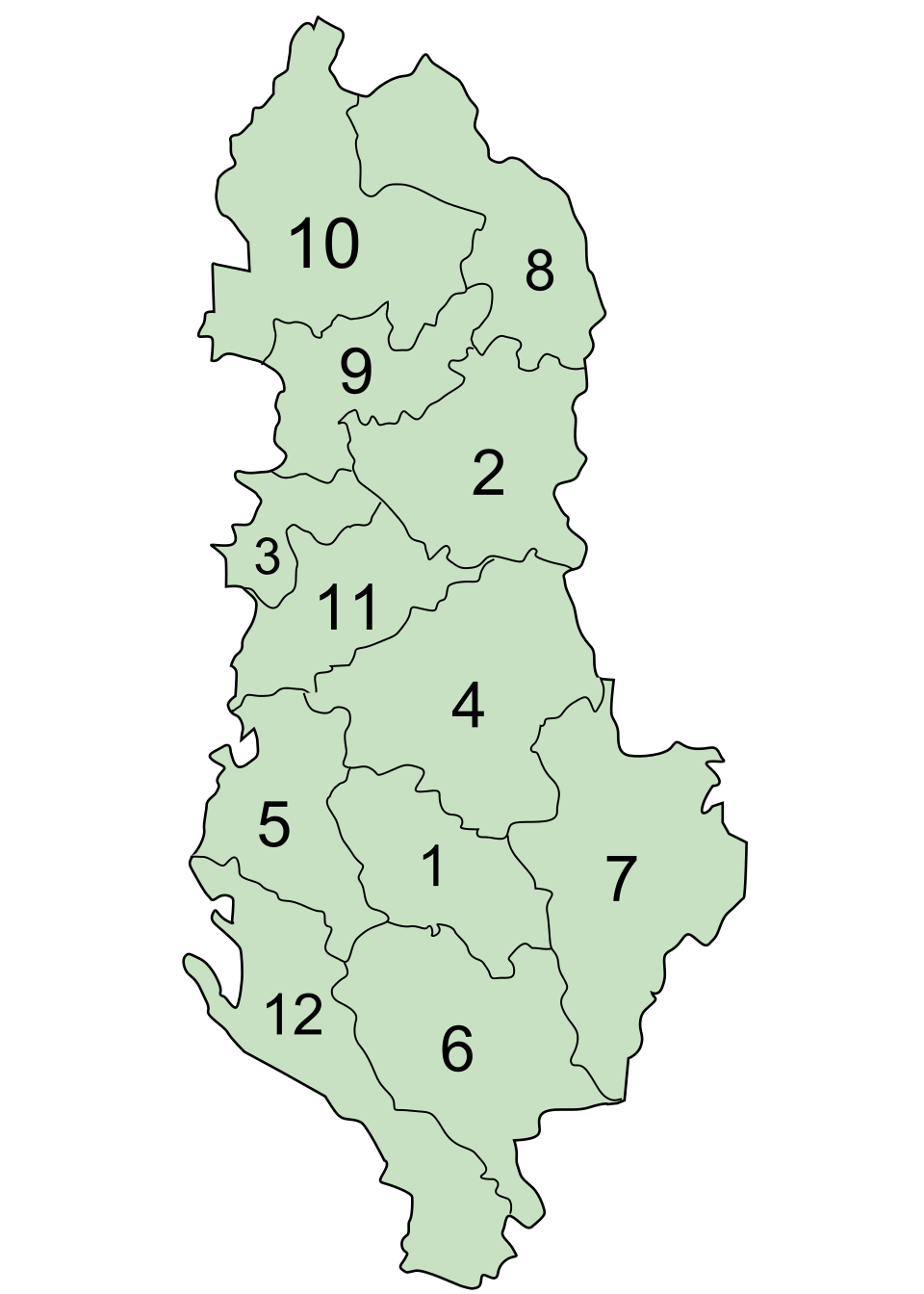
Albania is divided into 12 counties. These counties include 36 districts and 373 municipalities
Cities
{{Main|List of cities and towns in Albania}}
This is a list of the largest cities in Albania.
Armed forces
The Albanian Armed Forces were first formed after independence in 1912. Albania reduced the number of active troops from 65,000 in 1988 to 14,500 in 2009. In 2010 forced conscription was abolished.
Geography
Albania has a total area of 28,748 square kilometers. Albania’s coastline length is {{convert|476|km|0|abbr=on}}.{{rp|240}} It goes along the Adriatic and Ionian Seas. On the coast there are mild, wet winters and warm, sunny, and rather dry summers.
70% of the country is mountains. The highest mountain is Korab.
Albania is bordered by Greece, the Republic of North Macedonia, Montenegro and Kosovo. A short stretch of sea separates Albania from the far southeast of Italy.
Flora and fauna
Although a small country, Albania has a lot of variety in plants and animals. The total number of plants is over 3250 species. There are over 350 bird species, 330 freshwater and marine fish and 80 mammal species. The double-headed eagle is the national symbol of Albania.
Written for younger readers
Albania, in simpler words
This version comes from Wikijunior, a set of books written for children aged 8 to 11. It is shorter and uses plainer language than the article above.
From Wikijunior: Europe
Albania (Shqipëri in Albanian) is a small country in south-eastern Europe in the Balkan peninsula. It shares borders with Greece, Montenegro, Kosovo, and Macedonia. The capital is Tirana. The currency of Albania is the Lek. Other large cities are Durrës and Elbasan. Albania isn’t part of the European Union.
During the fifteenth century Albania enjoyed a brief period of independence under the legendary hero, Skanderbeg. Aside from this exception, the country did not enjoy independence until the twentieth century. After five hundred years of Ottoman rule, an independent Albania was proclaimed in 1912. The country adopted a republican form of government in 1920. In 1939 the Italians invaded the country. Because of this event Albania was one of the first countries occupied by the Axis Powers in World War II.
After the war Albania became a communist state known as the Socialist People’s Republic of Albania and was ruled by Enver Hoxha until 1985. Albania became a democratic country in 1991 but faced problems throughout the 1990s. In 1996 there were severe economic problems because of the failure of Ponzi schemes in the country. In 1997 there was an armed rebellion and hundreds of thousands of people emigrated to other parts of Europe and North America. In 1999 Albania faced an influx of refugees from Kosovo, Serbia during violence in that province.
Albania has a total area of 28,750 square kilometers. Albania has coastline on the Adriatic Sea and the Ionian Sea. Albania has a continental climate with hot summers and fairly cold temperatures. 70% of the country is mountainous with the highest mountain being Korab at 2,753 metres.
Albania has many fairly big lakes including one of central Europe’s biggest lakes - Lake Shkodër - which is located partly in Albania and partly in neighbouring Montenegro.
Albania has been populated since prehistoric times and in recent history the country has been home to large numbers of Catholic Christians and Jews but in the past few hundred years people have either converted to Islam or moved elsewhere. About 40% of the population are Muslim, 40% are Christian and 20% are Atheist (no religion). One of the most internationally famous Albanians was Agnes Gonxha Bojaxhiu, better known as Mother Teresa who was a Roman Catholic nun who worked with the poor around the world, especially India.
Between 1945 and 1992 Albania was a communist country but currently the country is hoping to join organizations like the European Union. The national language is Albanian. Many Albanians also speak English, Italian and Greek. A large number of Albanians also live in Macedonia, Greece, Italy and in Kosovo.
The literacy rate for the total population, age 9 or older, is about 94%. Elementary education is required for grades 1-9, but most students continue at least until a secondary education (grades 10-12). Students must successfully pass graduation exams at the end of the 9th grade and at the end of the 12th grade in order to continue their education. The school year begins in September and finishes in late May or early June.
The most popular sport in Albania is football and the most followed sports event is the World Cup. Other played sports include basketball, volleyball, and gymnastics.
Today Albania is a popular destination for tourists from Europe and elsewhere. Tourists visit for the Greek, Roman and Ottoman archaeological buildings as well as some remnants from Communist times. The mountains and beaches in Albania are said to be as good, or better, than elsewhere in Europe but much less crowded. In 2011 Lonely Planet said that Albania is the number 1 destination to visit and most tourists who visit come from Kosovo (Serbia), Greece, Macedonia and Italy. Other visitors come from Poland, Czech Republic, France and Sweden.
There are 3 UNESCO World Heritage Sites in Albania including the Greek and Roman city of Butrint and a medieval Ottoman town called Gjirokastër.
Where this page comes from
The article above is adapted from “Albania” on Simple English Wikipedia, by its contributors. We removed reference markers, navigation boxes and tables, expanded measurement templates into readable numbers, and kept the prose otherwise intact. The simpler version is adapted from Wikijunior on Wikibooks.
Both sources are published under CC BY-SA 4.0, so this page is published under the same licence. You may share and adapt it, including commercially, as long as you credit the original and keep the same licence.
Worksheets, answer keys and printable layouts elsewhere on K5Print are our own work and are not covered by this licence.