Alexandria

Fast facts
- Leader
- Ayman Mohammed Ibrahim Ahmed Ateyya
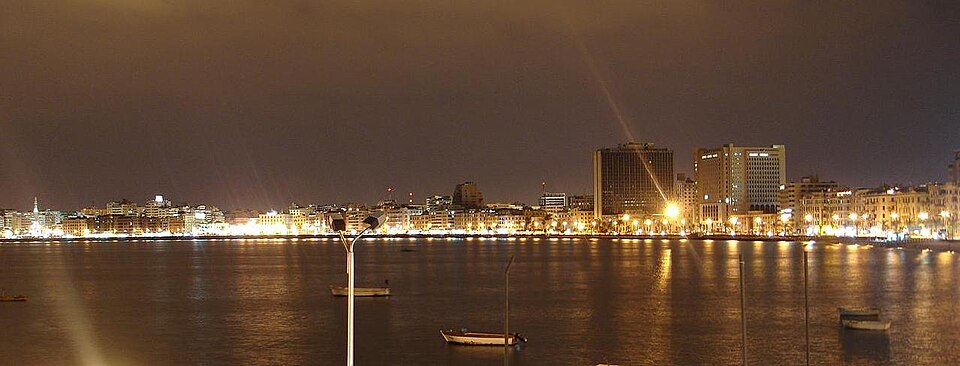
Alexandria () is the second-largest city in Egypt and capital of the Alexandria Governorate. It is located at the western part of the Nile Delta, and extends about 40 km (25 mi) along the country’s northern coast on the Mediterranean Sea. It was founded by Alexander the Great in 331 BC as Ἀλεξάνδρεια (Alexandria), and became one of the largest and most important cities of the ancient world as a leading hub for science and philosophy. It is located 225 km (140 miles) northwest of Cairo, Egypt’s modern capital.
Alexandria has a population of over 3.8 million people, making it the sixth-largest city in the Arab world, seventh-largest city in the Middle East, and the eleventh-largest city in Africa. Alexandria Port is the main port of Egypt, and the city is an important industrial centre, containing the Alexandria Shipyard. It has two main airports. It has the Bibliotheca Alexandrina, a library and cultural centre that was built over the ancient Library of Alexandria.
Ancient era
Radiocarbon dating of seashells show that people have been living in the area that is now Alexandria starting from the Old Kingdom of Ancient Egypt (27th-21st centuries BCE), and again in the period 1000–800 BC, after which there was an absence of human activity. A small fishing village called Rhacotis () which existed since the 13th century BCE existed in the area, which eventually became the Egyptian quarter (section) of Alexandria.
In 331 BC, Alexander the Great founded the city of Alexandria. He wanted to build a large Greek city (polis) in Egypt to build a causeway to the nearby island of Pharos that would be named after him, and so he called it Alexandria. For nearly 300 years, it was the capital of the Ptolemaic dynasty of Egypt. Many famous ancient Greek scientists, such as Euclid of Alexandria and Eratosthenes, lived or studied there. It was home to the largest library in the ancient Western world, the Library of Alexandria, which would eventually be destroyed due to different reasons.
The Septuagint, a Greek translation of the Tanakh (Hebrew Bible), was completed in Alexandria. Alexandria was also very important for Early Christianity, and much of Christian theology was developed in Alexandria.
Alexandria was a wealthy city in its heyday, and remained the main way Egyptian grain was moved by sea to Ancient Rome. Rome depended greatly on Egyptian grain. Much of Alexandria sank below the sea in the 4th century, with much of her remains still in the Mediterranean.
Islamic era
In 619, Alexandria came under control of the Sassanids, who created a new palace called the Tawarus, later known in Arabic as Qasr Faris (“fort of the Persians”). In 641, the Arab and Muslim general and companion of Muhammad Amr ibn al-As captured Alexandria during the Muslim conquest of Egypt in 641 AD, becoming part of the Rashidun Caliphate.
After this, the name Alexandria was Arabicised (made into Arabic): the Al at the beginning became the Arabic definite article Al (ال, ’the’), because it was easier to pronounce than Al-Alexandria. Metathesis occurred on x, meaning it was changed from in Arabic to ; and the suffix -eia was became the female suffix (because Alexandria is a female name in Arabic) -iyya (ـِيَّة), making the Arabic name al-ʔiskandariyya (الْإِسْكَنْدَرِيَّة).
After the Muslim conquest of Egypt in 641 AD, the Rashidun did not want to keep their capital at Alexandria, because it was too vulnerable to naval raids. They made a new capital, much farther upriver, on the east side of the Nile, and called it Fustat, which would eventually become Cairo. Alexandria became less important throughout the ages, but it remained an important part of Egypt.
Modern era
Muhammad Ali, the Ottoman governor and de facto (in reality) ruler of Egypt began rebuilding and redeveloping Alexandria in the 1800s, and, by 1850, Alexandria was restored to its former glory. Many Greeks and other Europeans began moving to the city, which, by the early 20th century, became a home for novelists and poets. These people would become known as the Mutamassirun, and there were 300,000 Greek Egyptians in Egypt by the 1940s, mostly in Alexandria.
Following the 1956 Suez Crisis, Europeans began leaving Alexandria. The nationalisation of property by Arab nationalist and socialist Gamal Abdel Nasser, which reached its highest point in 1961, drove out nearly all the rest, almost ending Alexandria’s cosmopolitan history. Today, the Greek community in Egypt as a whole numbers around 7,000 people, with many others with Greek heritage now labelled as Egyptian.
The fourth Wikimania was hosted in Alexandria in 2008.
Written for younger readers
Alexandria, in simpler words
This version comes from Wikijunior, a set of books written for children aged 8 to 11. It is shorter and uses plainer language than the article above.
From Wikijunior: Big Book Of Cities And Towns
Alexandria is an important city of Egypt. It has a history dating back to ancient times.
File:Ancientlibraryalex.jpg|Drawing of the ancient library of Alexandria. It was destroyed long ago, but was said to be among the most important libraries in the world. File:Fassade des griechisch-römischen Museums in Alexandria, Ägypten.jpg|Greco Roman Museum in Alexandria File:AlexSarapeionPompeysPillar.jpg|Pompey’s Pillar, an ancient monument made by the Romans. File:Leuchtturm von Alexandria.png|Computer model of the lighthouse of Alexandria, a famous lighthouse in ancient times. It was destroyed long ago. File:QaitbeyCitadel.jpg|The Citadel of Qaitbey. File:Alexandria Opera House.jpg|Alexandria Opera House
Where this page comes from
The article above is adapted from “Alexandria” on Simple English Wikipedia, by its contributors. We removed reference markers, navigation boxes and tables, expanded measurement templates into readable numbers, and kept the prose otherwise intact. The simpler version is adapted from Wikijunior on Wikibooks.
Both sources are published under CC BY-SA 4.0, so this page is published under the same licence. You may share and adapt it, including commercially, as long as you credit the original and keep the same licence.
Worksheets, answer keys and printable layouts elsewhere on K5Print are our own work and are not covered by this licence.