Apple
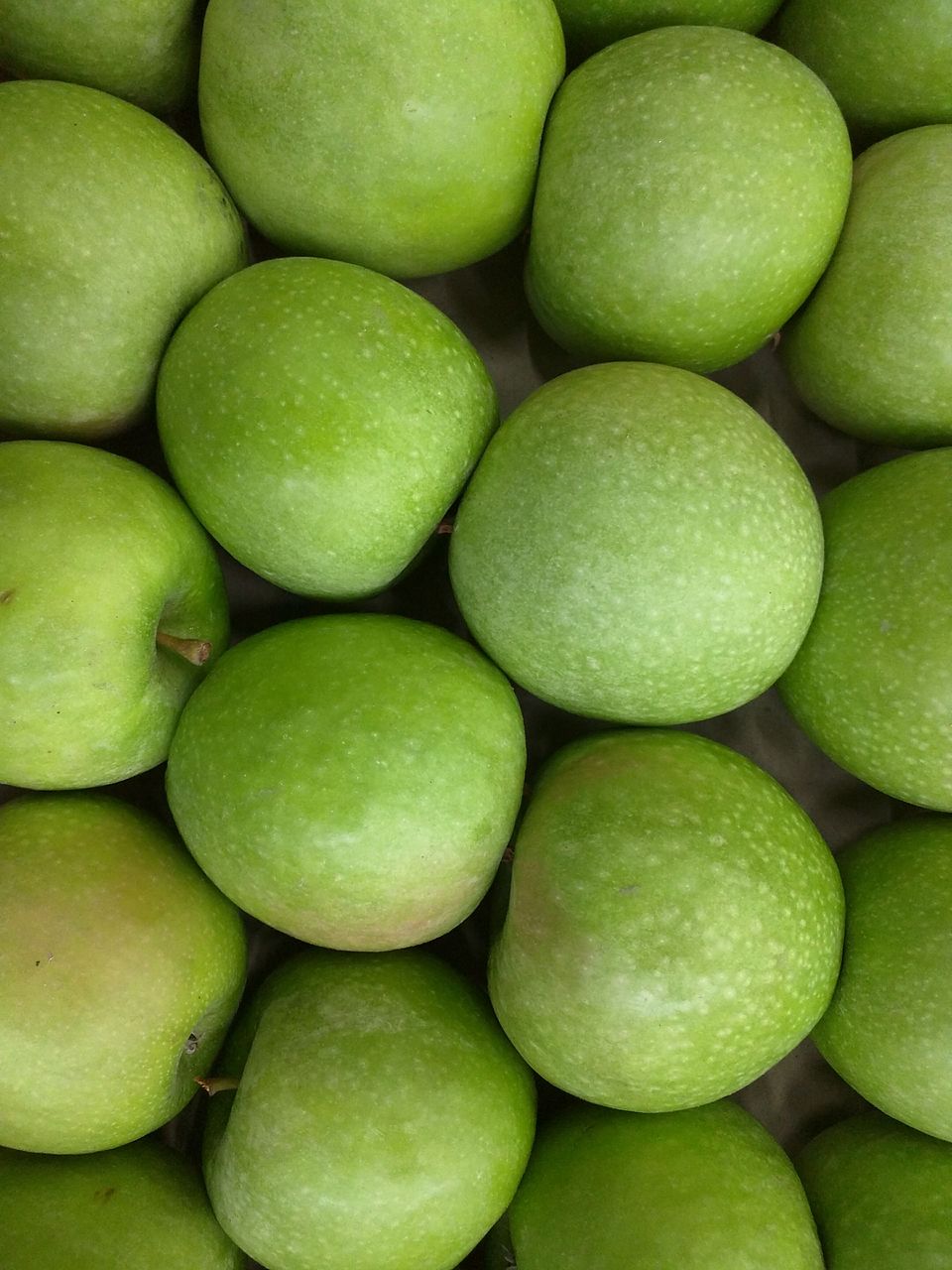

Scientific name
- Scientific name
- Malus domestica
How to say it in other languages
- French
- Pomme
- German
- Apfel
- Italian
- Melo
- Japanese
- セイヨウリンゴ
- Korean
- 사과나무
- Portuguese
- Maçã
- Russian
- Яблоня домашняя
- Spanish
- Manzano
Facts from Wikipedia’s “Apple” page and Wikispecies (CC BY-SA 4.0).
Nutrition facts: raw apple with skin
One serving is 1 extra small (2-1/2" dia) (101 g).
| Nutrient | Per 100 g | Per serving | % Daily Value |
|---|---|---|---|
| Calories | 52 kcal | 53 kcal | — |
| Protein | 0.3 g | 0.3 g | 1% |
| Total fat | 0.2 g | 0.2 g | — |
| Carbohydrate | 13.8 g | 13.9 g | 5% |
| Fiber | 2.4 g | 2.4 g | 9% |
| Sugars | 10.4 g | 10.5 g | — |
| Vitamin C | 4.6 mg | 4.7 mg | 5% |
| Vitamin A | 3 µg | 3 µg | — |
| Calcium | 6 mg | 6 mg | — |
| Iron | 0.1 mg | 0.1 mg | 1% |
| Potassium | 107 mg | 108 mg | 2% |
| Sodium | 1 mg | 1 mg | — |
Data: USDA FoodData Central (public domain, CC0) — “Apples, raw, with skin (Includes foods for USDA's Food Distribution Program)”. Percent Daily Values use the FDA’s reference amounts for labels.
The apple tree comes from southern Kazakhstan; Kyrgyzstan; Uzbekistan; Turkey; and the northwestern part of China. Apples have been grown for thousands of years in Asia and in Europe. They were brought to North America by European World Colonial settlers. Apples have Religious and mythological significance in many cultures.
Apples are generally grown by grafting, although wild apples grow readily from seed. Apple trees are normally large if grown from seed, but small if grafted onto roots (rootstock). There are more than 10,000 known variants of apples, with a range of desired characteristics. Different variants are bred for various tastes and uses: cooking, eating raw and cider production are the most common uses. In addition to that, when it comes to food toxicity, the seeds in apples can be fatal, but only if they’ve been crushed. Apples contain amygdalin, which can release cyanide when digested. Apple seeds contain a chemical that can make cyanide, but the amount is too small to harm people who eat a few seeds.
Trees and fruit are attacked by fungi, bacteria and pests. In 2010, the fruit’s genome was sequenced as part of research on disease control and selective breeding in apple production.
Worldwide production of apples in 2013 was 90.8 million tonnes. China grew 49% of the total.
Botanical information
The apple tree is a small, leaf-shedding tree that grows up to 3 to 12 metres tall. The apple tree has a broad crown with thick twigs. The leaves are alternately arranged simple ovals. They are 5 to 12 centimetres long and 3–6 centimetres wide. It has a sharp top with a soft underside. Blossoms come out in spring at the same time that the leaves begin to bud. The flowers are white. They also have a slightly pink color. They have five petals, and 2.5 to 3.5 centimetres in diameter. The fruit matures in autumn. It is usually 5 to 9 centimetres in diameter. There are five carpels arranged in a star in the middle of the fruit. Every carpel has one to three seeds.
Wild ancestors
The wild ancestor of apple trees is Malus sieversii. They grow wild in the mountains of Central Asia in the north of Kazakhstan, Kyrgyzstan, Tajikistan, and Xinjiang, China, and possibly also Malus sylvestris. Unlike domesticated apples, their leaves become red in autumn. They are being used recently to develop Malus domestica to grow in colder climates.
History
The apple tree was possibly the earliest tree to be cultivated. Its fruits have become better over thousands of years. It is said that Alexander the Great of Greek civilisation discovered dwarf apples in Asia Minor in 300 BC. Asia and Europe have used winter apples as an important food for thousands of years. From when Europeans arrived, Argentina and the United States have used apples as food as well. Apples were brought to North America. The first apple orchard on the North American continent was said to be near Boston in 1625. In the 1900s, costly fruit industries, where the apple was a very important species, began developing.
Paganism
In Norse mythology, the goddess Iðunn gives apples to the gods in Prose Edda (written in the 13th century by Snorri Sturluson) that makes them young forever. English scholar H. R. Ellis Davidson suggests that apples were related to religious practices in Germanic paganism. It was from there, she claims, that Norse paganism developed. She points out that buckets of apples were discovered in the place of burial for the Oseberg ship in Norway. She also remarks that fruit and nuts (Iðunn having been described as changing into a nut in Skáldskaparmál) have been discovered in the early graves of the Germanic peoples in England. They have also been discovered somewhere else on the continent of Europe. She suggests that this may have had a symbolic meaning. Nuts are still a symbol of fertility in Southwest England.
Cooking
Sometimes apples are eaten after they are cooked. Often, apples are eaten uncooked. Apples can also be made into drinks. Apple juice and apples cider are drinks made with apples. They can also be used for many desserts such as apple pie or crumble.
The flesh of the fruit is firm with a taste anywhere from sour to sweet. Apples used for cooking are sour, and need to be cooked with sugar, while other apples are sweet, and do not need cooking. There are some seeds at the core, that can be removed with a tool that removes the core, or by carefully using a knife.
The scientific name of the apple tree genus in the Latin language is Malus. Most apples that people grow are of the Malus domestica species.
Most apples are good to eat raw (not cooked), and are also used in many kinds of baked foods, such as apple pie and baked apples, Apples are cored and peeled and then cooked until they are soft to make apple sauce or apple butter.
Apples are also made into the drinks apple juice and cider. Usually, cider contains a little alcohol, about as much as beer. The regions of Brittany in France and Cornwall in England are known for their apple ciders.
Apple variants
If one wants to grow a certain type of apple, it is not possible to do this by planting a seed from the wanted type. The seed will have DNA from the apple that the seeds came from, but it will also have DNA from the apple flower that pollinated the seeds, which might be a different variant of apple. This means that the tree which would grow from planting would be a mixture of two, or a hybrid. In order to grow a certain type of apple, a small twig, or ‘scion’, is cut from the tree that grows the type of apple desired, and then added on to a specially grown stump called a rootstock. The tree that grows will create apples of the type needed.
There are more than 7,500 known variants of apples. Different variants are available for temperate and subtropical climates. One large collection of over 2,100 apple variants is at the National Fruit Collection in England. Most of these variants are grown for eating fresh (dessert apples). However, some are grown simply for cooking or making cider. Cider apples are usually too tart to eat immediately. However, they give cider a rich flavor that dessert apples cannot.
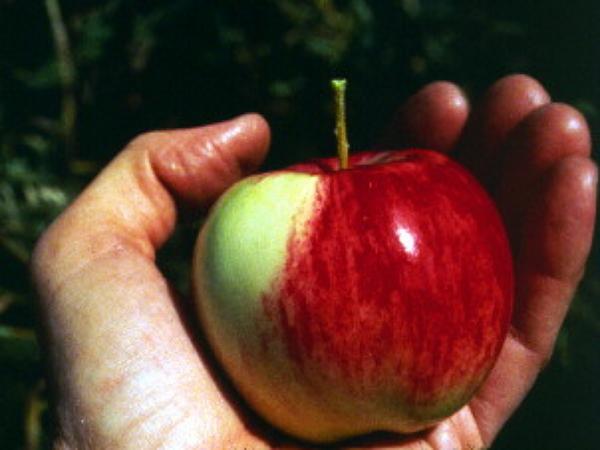
Most popular apple cultivars are soft but crisp. Colorful skin, easy shipping, disease resistance, ‘Red Delicious’ apple shape, and popular flavor are also needed. Modern apples are usually sweeter than older cultivars. This is because popular tastes in apples have become different. Most North Americans and Europeans enjoy sweet apples. Extremely sweet apples with hardly any acid taste are popular in Asia and India.
World production
Apples are grown around the world. China produces more than half of all commercially grown apples. In 2020/2021, China produced 44,066,000 metric tons. Other important producers were the European Union (11,719,000 metric tons), the United States (4,490,000 metric tons), and Turkey (4,300,000 metric tons). Total world production was 80,522,000 metric tons.
In the United Kingdom
In the United Kingdom there are about 3000 different types of apples. The most common apple type grown in England is the ‘Bramley seedling’, which is a popular cooking apple.
Apple orchards are not as common as they were in the early 1900s, when apples were rarely brought in from other countries. Organizations such as Common Ground teach people about the importance of rare and local varieties of fruit.
In North America
Many apples are grown in temperate parts of the United States and Canada. “Washington State currently produces over half the Nation’s domestically grown apples and has been the leading apple-growing State since the early 1920s.” New York and Michigan are the next two leading states in apple production. “The total reported area dedicated to the crop in the United States is 336,940 acres or 526.47 square miles.”
In many areas where apple growing is important, people have huge celebrations:
- Annapolis Valley Apple Blossom Festival - held five days every spring (May-June) in Nova Scotia
- Shenandoah Apple Blossom Festival - held six days every spring in Winchester, Virginia.
- Washington State Apple Blossom Festival - held two weeks every spring (April-May) in Wenatchee, Washington.
Varieties of apples
There are many different varieties of apples, including
- Aport
- Cox’s Orange Pippin
- Fuji (apple)
- Gala
- Golden Delicious (sometimes called a Green Delicious Apple)
- Granny Smith
- Honeycrisp
- Jonathan
- Jonagold
- McIntosh
- Pink Lady
- Red Delicious
- Winesap
- Honey crisp
Family
Apples are in the group Maloideae. This is a subfamily of the family Rosaceae. They are in the same subfamily as pears.
Where this page comes from
The article above is adapted from “Apple” on Simple English Wikipedia, by its contributors. We removed reference markers, navigation boxes and tables, expanded measurement templates into readable numbers, and kept the prose otherwise intact.
Both sources are published under CC BY-SA 4.0, so this page is published under the same licence. You may share and adapt it, including commercially, as long as you credit the original and keep the same licence.
Worksheets, answer keys and printable layouts elsewhere on K5Print are our own work and are not covered by this licence.