Argentina

Fast facts
- Capital
- Buenos Aires
- Currency
- Peso ($)
- Time zone
- ART
- Drives on
- right
- Calling code
- +54
Facts from Wikipedia’s “Argentina” page (CC BY-SA 4.0).
Argentina, officially the Argentine Republic, is a country in South America. Argentina is the second-largest country in South America and the eighth-largest country in the world.
Spanish is the most spoken language, and the official language, but many other languages are spoken. There are minorities speaking Italian, German, English, Quechua and even Welsh in Patagonia.
In eastern Argentina is Buenos Aires, the capital of Argentina, it is also one of the largest cities in the world. In order by number of people, the largest cities in Argentina are Buenos Aires, Córdoba, Rosario, Mendoza, La Plata, Tucumán, Mar del Plata, Salta, Santa Fe, Neuquén and Bahía Blanca.
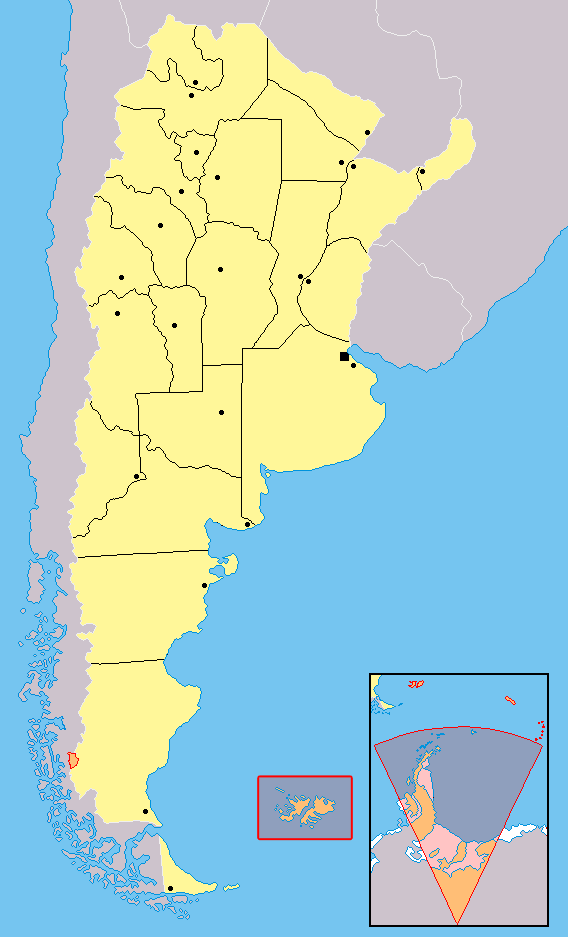
Argentina is between the Andes mountain range in the west and the southern Atlantic Ocean in the east and south. It is bordered by Paraguay and Bolivia in the north, Brazil and Uruguay in the northeast, and Chile in the west and south. It also claims the Falkland Islands (Spanish: Islas Malvinas) and South Georgia and the South Sandwich Islands. Most citizens of the Argentine Republic are descendants of immigrants from Europe. They are united by citizenship and not necessarily by ethnicity. Most Argentines embrace both their ethnic origins and Argentine nationality.
History
The name Argentina comes from the Latin argentum (silver) as the Spanish conquistadors believed the area had silver. In the Americas (South and North), Canada, US, Brazil and Argentina are the largest countries (in that order).
The oldest signs of people in Argentina are in the Patagonia (Piedra Museo, Santa Cruz), and are more than 13,000 years old. In 1480 the Inca Empire conquered northwestern Argentina, making it part of the empire. In the northeastern area, the Guaraní developed a culture based on yuca and sweet potato however typical dishes all around Argentina are pasta, red wines (Italian influence) and beef.
Other languages spoken are Italian, English and German. Lunfardo is Argentinean slang and is a mix of Spanish and Italian. Argentinians are said to speak Spanish with an Italian accent.
Argentina declared independent from Spain in 1816, and achieved it in a War led by José de San Martín in 1818. Many immigrants from Europe came to the country. By the 1920s it was the 7th wealthiest country in the world, but it began a decline after this. In the 1940s, following the “infamous decade” where the country’s politics were not stable, Juan Peron came to power. Peron was one of the most important people in the country’s history and many politicians today call themselves Peronist. Peron was forced out of power in 1955. After spending years in exile he returned to power in the 1970s.
In 1976, the country was falling into chaos, and the military took power. This was not the first time the military had done this. Leading the new government was Jorge Rafael Videla. Videla was one of history’s most brutal dictators. Thousands of people disappeared or were killed during his time as president. Videla retired in 1980.
One of his successors was another general turned dictator, Leopoldo Galtieri. By the time Galtieri was in office in 1981 the dictatorship became unpopular. To stir up support, Galtieri ordered an invasion of the Falkland Islands, starting the Falklands War. Argentina lost the war, and soon the country fell into chaos again. Galtieri was removed from power and eventually democracy was restored. Galtieri and Videla would be charged with “crimes against humanity” because of the mass murder and other crimes that they ordered as president.
In the early 21st century Argentina is one of the most important countries in Latin America, though it still has many problems. It has a large economy and is influential in the “southern cone” of South America and a member of the G20 developing nations.
In December 2023, Argentina was the invitee country but it did not joined to the BRICS bloc.
Politics
Argentina is a federal republic. The people of Argentina vote for a President to rule them and Senators and Deputies to speak for them and make laws for them. The President is Javier Milei since December 2023.
Administrative divisions
Argentina is divided into 23 provinces (provincias; singular: provincia), and 1 city (commonly known as capital federal):
Geography
Argentina is almost 3,700 km long from north to south, and 1,400 km from east to west (maximum values). It can be divided into three parts: the Pampas in the central part of the country, Patagonia in the southern part down to Tierra del Fuego; and the Andes mountain range along the western border with Chile, with the highest point in the province of Mendoza. Cerro Aconcagua, at 6,960 metres (22,834 ft), is the Americas’ highest mountain.
The most important rivers include the River Plate, Paraguay, Bermejo, Colorado, Uruguay and the largest river, the Paraná. River Plate was incorrectly translated though, and should have been translated to English as River of (the) Silver. River Plate is also a famous Buenos Aires soccer team.
See List of cities in Argentina for the many places people live in Argentina.
Other information
The majority of the Argentineans are descendants of Europeans mainly from Spain, Italy, Russia, France, Germany , Arabs other Europeans countries and Mestizo representing more than 90% of the total population of the country. More than 300,000 Roma gypsies live in Argentina. Since the 1990s, Romanian, Brazilian and Colombian gypsies arrived in Argentina.
Football or soccer is the most popular sport, although the national sport of the country is Pato. Argentina has a number of highly ranked Polo players. Field hockey (for women) rugby and golf are also favorites.
Argentina is a Christian country. Most of Argentina’s people (80 percent) are Roman Catholic. Argentina also has the largest population of Jewish community after Israel and US. Middle Eastern immigrants who were Muslims converted to Catholicism, but there are still Muslims as well.
Medicine is socialized and so is education, making Argentina’s literacy rate about 98%. State University is free as well.
Written for younger readers
Argentina, in simpler words
This version comes from Wikijunior, a set of books written for children aged 8 to 11. It is shorter and uses plainer language than the article above.
From Wikijunior: South America
NOTOC
Argentina is the second largest country in South America and the eighth largest in the world. It is located between the Andes mountains on one side and the Atlantic Ocean on the other. Argentina and Chile occupy the most southern part of all South America. The country also borders Bolivia, Brazil, Uruguay and Paraguay. Its capital city is Buenos Aires, inside the estuary of Rio de la Plata (Silver River).
Argentina’s official language is Spanish and its national bird is the Hornero. The National Holiday is Revolution Day, which is on May 25th.
The Pampa (meaning ‘plain’ in the Native American Quechua language) is a fertile plain around Buenos Aires in Argentina. It is made up of most of Buenos Aires, La Pampa and Santa Fe provinces and also has parts of Córdoba province as well. Parts of the plain extend into the countries of Uruguay and Brazil.
Plants are very simple in this area. They are mostly grasses and low plants, often growing quickly if water is close. Only these small plants grow, as many fires happen on the plain, destroying any other larger plants. Because of these low plants, much of the area is used for feeding cattle or for growing soybeans.
This kind of plain is also called a prairie in North America, a steppe in Europe and Asia, and a veld in South Africa.
A marvelous book about Patagonia is titled “IN PATAGONIA” by Bruce Chatwin which tells the story of Chatwin’s journey through the entire length of the region during the 1970s.
The word Argentina means silver in Latin. The country was named after silver because, when shipwrecked Spaniards washed up on Argentina’s shore, the indigenous Americans brought them gifts made out of silver.
Before the European invasion of the Americas, Argentina was rather sparsely populated. Different Native American tribes lived in small villages, and Argentina bordered the Inca empire, but large parts of the country had few inhabitants. The Spanish arrived in 1502 on a voyage of Amerigo Vespucci, the mapmaker that America was named after. Buenos Aires became a Spanish colony in 1580, and was originally a part of greater Peru. It became an important port after 1776 (with the foundation of the “Viceroyalty of the Rio de la Plata”), exporting leather and other goods.
Spain lost control of the region when France defeated Spain in the Napoleonic Wars, and the colonists there became somewhat independent. They even prevented several attempted British takeovers in the early 1800s. On July 9, 1816, Argentina officially declared its independence.
Unfortunately, the new country’s first leaders started a civil war that would last several decades. This resulted in a period of anarchy until Juan Manuel de Rosas unified most of the country under the rule of Buenos Aires. He was a tyrant who killed his opponents and anyone who disagreed with him. He attempted to take over Paraguay and Uruguay, and generally developed bad relations with his neighbors. He was overthrown in 1852 with the support of Uruguay and Brazil, and Argentina got its first constitution.
At this time, most people considered “Argentinians” were ethnically Spanish, with Native Americans still thought of as a menace. The country’s economy was based on raising animals. Soon Great Britain became more and more involved with Argentina’s economy and politics, and Argentina moved towards being a modern country.
In the late 1800s, new farming techniques helped improve the lives of Argentinians, and investment by Britain and others helped provide economic wealth. Immigrants came to Argentina from all over Europe, and better roads and railroads were built. The War of the Triple Alliance against Paraguay was bloody and expensive, but Argentina soon recovered and gained new prosperity, mainly due to trade with Europe. Buenos Aires became known as the Paris of the Americas.
About 41.45 million people live in Argentina. They have backgrounds from many other countries and origins. Almost 88 % of the population comes from Italian or Spanish roots, and Argentinians come from many other countries as well. Fifty six percent of the Argentinians have native roots (different kinds of hybridization); only 2 or 3 % of Argentinians are Pure Native American.
In Argentina, you can often find the influences of many different cultures. Pizza and pasta from Italy are very popular here, but so is native maize and pumpkin. Many Jewish sweets and German dishes are also thought of as part of Argentinian food. Tango originated in Buenos Aires and Montevideo (Uruguay), and is very popular throughout Argentina, though many different musical styles are enjoyed. Argentina is more of a melting pot of various cultures than any other South American country.
Despite all this, nearly everyone in Argentina speaks Spanish, the official language, and most Argentinians are Roman Catholic. About 1 million people a year convert to different religions however.
Although its national sport is Pato Pato, Soccer remains the most popular sport in Argentina. The Argentine Soccer team has won three World Cups, Lionel Messi and Diego Armando Maradona, two of its players, are famous all over the world. Other popular sports include Tennis, Rugby, Polo, Basketball and Boxing.
Messi and Di Maria. es:Wikichicos/América del Sur/Argentina
Where this page comes from
The article above is adapted from “Argentina” on Simple English Wikipedia, by its contributors. We removed reference markers, navigation boxes and tables, expanded measurement templates into readable numbers, and kept the prose otherwise intact. The simpler version is adapted from Wikijunior on Wikibooks.
Both sources are published under CC BY-SA 4.0, so this page is published under the same licence. You may share and adapt it, including commercially, as long as you credit the original and keep the same licence.
Worksheets, answer keys and printable layouts elsewhere on K5Print are our own work and are not covered by this licence.