Austria

Fast facts
- Capital
- Vienna
- Official language
- German (also in national language as Austrian German)
- Currency
- Euro (€)
- Time zone
- CET
- Drives on
- right
- Calling code
- +43
Facts from Wikipedia’s “Austria” page (CC BY-SA 4.0).
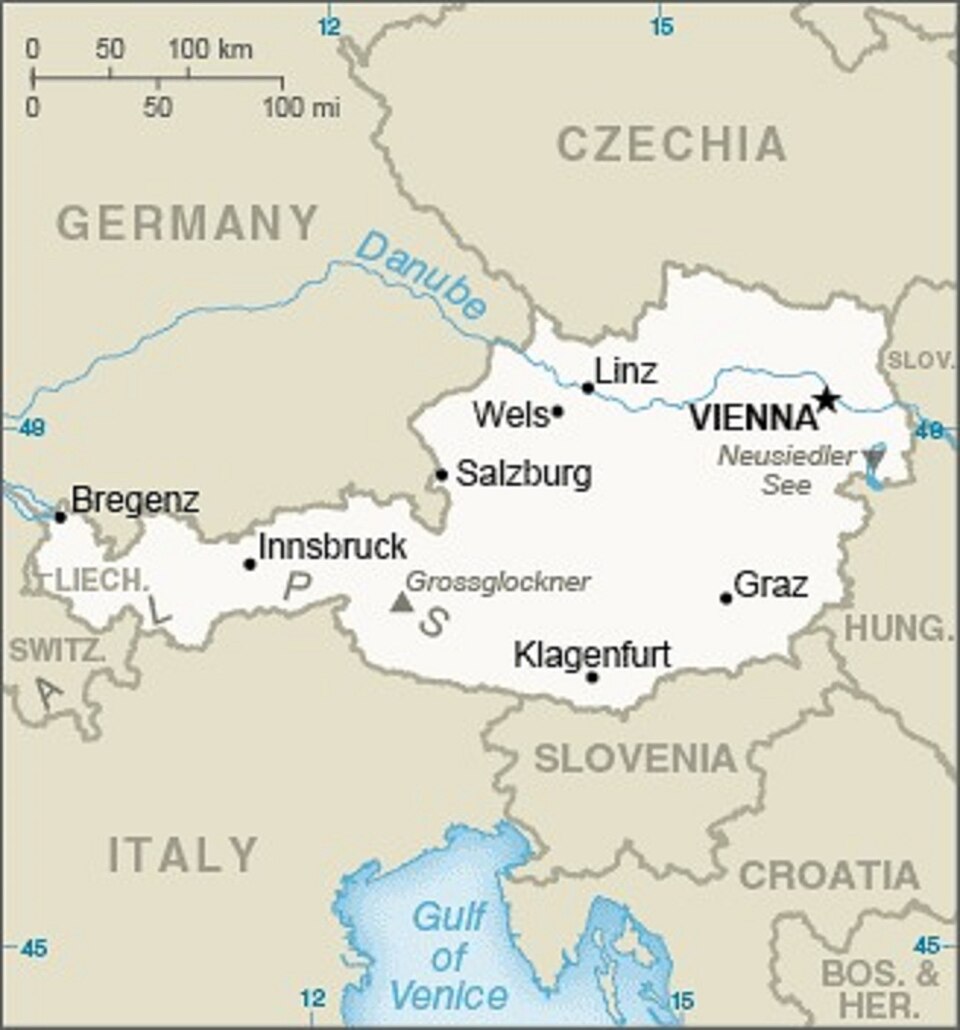
Austria (, ; ), officially the Republic of Austria (Republik Österreich ), is a country in Central Europe. Around Austria are the countries of Germany, Czech Republic, Slovakia, Hungary, Slovenia, Italy, Switzerland, and Liechtenstein.
The people in Austria speak German, a few also speak Hungarian, Slovenian and Croatian. The capital of Austria is Vienna (Wien).
History
Austria is more than 1000 years old. Its history can be followed to the 9th century. At that time, the first people moved to the land now known as Austria. The name Ostarrichi is first written in an official document from 996. Since then, that word developed into the Modern German word Österreich, which literally means “Eastern Empire.”
Ancient times
There has been human settlement in the area that is now Austria for a long time. The first settlers go back to the Paleolithic Age, the time of the Neanderthals. They left works of art such as the Venus of Willendorf. In the Neolithic Age people, lived there to dig for mineral resources, especially copper. Ötzi, a mummy found in a glacier between Austria and Italy, is from that time.
During the Bronze Age, people built larger settlements and fortresses, especially where there were mineral resources. Salt mining began near Hallstatt. At that time, Celts began to form the first states.
The Romans
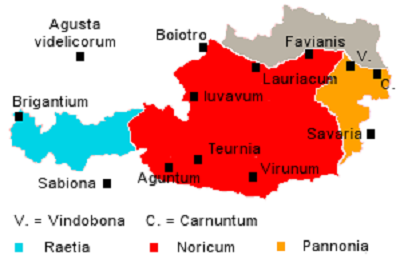
The Romans came 15 BC to Austria and made the Celtic Regnum Noricum to a Roman province. What is now Austria, was part of three provinces, Raetia, Noricum and Pannonia. The border in the north was the Danube.
Holy Roman Empire
From the Early Middle Ages, the area of modern-day Austria was part of the Holy Roman Empire. The capital of the Holy Roman Empire was the Austrian city of Vienna. The Austrian Habsburg family became the rulers of the empire, and the son of the Holy Roman Emperor held the title of Archduke of Austria.
In 1806, France defeated the Holy Roman Empire and replaced it with the Confederation of the Rhine. Former Holy Roman Emperor Francis II became the Emperor of the new Austrian Empire, which later became Austria-Hungary.
Modern history
In 1869, the first postcards were sent from Austria. Within three months, almost 3 million cards had been sold.
In 1914, Franz Ferdinand was assassinated in Sarajevo. Austria-Hungary declared war on Serbia and this led to World War I. In 1918, both Austria and Hungary became republics and split into separate countries that were much smaller tha before.
In 1938, Austria became part of Nazi Germany. However, Austrias became independent again in May 1945.
Geography
Austria is a mountainous country since it is partially in the Alps. Grossglockner is the tallest mountain in Austria. The high mountainous Alps in the west of Austria flatten somewhat into low lands and plains in the east of the country where the Danube flows.
Climate
Austria has a continental climate.
The highest temperature ever recorded in Austria was 40.5 °C (105 °F), on 8 August 2013 in Bad Deutsch-Altenburg. The lowest temperature ever recorded in Austria was -52.6 °C (-62.7 °F), on 19 February 1932 at Grünloch doline.
Politics
Austria is a democratic republic. The President of Austria is the head of state and the Chancellor of Austria is the head of government.
It is a neutral state, that means it does not take part in wars with other countries. It has been in the United Nations since 1955 and in the European Union since 1995.
Austria is also a federal state and divided into nine states ():
- Burgenland (Burgenland)
- Carinthia (Kärnten)
- Lower Austria (Niederösterreich)
- Upper Austria (Oberösterreich)
- Salzburg(erland) (Salzburg)
- Styria (Steiermark)
- Tyrol (Tirol)
- Vorarlberg (Vorarlberg)
- Vienna (Wien)
A new cabinet (Austria) was formed (February 2025). It is formed by political parties ÖVP, SPÖ, and Neos.
The chancellor is Christian Stocker since 2025. Austria has been a member-state of the United Nations since 1955, the European Union since 1995 and OPEC since 2019.
More information: States of Austria.
Music and arts
Many famous composers were Austrians or born in Austria. There are Wolfgang Amadeus Mozart, Joseph Haydn, Franz Schubert, Anton Bruckner, Johann Strauss, Sr., Johann Strauss, Jr. and Gustav Mahler. In modern times there were Arnold Schoenberg, Anton Webern and Alban Berg, who belonged to the Second Viennese School.
Austria has many artists, there are Gustav Klimt, Oskar Kokoschka, Egon Schiele or Friedensreich Hundertwasser, Inge Morath or Otto Wagner and scienc.
Food
Famous Austrian dishes are Wiener Schnitzel, Apfelstrudel, Schweinsbraten, Kaiserschmarren, Knödel, Sachertorte and Tafelspitz. But you can also find a lot of local dishes like Kärntner Reindling (a kind of cake), Kärntner Nudeln (also called “Kärntner Kasnudeln”, you may write it “…nudln” too), Tiroler Knödl (may be written “…knödel”; ), Tiroler Schlipfkrapfen (another kind of “Kärntner Nudeln”), Salzburger Nockerl (also may be written …“Nockerln”), Steirisches Wurzelfleisch (…“Wurzlfleisch”) or Sterz (“Steirischer Sterz”).
UNESCO World Heritage Sites
- Historic Centre of Salzburg — 1996
- Schönbrunn Palace — 1996
- Hallstatt–Dachstein Salzkammergut Cultural Landscape — 1997
- Semmering Railway — 1998
- Historic Centre of Graz and Schloss Eggenberg — 1999 (extended in 2010)
- Wachau Cultural Landscape — 2000
- Historic Centre of Vienna — 2001
- Lake Neusiedl — 2001
Written for younger readers
Austria, in simpler words
This version comes from Wikijunior, a set of books written for children aged 8 to 11. It is shorter and uses plainer language than the article above.
From Wikijunior: Europe
Austria is a country in Central Europe. It shares borders with Hungary, Slovakia, Czech Republic, Germany, Liechtenstein, Switzerland, Italy and Slovenia. The main language of Austria is German. The capital city is Vienna. Other big cities are Salzburg and Linz. Austria has been part of the European Union since 1995 and uses the Euro as its currency.
During history Austria has been part of Celtic, Roman, Bavarians, Slavs and Avar countries or empires. Between 1278 CE and 1914 Austria was ruled by the Habsburgs, the Austrian Royal family. The 19th century Austrian-Hungarian Empire was very powerful and covered all of today’s Austria and Hungary as well as parts or all of Poland, Czech Republic, Slovakia, Slovenia, Romania, Croatia, Italy and other countries. The huge number of ethnic groups in the empire created problems and in 1914 Archduke Franz Ferdinand was assassinated by a Bosnia-Serb in Sarajevo, the capital of present-day Bosnia (then part of the Austro-Hungarian Empire) kicking off World War I.
After World War I the empire split up. Austria’s size was reduced to more-or-less today’s size and the country was forbidden to unite with Germany. Economic and political problems continued during the 1920s and 1930s and in 1938 Austria became part of Adolf Hitler’s Third Reich. World War II crippled Austria resulting in 260,000 military deaths, 65,000 Austrian Jews killed in the Holocaust and 140,000 other Jews fled the country. Austria was officially neutral in the years after the end of the war. Since that time Austria has became a very peaceful and economically successful country and joined the European Union in 1995.
The population of Austria is 8,205,533. The total area of Austria is 32,382 sq mi (83,870 km 2 ).
About 3/4 of Austria is covered with mountains and because of this the climate varies greatly from one place to another. Some of Europe’s highest mountains, part of the Alps, are located in Austria. The highest mountain in Austria is Großglockner at 3,797 metres. In Eastern Austria the climate is average with cold winters and warm summers. The Western part of Austria’s climate changes depending on the conditions of the Atlantic Ocean. Austria is one of the countries in Europe that have the most forest land. 42 percent of the land is covered with forests. Because of this Austria has a wide variety of trees but the wildlife in Austria is scarce. Chamois, deer, and marmot are still present but the bears which used to have a large population are almost gone. Hunting is regulated to protect the remaining animals they have in the country.
The official Language of Austria is German. Other popular languages are Slovene, Croatian, and Hungarian. Most of the population’s religion is Roman Catholic. Before World War II Austria had a very large Jewish population.
In Austria you are required to go to school from the ages of 6-15. After that you have a few choices for secondary school. You can choose to go to a school that prepares you to go to a technical college for specialized training in certain areas or you can go to a general high school and receive an education which allows you to continue on to a University.
Austria is one of the world’s top tourist destinations. Austria is a great winter sports area, and has many summer music festivals and lake resorts. One of the largest tourist attractions of Austria are the Alps. Most of the tourism that comes to Austria comes from Germany. 9% of Austria’s money comes from tourism and it’s the 9th biggest country for tourism in the world. The cities of Vienna and Salzburg are popular with cultural visitors.
There are 9 UNESCO World Heritage Sites in Austria including one which is shared with other countries. These world important sites include the historical centres of Vienna, Salzburg, Graz and Schloss Eggenberg and Lake Neusiedl in the south-east of the country.
de:Wikijunior Europa/ Österreich
Where this page comes from
The article above is adapted from “Austria” on Simple English Wikipedia, by its contributors. We removed reference markers, navigation boxes and tables, expanded measurement templates into readable numbers, and kept the prose otherwise intact. The simpler version is adapted from Wikijunior on Wikibooks.
Both sources are published under CC BY-SA 4.0, so this page is published under the same licence. You may share and adapt it, including commercially, as long as you credit the original and keep the same licence.
Worksheets, answer keys and printable layouts elsewhere on K5Print are our own work and are not covered by this licence.