Azerbaijan

Fast facts
- Capital
- Baku
- Official language
- Azerbaijani
- Languages
- See full list
- Currency
- Manat (₼)
- Time zone
- AZT
- Drives on
- right
- Calling code
- +994
Facts from Wikipedia’s “Azerbaijan” page (CC BY-SA 4.0).
Azerbaijan (; officially called the Republic of Azerbaijan) is a country in the South Caucasus region of Eurasia. It borders on Russia in the north, Georgia and, Armenia in the west, Iran in the south, and the Caspian Sea on the east. Its capital city is Baku.
Azerbaijan is also a Persian word that means “guard of fire” (Persian: نگهبان آتش).
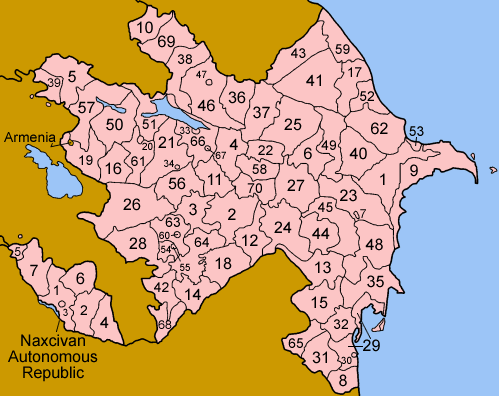
Azerbaijan also includes the Nakhchivan Autonomous Republic, an exclave between Armenia on the north and east, Iran on the south and west, and Turkey on the northwest.
Azerbaijan’s land is both in Asia and Europe. This means it is a Eurasian country. Because Azerbaijan is close to Europe and its history is related to Europe, Azerbaijan is a member of a number of European groups, including the Council of Europe since 2001. Azerbaijan has diplomatic relations with 158 countries. They have membership in 38 international organizations. On May 9, 2006 Azerbaijan was elected to membership in the newly made Human Rights Council by the United Nations General Assembly.
More than 90% of the people are ethnic Azerbaijanis. Minorities include Russians, Georgians and other minorities. The Constitution of Azerbaijan does not say there is an official religion. But, Shia Islam, is by far the largest religion in the country, followed by Sunni Islam. There are also a small number of Christians (mainly Eastern Orthodox), Jews (mainly Ashkenazi), agnostics and atheists.
History
Azerbaijan was historically part of Iran and the name of Azerbaijan comes from Atropates. He was a Persian satrap under the Achaemenid Empire.
After the Arab conquest in the 7th century the country has been always under Muslim influence, when its people became Muslim, until the Russian Empire entered the Caucasus region.
From 1920 to 1991, Azerbaijan was a Communist country, and as the Azerbaijan SSR, a member of the Soviet Union. Azerbaijan became independent from the Soviet Union when it collapsed in 1991.
Since the early 19th century many Russians settled in Azerbaijan, but after the end of the Soviet Union with the independence of Azerbaijan, most Russians and other minorities have left the country and are continuing to leave the country.
Biodiversity
There are 106 species of mammals, 97 species of fish, 363 species of birds, 10 species of amphibians and 52 species of reptiles which have been recorded and classified in Azerbaijan. The national animal of Azerbaijan is the Karabakh horse. It is a mountain-steppe racing and riding horse native to Azerbaijan. It is one of the oldest breeds, with ancestry dating to the ancient world. However today the horse is an endangered species.
Azerbaijan’s flora is more than 4,500 species of higher plants. Due the unique climate in Azerbaijan, the flora is much richer in the number of species than the flora of the other countries of the South Caucasus. About 67 percent of the species growing in the whole Caucasus can be in Azerbaijan.
Education
Many Azerbaijanis have some form of higher education, most notably in scientific and technical subjects. According to Soviet data, 100 percent of males and females (ages nine to forty-nine) were literate (able to read) in 1970. In 2009, the literacy rate in Azerbaijan was 99.5 percent.
Culture
The culture of Azerbaijan has come about as a result of many influences. Today, Western influences, including globalized consumer culture, are strong. National traditions are well kept in the country. Some of the main parts of the Azerbaijani culture are: music, literature, folk dances and art, cuisine, architecture, and movies.
Music and folk dances
Music of Azerbaijan builds on folk traditions that goes back nearly a thousand years. Among national musical instruments there are 14 string instruments, eight percussion instruments and six wind instruments.
Mugham, meykhana and Ashiq are some of the many musical traditions of Azerbaijan. Mugham is music with poetry and instrumental interludes. When performing Mugham, the singers have to bring their emotions into singing and music. Mugham singer Alim Qasimov is one of the five best singers of all time. Meykhana is a song with no music. It is usually done by several people. They make up the words about a particular subject. Ashiq joins poetry, storytelling, dance and vocal and instrumental music. It is as a symbol of Azerbaijani culture.
Azerbaijan was at the Eurovision Song Contest for the first time in 2008. They hosted the contest in 2012, in Baku.
There are dozens of Azerbaijani folk dances. They are performed at formal festivals. The dancers wear national clothes like the Chokha. Most dances have a very fast rhythm.
Architecture
Azerbaijani architecture typically joins East and West. Many ancient treasures such as the Maiden Tower and Palace of the Shirvanshahs in the Walled City of Baku survive in modern Azerbaijan. Plans have been shown for the building of the Azerbaijan Tower. It will reportedly replace the Burj Khalifa as the tallest building in the world. The planned height is 1,050 metres (3,445 ft).
Movies
The movie industry in Azerbaijan dates back to 1898. In fact, Azerbaijan was among the first countries involved in making movies. In 1991, after Azerbaijan gained its freedom from the Soviet Union, the first Baku International Film Festival East-West was held in Baku.
Food
The traditional food is famous for many vegetables and greens used seasonally in the dishes. Fresh herbs, including mint, cilantro (coriander), dill, basil, parsley, tarragon, leeks, chives, thyme, marjoram, green onion, and watercress, are very popular. They are often served with main dishes on the table. National dishes show the variety of the landscape. They are based on fish from the Caspian Sea, local meat (mainly mutton and beef), and the many seasonal vegetables and greens. Saffron-rice plov is the flagship food in Azerbaijan and black tea is the national beverage.
Literature
The earliest known person in Azerbaijani literature was Hasanoghlu or Pur Hasan Asfaraini. He made a divan of Persian and Turkic ghazals. Classical literature in Azerbaijani was formed in 14th century. Among the poets of this period were Gazi Burhanaddin and Haqiqi. The famed Book of Dede Korkut has two manuscripts copied in the 16th century. It is a collection of 12 stories showing the oral tradition of Oghuz nomads.
In the span of the 17th century and 18th century, Fizuli’s unique types as well Ashik poetry were taken up by poets and writers such as Qovsi of Tabriz and Shah Abbas Sani.
The first newspaper in Azerbaijani, Akinchi was published in 1875.
Sports
Sport in Azerbaijan is very old. Even now, both traditional and modern sports are still practiced. Freestyle wrestling has been traditionally said to be Azerbaijan’s national sport. The most popular sports in Azerbaijan are football and chess. The national football team does not do well in international competitions. On March 19, 2010, Azerbaijan won the bid to host the 2012 FIFA U-17 Women’s World Cup.
Futsal is another popular sport in Azerbaijan. Azerbaijan national futsal team got fourth place in 2010 UEFA Futsal Championship.
Backgammon plays a major role in Azerbaijani culture. This game is very popular in Azerbaijan and is widely played by the local public.
Demographics
Out of 9,165,000 people (July 2011), nearly 52% were urban. The remaining 48% were rural. 51% of the people were female.
About 3 million Azerbaijanis, many of them guest workers, live in Russia.
The biggest reason for death in 2005 was from respiratory diseases.
Divisions
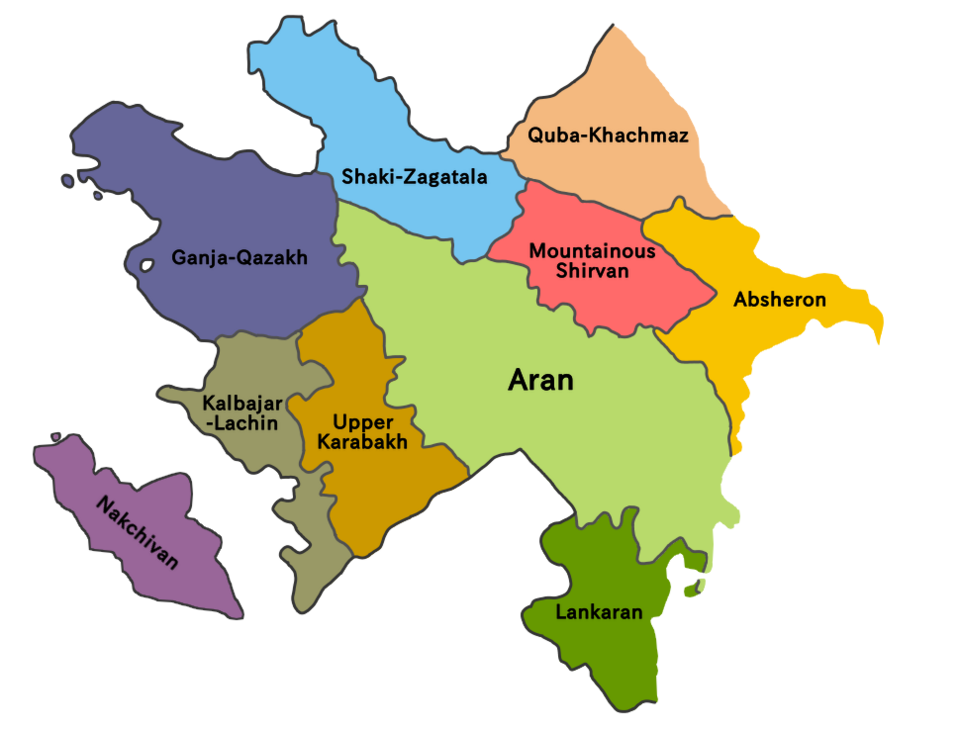
Azerbaijan is divided into 10 economic regions; 66 rayons and 77 cities. 11 cities are under the direct authority of the republic. Azerbaijan includes the Nakhchivan Autonomous Republic. The President of Azerbaijan picks the governors of these units. The government of Nakhchivan is elected and approved by the parliament of Nakhchivan Autonomous Republic.
Absheron (Abşeron)
Baku (Bakı)
Khizi (Xızı)
Sumqayit (Sumqayıt)
Aghjabadi (Ağcabədi)
Aghdash (Ağdaş)
Barda (Bərdə)
Beylagan (Beyləqan)
Bilasuvar (Biləsuvar)
Goychay (Göyçay)
Hajigabul (Hacıqabul)
Imishli (İmişli)
Kurdamir (Kürdəmir)
Mingachevir (Mingəçevir)
Neftchala (Neftçala)
Saatly (Saatlı)
Sabirabad (Sabirabad)
Salyan (Salyan)
Shirvan (Şirvan)
Ujar (Ucar)
Yevlakh (Yevlax)
Yevlakh (Yevlax)
Zardab (Zərdab)
Aghsu (Ağsu)
Gobustan (Qobustan)
Ismailly (İsmayıllı)
Shamakhy (Şamaxı)
Aghstafa (Ağstafa)
Dashkasan (Daşkəsən)
Gadabay (Gədəbəy)
Ganja (Gəncə)
Gazakh (Qazax)
Goygol (Göygöl)
Goranboy (Goranboy)
Naftalan (Naftalan)
Samukh (Samux)
Shamkir (Şəmkir)
Tovuz (Tovuz)
Guba (Quba)
Gusar (Qusar)
Khachmaz (Xaçmaz)
Shabran (Şabran)
Siyazan (Siyəzən)
Gubadly (Qubadlı)
Kalbajar (Kəlbəcər)
Lachin (Laçın)
Zangilan (Zəngilan)
Astara (Astara)
Jalilabad (Cəlilabad)
Lankaran (Lənkəran)
Lankaran (Lənkəran)
Lerik (Lerik)
Masally (Masallı)
Yardimly (Yardımlı)
Babek (Babək)
Julfa (Culfa)
Kangarli (Kəngərli)
Nakhchivan (Naxçıvan)
Ordubad (Ordubad)
Sadarak (Sədərək)
Shahbuz (Şahbuz)
Sharur (Şərur)
Balakan (Balakən)
Gabala (Qəbələ)
Gakh (Qax)
Oghuz (Oğuz)
Shaki (Şəki)
Shaki (Şəki)
Zaqatala (Zaqatala)
Aghdam (Ağdam)
Fuzuli (Füzuli)
Jabrayil (Cəbrayıl)
Khankendi (Xankəndi)
Khojaly (Xocalı)
Khojavend (Xocavənd)
Shusha (Şuşa)
Shusha (Şuşa)
Tartar (Tərtər)
Note: The cities under the direct authority of the republic in italics.
Economy
The economy of Azerbaijan is based on industry, agriculture, and on services including tourism. The energy sector based on the large reserves of crude oil and natural gas, is the main source of economic growth in Azerbaijan today, though half of the Azerbaijani people earn their income directly or indirectly through services and a third earn their income through agriculture. The energy boom has led to massive foreign direct investment and the growth rate of the Azerbaijani economy is one of the world’s highest.
After gaining independence in 1991 with the end of the Soviet Union, Azerbaijan made the long and difficult change from a command economy to a market economy. The government has largely completed privatization of agricultural lands and small, medium and large state-owned companies. Azerbaijan is continuing making economic reforms, and old economic ties and structures have been slowly replaced. With independence, Azerbaijan became a member of the International Monetary Fund, the World Bank, the European Bank for Reconstruction and Development, the Islamic Development Bank and the Asian Development Bank. Azerbaijan’s currency is the Azerbaijani manat (AZN) which is divided into 100 qəpik. It became the national currency in 1992 and replaced the old Soviet ruble. The Central Bank of Azerbaijan was created in 1992. The Central Bank serves as Azerbaijan’s central bank, and is responsible for printing and distributing the national currency, the Azerbaijani manat, and to control all commercial banks.
General information
- Azerbaijan International
- Heydar Aliyev Foundation
- Azerbaijan at University of Colorado at Boulder
- Country profile from BBC
Major government resources
- President of Azerbaijan website
- Azerbaijan State Statistical Committee
- United Nations Office in Azerbaijan
Major news media
- Azerbaijan Today
- Azerbaijan Press Agency
- Trend News Agency
- News.Az
Tourism
- Azerbaijan Tourism Portal
Written for younger readers
Azerbaijan, in simpler words
This version comes from Wikijunior, a set of books written for children aged 8 to 11. It is shorter and uses plainer language than the article above.
From Wikijunior: Asia
Azerbaijan (Azerbaijani: Azərbaycan) is a country in Eurasia. Azerbaijan was known as “Caucasian Albania” in ancient times. The name, “Azerbaijan”, is widely believed to have originated from the Arabicized form of the old Persian word, “Atropatakan” (aka Atropatena or Atropatene) - the country of Atropatos”.
Azerbaijan was an independent nation from 1918 to 1920 but was then part of the Soviet Union. It became a constituent (union) republic in 1936. Azerbaijan declared sovereignty on September 23, 1989, and independence on August 30, 1999 (after the fall of the Soviet Union). Since 1991, Azerbaijan has been involved in a heated struggle with Armenia for the autonomous (self-govern) Nagorno-Karabakh region, which is officially considered part of Azerbaijan yet is populated mostly by ethnic Armenians.
Azerbaijan is also known for its distinctive traditional exports of fine horses and caviar.
The currency of Azerbaijan is the Azerbaijani manat & the current president of Azerbaijan is Ilham Aliyev (since October 2003).
Azerbaijan is a country located in the South Caucasus region of Eurasia. It is located in the Eurasian region bordering north to Russia and Georgia, west to Armenia and Turkey, and south toIran. Bordering to the east is the Caspian Sea, the largest lake in the world by surface area & the largest enclosed body of water on Earth.
The capital city of Azerbaijan is Baku (or Bakı in Azerbaijani). It is the largest city in the country and is located next to the Caspian Sea.
According to a 2023 estimate, Azerbaijan’s population stands at 10,420,515 people. An estimated population of 91.6% are Azerbaijani natives, 2.0% are Lezgis, 1.3% are Armenians, 1.3% are Russians, 1.3% are Talyshs, and 2.4% of other minorities group (2009 census). The Nagorno-Karabakh region is populated by mostly ethnic Armenians.
Azerbaijani, also called the Azeri, is the most widely spoken language in Azerbaijan. 93% of the population speaks Azeri. In modern times, the Azerbaijani alphabet has 32 letters, which is very similar to Latin letters except the following: ç, ə, ğ, ő, ş, ü.
It is a Turkic language, which means that it is related to languages such as Turkish, Kazakh, and Uzbek.
The Azerbaijani language has had a couple of major changes throughout history, where the Arabic script was introduced in the 7th century and was used until the early half of the 20th century. Movements aiming to reform the Azerbaijani alphabet are what caused the abolishment of the Arabic alphabet. In 1929, a new alphabet system based on the Latin script was introduced. This alphabet was used for Azerbaijani until 1939. The Cyrillic alphabet, Yanalif (new alphabet), was introduced by the Soviet Union. After independence, the Azerbaijani government switched Azerbaijani from the Cyrillic alphabet to the Latin alphabet.
There are 2 distinct branches of Azerbaijani languages, namely the north Azerbaijani branch and the south Azerbaijani branch. They are sometimes classified as separate languages, although there is a fair degree of understanding between them.
North Azerbaijani is spoken in Azerbaijan, where it is the official language. It is also spoken in southern Dagestan (a republic of Russia), in the southern Caucasus Mountains, and in parts of Central Asia. The alphabet is based on the Latin alphabet.
South Azerbaijani is spoken mainly in the northwestern portion of Iran, where it is known as تورکی (Türki), and in parts of Iraq, Turkey, Afghanistan and Syria. It is written with a version of the Arabic script and is known as Azeri Turk in Iran.
According to a 2021 census, the most common religion practiced is Islam (96%), with 65% being Shia Muslims and 35% being Sunni Muslims. The remaining 4% are minority Christian sects, such as Russian Orthodox, Georgian Orthodox, and Armenian Apostolic. The ethnic Azerbaijanis mostly practice Islam, while the Christian sects constitute the minority ethnic population.
The national sport of Azerbaijan is chovgan. Chovgan shares resemblances to polo and is played on horseback. The sport’s name comes from a type of curved stick traditionally used to catch sheep.
The sports’ rules are as follows: The game is made up of horse riders who are divided into two teams. Each team gets on horseback and tries to score more goals than its opposing team.
The entire game is divided into 2 half-times. The duration of the game consists of six periods lasting 7 minutes. Each time period is called a “chukka” or “chukker”.
To initiate the game, each team’s players remain on their horses in a uniformed row behind a middle line in the middle of the field. Then, the referee throws the ball in between the two teams to begin the game (approximately 6.5 meters away from each team). Players begin riding towards the ball, trying to get the ball in the other team’s net. If the other team commits a foul or a break has begun between the two “chukkas”, the game is momentarily paused.
The most popular sport in Azerbaijan is football (or soccer).
The Palace of Shirvanshahs (The King of Shirvans, a royal title used during the medieval Islamic period) is an elegant palace located in Baku, Azerbaijan. It is composed of several distinct sections, the divanhane (main reception hall), the shah’s mosque accompanied by a minaret, the tomb of Seyid Yahya Bakuvi (a 15th-century Azerbaijani philosopher), a portal in the eastern sphere of the palace known as Murad’s Gate, a reservoir (a large ovdan that provided drinking-water) and the remnants of the bath-house.
In the 15th century, the Shirvanshah dynasty moved the country’s capital from Shemakha to Baku. The palace’s construction was done under Shirvanshah Ibrahim I, who ruled from 1411 to 1465, in the new capital. During his rule, the palace was used as a royal residence, center of government, and center of culture. Located in the inner city of Baku, it proved to be the perfect place for the king to rule over his domain. The multi-building complex would’ve been a great abode for the king, containing a mosque, a private hammam (bath), and a large cistern (water tank).
As of 2023, the palace is a recognized UNESCO World Heritage Site.
The Maiden Tower is a round bastion tower. The tower is made of red brick and contains only one entrance, located right below the face of the tower. Once inside, the tower shows its spiral yet narrow staircase that leads to the top. Inside the tower, the central, cylindrical void is divided by shallow vaults into eight floors, each containing a single room. Once one goes up to the top of the tower, a ravishing view of Baku awaits.
Built in the 12th century, the tower was originally built on the shores of the Caspian Sea. Due to land reclamation (the process of making more land artificially), the tower is no longer within the eyesight of the Caspian Sea. It originally served as a watch tower. The importance of the Maiden Tower is evident in the country’s currency notes, where it makes a noticeable appearance. The Azer name, Qiz Qalasi, contains a fascinating tale behind its unique name.
Legend says that a foreign prince fell in love with an Azerbaijani king’s daughter & wanted to marry her. The princess was not on the same page as the prince, so she instructed her father to build the biggest tower he could build in order to delay the wedding. When the tower completed construction, the princess rose up the tower, taking in the breathtaking view of the sea, and threw herself into the passing waves crashing against the tower walls.
The Gobustan Rock Art is a showcase of ancient artistic brilliance. It is a vast area of rocky outcrops covered in prehistoric rock art, including petroglyphs (rock carvings made by pecking away from the surface of the rock), pictograms (a picture that serves as a symbol), and geoglyphs (a large drawing made on the earth floor). The rock art dates back to the Upper Paleolithic period and provides a cool glimpse into the lives & culture of the people who inhabited the Gobustan region over 40,000 years ago.
The rock art shows a lot of subjects, including hunting, fishing, animal husbandry, and religious ceremonies. Other depictions include animals, such as bulls, goats, and deer. The art is surprisingly detailed and provides a lot of information about the people who lived in Gobustan.
The petroglyphs were accidentally discovered by stone quarry workers in the 1930s. In 1939, a group of Azerbaijani archaeologists began the first archeological study of rock art. From 1940 to 1965, various archeological teams identified and documented approximately 3,500 individual rock paintings on 750 different rocks. The most ancient petroglyph goes back to the 8th century BC.
Where this page comes from
The article above is adapted from “Azerbaijan” on Simple English Wikipedia, by its contributors. We removed reference markers, navigation boxes and tables, expanded measurement templates into readable numbers, and kept the prose otherwise intact. The simpler version is adapted from Wikijunior on Wikibooks.
Both sources are published under CC BY-SA 4.0, so this page is published under the same licence. You may share and adapt it, including commercially, as long as you credit the original and keep the same licence.
Worksheets, answer keys and printable layouts elsewhere on K5Print are our own work and are not covered by this licence.