Bahrain

Fast facts
- Capital
- Manama
- Official language
- Arabic, English
- Currency
- Bahraini dinar
- Time zone
- AST
- Drives on
- Right
- Calling code
- 973
Facts from Wikipedia’s “Bahrain” page (CC BY-SA 4.0).
Bahrain (officially called Kingdom of Bahrain) is an island country in the Persian Gulf. Saudi Arabia is to the west and is connected to Bahrain by the King Fahd Causeway, and Qatar is to the south across the Persian Gulf. The Qatar-Bahrain Friendship Bridge, not yet built, will link Bahrain to Qatar as the longest fixed bridge in the world. Qatar and Bahrain’s flag is the same design but not the same colors because Qatar is white and maroon and Bahrain is white and red and also the number of spikes varies in the flags of these countries.
History
People have lived in Bahrain before there was writing. It has been ruled and influenced by the Assyrians, Babylonians, Greeks, Persians, and the Arabs, who made the island Muslim. Bahrain was in old times known as Dilmun, Tylos, Awal and Mishmahig.
The islands of Bahrain, set in the middle south of the Persian Gulf, have attracted many invaders in history. The word Bahrain, “Two Seas”, means that the islands contain two kinds of water, sweet water springs and salty water in the sea.
A location between East and West, fertile lands, fresh water, and pearls made Bahrain important in history. About 2300 BC, Bahrain started trading with Mesopotamia (now Iraq) and the Indus Valley (now near India). It was then called Delmon, and was linked to the Sumerian Civilization about 2000 BC. Bahrain also became part of the Babylonian empire about 600 BC. Historical records called Bahrain the “Life of Eternity”, “Paradise”, the “Pearl of the Persian Gulf” and other names.
Until 1521, Bahrain also ruled Al-Hasa and Qatif (both are now the eastern province of Saudi Arabia) and Awal (now the Bahrain Islands). The country had all of the land from what is now Kuwait to Oman. This was called Iqlim Al-Bahrain (Province of Bahrain). In 1521, the Portuguese took Awal (now Bahrain) from the rest and since then the name of Bahrain only means today’s Bahrain.
Modern history
The modern history of Bahrain begins with Great Britain exploring the area, trying to keep Iran from taking more land. The British gave support to the Al-Khalifa family, who made a power base in the island and allied with the British to keep the island from Iran. The British got free passage to the Persian Gulf through this agreement. In November of 1957, the Iranian parliament declared that Bahrain was the Fourteenth Province of Iran. Later the British would become involved in the politics of Bahrain by choosing an Emir of the island. Iran and Britain later agreed that the United Nations Secretary General would judge the political situation in Bahrain. In a Plebiscite to decide the country’s future, the majority of the people of Bahrain chose to reject Iran’s claims, and to define their country and their culture to be Arabic, and not Persian.
Oil was found in the early 20th century and brought modern improvements to the country. Relations with the United Kingdom also became closer, and the British brought more military bases to the nation. British influence grew, until Charles Belgrave became an advisor; Belgrave brought modern education to Bahrain.
After World War II, anti-British feeling spread through the Arab world and led to riots in Bahrain. The British withdraw from Bahrain in 1971. The sales of more oil in the 1980s brought money to Bahrain, but even when the sales of oil decreased in later years, it did not cause as many problems in Bahrain as in other oil countries, because the economy of Bahrain had grown into other areas.
In 1973 the election of first parliament was done but the government stopped & dissociate the parliament in 1975 which result in strong protests by the Bahraini opposition (Moderate Islamic & non-Islamist opposition).
In 1994, many highly educated Bahraini people signed a letter to Prince of Bahrain at that time Isa bin Salman Al Khalifa to re-establish the parliament life which is strongly refused & the leader of the opposition at that time Sheikh Abdulamir Aljamri was jailed then a huge protest & conflicts occurs between Bahraini nation & the armed forces.
In 1999, Sheikh Hamad bin Isa Al Khalifa followed his father as head of state and called for elections for parliament to resolve the congestion that occurred over that last period. The women were given the right to vote and the new ruler released all political prisoners in 2001.
In 2002 the King released a new constitution without any voting from the nation & canceled 1973 constitution which caused strong refuse from the most of nation parties & opposition. The situations became worse later & some of political activists were jailed like Abdulhadi Al-Khuwajah, Hasan Mushaima.
Many political websites that refused these changes were blocked like Bahrain online forum (the most popular website in Bahrain): www.bahrainonline.org; Until 2009 there were many riots & conflicts especially from Shia group which faces a huge organized discrimination according to Human Rights Watch & US Congress.
In 2023, Around 700-1000 political detainees in Bahrain begin a hunger strike demanding an end to solitary confinement, access to medical care and religious freedom (right to pray together in groups). A large number of Bahrainis came on streets of Manama in support of prisoners. The hunger strike was suspended after a week as the Bahraini officials agreed to the demands but many prisoners went back to hunger strike again the next day itself, as they say none of the demands were fulfilled.
Politics
Bahrain is a constitutional monarchy ruled by the King, Shaikh Hamad bin Isa Al Khalifa. The head of government is the Prime Minister, which is currently held by Crown Prince Salman bin Hamad bin Isa Al Khalifa. Shaikh Khalifa bin Salman Al Khalifa was the country’s first prime minister from 1971 until his death in 2020. The prime minister has a cabinet of 15 members.
Bahrain has a bicameral legislature with a lower house, the Chamber of Deputies, elected by all of the people and the upper house, the Shura Council, appointed by the King. Both houses have forty members. The first elections were held in 2002, with Members of Parliament serving four year terms.
Women were given the right to vote and stand in national elections for the first time in 2003 election, but no women were elected to office that year, and Shia and Sunni Islamists won a majority of seats. Because no women were elected, six were appointed to the Shura Council, which also includes members of the Kingdom’s Jewish and Christian people.
The King recently created the Supreme Judicial Council to organise the country’s courts and the government offices.
Governorates
Bahrain is split into five governorates. Until July 3 2003, it was divided into twelve municipalities.
- Capital
- Central
- Muharraq
- Northern
- Southern
For further information, see: Decree-Law establishing governorates from the Bahrain official website.
Cities
The largest cities in Bahrain are:
- Manama - 154,700
- Riffa - 111,000
- Muharraq - 98,800
- Hamad Town - 57,000
- A’ali - 51,400
- Isa Town- 39,800
- Sitra - 37,100
- Budaiya - 33,200
- Jidhafs - 32,600
- Al-Malikiyah - 14,800
- Adliya
Other towns include: Awali, Diraz, Hidd, Sar, Bani Jamrah.
Economy
In Bahrain, petroleum (oil product) producing and processing is about 60% of the money from export, 60% of government money, and 30% of Gross Domestic Product. The economy has changed as the sales of oil have changed since 1985, for example, during and after the Persian Gulf War of 1990 - 1991. Bahrain has high quality communications and transport, and so the country is home to many international companies with business in the Persian Gulf. A large part of the country’s income comes from petroleum products made from imported crude oil. There are several major industrial projects being built. Unemployment, especially among young people, and the decrease of both oil and water resources are major economic problems.
Geography
Bahrain is a flat and dry archipelago, with a low desert plain rising gently to a low central hill, in the Arabian Gulf, east of Saudi Arabia. The highest point is the 122 meter Jabal ad Dukhan (“Mountain of Smoke”).
Bahrain has a total area of 620 km², which is a few square kilometres larger than the Isle of Man. As an archipelago of 33 islands, Bahrain does not share a land border with any other country, but it does have a 161 km coast line and claims a further 12 nm of territorial sea and a 24 nm contiguous zone. Bahrain enjoys mild winters and has very hot, humid summers.
Bahrain’s natural resources include large amounts of oil natural gas as well as fish. Only 1% of the country includes land where crops can be grown. 92% of Bahrain is desert, and droughts and dust storms are the main natural dangers.
Environmental problems in Bahrain include desertification, which is causing the land where crops can be grown to decrease, and damage to coast lines, coral reefs, and sea vegetation caused by oil spills from large tankers and oil refineries.
About the people
The official religion of Bahrain is Islam; most of the people are Shi’a and Sunni Muslims, but there are also small Jewish and Christian minorities. Most Bahrainis are Arabs, although some tribes came from Persia. Today, many of the people in Bahrain are guest workers who come from Iran, South Asia and Southeast Asia. A Financial Times article from 31 May 1983 found that “Bahrain is a polyglot (speaking many languages) state, both religiously and racially. Leaving aside the temporary immigrants of the past 10 years, there are at least eight or nine communities (groups of people) on the island”.
The present communities may be classified as Al-Khalifa, Arab tribes allied to Al-Khalifa, the Baharnah (Shia Arabs), the Howilla (Sunni Arabs from Persia), Sunni Arabs (from the mainland), Ajam (Persian Shia), Indians who traded with Bahrain and settled before the age of oil (used to be called Banyan), a tiny Jewish community, and a group which contains everyone else.
Culture
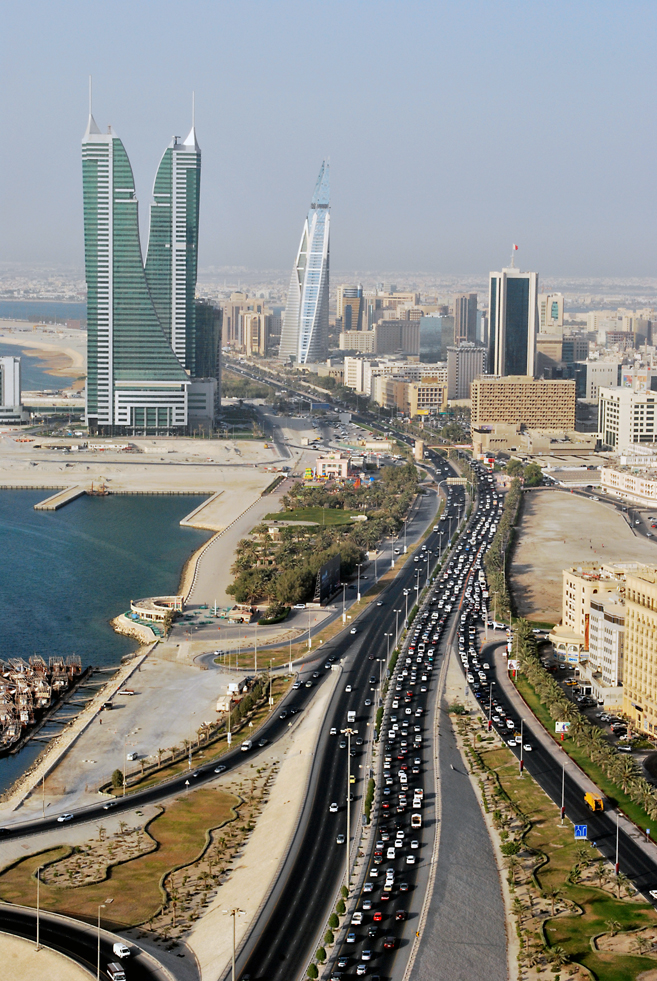
Manama, Bahrain’s capital city, is as modern as other cities in the world. But life in the island’s many villages (and in parts of Manama itself) remains traditional. Where there is tradition in the Persian Gulf area, there is Islamic conservatism: women cover themselves from head to foot and women travellers are expected to wear long skirts and one-piece bathing suits. Bahrain’s population is 85% Muslim and Islam is the state religion. Arabic is the official language, but many people speak English.
Traditional folk art continues in several places around Bahrain: dhows (fishing boats) are built near Manama and Muharraq, cloth is made at Bani Jamrah and pottery is made at A’ali. A few goldsmiths still work in the Manama souk, though much of the work is now done in other countries. One of the important parts of Bahraini culture is the drinking of traditional Arabian coffee. Traditional Arabian street food like shawarma (lamb or chicken cut from a large spit and served in pita bread) and desserts such as baklava are also found.
Formula One
Bahrain is the home of Formula One racing in the Middle East, hosting the Bahrain Grand Prix.
Written for younger readers
Bahrain, in simpler words
This version comes from Wikijunior, a set of books written for children aged 8 to 11. It is shorter and uses plainer language than the article above.
From Wikijunior: Asia
Bahrain (Arabic: البحرين al-Baḥrayn, “Two Seas”), officially the Kingdom of Bahrain, is widely believed to be the site of the ancient kingdom of Dilmun, a commercial centre that traded with the ancient Sumer civilization. The name, Bahrain, is from the Arabic term al-baḥrayn, meaning “two seas.” This is thought to refer to the two different water sources on the island: the inland spring waters and the saltwater coasts. It may also refer to the two coasts off the island: the north coast facing the Persian coast and the south coast across the water from Saudi Arabia.
During the Dilmun kingdom, Bahrain was famous for its shiny pearls. Thanks to the work of Muhammad, Bahrain came under Arab Islamic rule for centuries until the Portuguese ruled briefly from 1521-1602. The Portuguese were kicked out of Bahrain by the Iranians. In 1783, the Bani Utbah clan, a clan of Arab tribes, captured Bahrain from the Iranians and the same Al Khalifa family has been ruling the kingdom to this day!
The Bahrain currency is Bahraini Dinar and the current king of Bahrain is Hamad bin Isa Al Khalifa (since 2002).
Bahrain is a small island country in the Persian Gulf. Bahrain is neighboring to the west of the United Arab Emirates and to the east of Qatar. It is connected to Saudi Arabia by the King Fahd Causeway.
It has a total area of 760 square kilometers and is made up of 50 natural islands and an additional 33 man-made islands. Bahrain Island, the largest island in the country, makes up about 83 percent of the country’s landmass.
The capital city of Bahrain is Manama. It is the largest city in the country and is located on the northeastern coast of Bahrain Island.
According to the official census in 2014, there are about 1.36 million people living in Bahrain. The population growth percentage is 7.4% (avg).
The common language spoken in Bahrain is modern standard Arabic, a modernized form of classical Arabic. It is used in schools and is used in written communication with the Arabic-speaking international community. However, English is widely used and a compulsory second language at all schools. Persian is also common, although it is spoken mostly at home. A number of other languages spoken among expatriates include Urdu, Hindi, and Tagalog.
Overall, 70.2% population is predominately Muslim and includes both the Sunni and the Shīʿite sects, with the latter in the majority. The ruling family and many of the wealthier and more influential Bahrainis are Sunni. The rest of the population falls into Christianity, Judaism, Hinduism, the Bahá’í Faith, Buddhists, and Sikhs. An overwhelming majority of native Bahrainis are Muslim, with a few being Christians, Jews, Bahá’ís, and Sikhs.
Horse racing is a national pastime sport in Bahrain as horses are a significant part of Bahraini culture. Horse racing is a competitive, equestrian sport where two or more horses, ridden by jockeys, are put for race in a numbered set of laps at a race course.
There are more than 20 types of Arabian horses that are bred on the islands, and races are held weekly on Bahrain island’s large racecourse. The race course consists of two grass tracks measuring about 2,400 meters with a straight of 1200 meters and one sand track. The racecourse can hold about 10,000 spectators and has stables for 300 horses.
Tree of Life is a 500-year-old tree standing alone about 2 km (1.24 miles) away from Jebel-al. The reason why this tree is so special is because it is located in the midst of the desert without any source of water nearby! Local inhabitants believe that the tree marks the location of the Garden of Eden (biblical paradise) and the tree’s longevity has been sustained by the mythical God of water, Enki. In scientific reasoning, botanists concur that its roots go super deep and wide to get water from reserves located many kilometers away. Talk about dedication!
Qal’at al-Bahrain (Arabic: قلعة البحرين) is an ancient fort that sits atop an artificial hill. It used to be the capital of the ancient Dilmun culture. Its archaeological site comprises four main elements: an archaeological tell (an artificial hill formed over time by successive occupations) of over 16 hectares, immediately adjacent to the northern coast of Bahrain, a sea tower around 1600m northwest of the tell, a sea channel of just <16 hectares through the reef near the sea tower, and a number of groovy palm-groves. It is a recognized UNESCO World Heritage Site since it is one of the best-preserved sites of the ancient Dilmun culture that we have to this day.
Al Fateh Grand Mosque (Arabic: مسجد الفاتح) is a big mosque located right in the capital! The center hosts a mosque, an Islamic library, and a section that dwells in the teachings of the Qur’an. It stands as one of the largest mosques in the world with its ability to host over 7,000 worshippers! The mosque was constructed and finally revealed to the public in 1988 by Sheikh Isa ibn Salman Al Khalifa (the current king’s father). The name of the mosque, “Al-Fateh”, is a sign of deep respect to the founder of Bahrain, Ahmed Al-Fatah (or Ahmed the Conqueror). The mosque is built from concrete and fiberglass, with the mosque holding the record of having the world’s largest fiberglass dome.
Where this page comes from
The article above is adapted from “Bahrain” on Simple English Wikipedia, by its contributors. We removed reference markers, navigation boxes and tables, expanded measurement templates into readable numbers, and kept the prose otherwise intact. The simpler version is adapted from Wikijunior on Wikibooks.
Both sources are published under CC BY-SA 4.0, so this page is published under the same licence. You may share and adapt it, including commercially, as long as you credit the original and keep the same licence.
Worksheets, answer keys and printable layouts elsewhere on K5Print are our own work and are not covered by this licence.