Belarus

Fast facts
- Official language
- Belarusian Russian
- Languages
- Belarusian, Russian
- Capital
- Minsk
- Currency
- Belarusian ruble
- Time zone
- FET
- Drives on
- right
- Calling code
- 375
Facts from Wikipedia’s “Belarus” page (CC BY-SA 4.0).
Belarus (officially called Republic of Belarus) is a country in Eastern Europe. About nine million people live there. Its capital is Minsk. It was part of the Soviet Union until 1991. The president of Belarus has been Alexander Lukashenko since 1994. It is bordered by Russia, Ukraine, Poland, Lithuania and Latvia. Over forty percent of its 207,600 square kilometres is forested.
The State is a member of the UN, the CIS, Collective Security Treaty Organization, the Eurasian Economic Community, the Union State of Russia and Belarus (from 2 April 1997), as well as a member of other international organizations.
Until the 20th century, the lands of modern-day Belarus belonged to several countries. These included the Principality of Polotsk, the Grand Duchy of Lithuania, the Polish–Lithuanian Commonwealth, and the Russian Empire. After the Russian Revolution, Belarus became part of the Soviet Union. It was renamed the Byelorussian Soviet Socialist Republic (BSSR). The borders of Belarus took their modern shape in 1939. Some lands occupied by Poland in 1921 were added into it after 1939. The nation and its territory were devastated in World War II. Belarus lost about a third of its population and more than half of its economic resources. In 1945 the Belorussian SSR became a founding member of the United Nations, along with the Soviet Union and the Ukrainian SSR.
The parliament of the republic declared the sovereignty of Belarus on 27 July 1990. During the dissolution of the Soviet Union, Belarus became independent on 25 August 1991.
Over 70% of Belarus’s population of 9.49 million live in the urban areas. More than 80% of the population are ethnic Belarusians. Most of the rest are Russians, Poles and Ukrainians. The country has two official languages: Belarusian and Russian. The main religion in the country is Russian Orthodox Christianity. The second most popular, Roman Catholicism, has a much smaller following.
Prior to First World War
Both Homo erectus and Neanderthal remains have been found in the region. From 5,000 to 2,000 BCE, Bandkeramik cultures lived here. Cimmerians were in the area by 1,000 BCE. By 500 BCE, Slavs moved in. The Huns and Avars came through around 400–600 CE. They were unable to move the Slavs.
The region that is now Belarus was first settled by Slavic tribes in the 6th century. They came into contact with the Varangians, who were bands of Scandinavian warriors and traders. They formed Kievan Rus’ in 862. Polotsk and Turov become the capitals of the first principalities of today’s Belarus.
When Kievan Rus’ ruler Yaroslav I the Wise died, the state split. Later some were added into the Grand Duchy of Lithuania. Lithuania made a union with Poland. The union ended in 1795. The land of Belarus went to the Russian Empire. The land stayed with Russia until going to the German Empire during World War I.
Since initial independence
Belarus said they were free from Germany on 25 March 1918. They formed the Belarusian People’s Republic. Then the Polish–Soviet War started. A part of Belarus under Soviet rule became the Belorussian Soviet Socialist Republic in 1919. Then it added to the Lithuanian–Belorussian Soviet Socialist Republic. The Belorussian SSR became a founding member of the Union of Soviet Socialist Republics in 1922. The western part of modern Belarus stayed part of Poland as a result of the Treaty of Riga.
In BSSR Byelorussian language was officially recognized together with Russian, Polish and Yiddish. A motto “Workers of all countries, unite” was written on all of this 4 languages on the republican emblem. Schools with teaching on the national languages began operating.
In 1939, Nazi Germany invaded Poland. This was the beginning of World War II. After Polish powers left the county, the Soviet troops entered into lands with Ukrainian and Byelorussian majority, that were controlled by Poland before it. Parts of West Byelorussia were added to the Belorussian Soviet Socialist Republic. They are now West Belarus.
Nazi Germany invaded the Soviet Union in 1941. BSSR was the hardest-hit Soviet republic in World War II. During that time, Germany destroyed 209 out of 290 cities in the republic, 85% of the republic’s industry, and more than one million buildings. Casualties were between two and three million. The population of Belarus did not come back to its pre-war level until 1971.
In 1986, the Belorussian SSR had nuclear fallout from the explosion at the Chernobyl power plant in neighboring Ukrainian SSR.
Belarus said it was free on 27 July 1990. With the support of the Communist Party, the country’s name was changed to the Republic of Belarus on 25 August 1991.
Belarus helped Russia in the Russian invasion of Ukraine. At the start of the invasion, Belarus let Russian soldiers go through the country into Ukraine, giving them a faster way to get to the city of Kyiv.
Geography
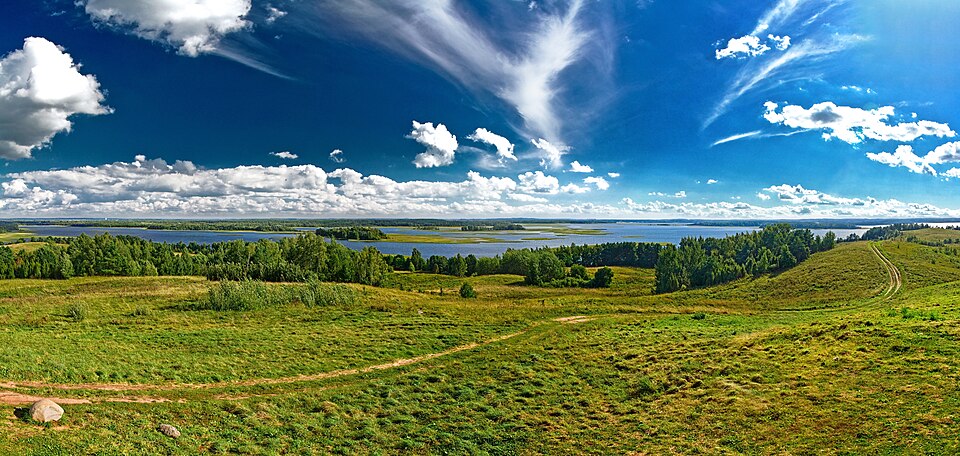
Belarus is landlocked and mostly flat. It has a lot of marshy land. Many streams and 11,000 lakes are found in Belarus. Three major rivers run through the country: the Neman, the Pripyat, and the Dnieper.
The highest point is Dzyarzhynskaya Hara at 345 metres (1,130 ft). Belarus has a hemiboreal humid continental climate (Dfb in the Koeppen climate classification).
Natural resources include peat deposits, small amounts of oil and natural gas, granite, dolomite (limestone), marl, chalk, sand, gravel, and clay. About 70% of the radiation from neighboring Ukraine’s 1986 Chernobyl nuclear disaster entered Belarusian territory. The farmland continues to be affected by radiation fallout.
Politics
Belarus is a presidential republic. It is governed by a president and the National Assembly.
Human rights
Lukashenko has described himself as having an “authoritarian ruling style”. Western countries have described Belarus under Lukashenko as a dictatorship. The Council of Europe has stopped Belarus from membership since 1997 for undemocratic voting.
Military
The Armed Forces of Belarus have three branches: the Army, the Air Force, and the Ministry of Defense joint staff. Lieutenant General Yuri Zhadobin heads the Ministry of Defense. Alexander Lukashenko (as president) is Commander-in-Chief.
Divisions
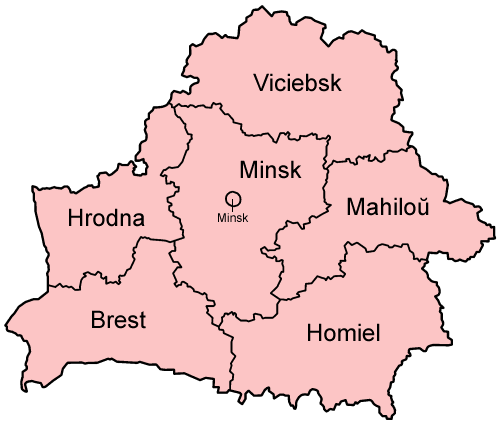
Belarus is divided into six regions. They are named after the cities that are their administrative centers.
Regions (with administrative centers):
- Brest Region (Brest)
- Gomel Region (Gomel)
- Grodno Region (Grodno)
- Mogilev Region (Mogilev)
- Minsk Region (Minsk)
- Vitebsk Region (Vitebsk)
Special administrative district:
- Minsk City
Economy
Most of the Belarusian economy is state-controlled. It has been described as “Soviet-style.” The country relies on Russia for some imports, including petroleum. As of 1994, Belarus’s main exports included heavy machinery (especially tractors), agricultural products, and energy products.
Demographics
According to 2019 census, the population is 9,413,446. Ethnic Belarusians are 84.9% of Belarus’ total population. The next largest ethnic groups are: Russians (7.5%), Poles (3.1%), and Ukrainians (1.7%). numbers of Jews, Roma, Latvians, Lithuanians and Tatars. Minsk, the nation’s capital and largest city, is home to 2,018,281 residents as of 2019. Gomel, with 481,000 people, is the second-largest city and is the capital of the Homiel Voblast. Other large cities are Mogilev (365,100), Vitebsk (342,400), Hrodna (314,800) and Brest (298,300). For other places in Belarus see List of settlements in Belarus.
Literature
Belarusian literature began with 11th- to 13th-century religious scripture. By the 16th century, Polotsk resident Francysk Skaryna translated the Bible into Belarusian. The modern era of Belarusian literature began in the late 19th century. One important writer was Yanka Kupala. Several poets and authors went into exile after the Nazi occupation of Belarus. They would not return until the 1960s. The last major revival of Belarusian literature was in the 1960s with novels published by Vasil Bykaŭ and Uladzimir Karatkievich.
Music
In the 19th century, Polish composer Stanisław Moniuszko made operas and chamber music pieces while living in Minsk. At the end of the 19th century, major Belarusian cities formed their own opera and ballet companies.
The National Academic Theatre of Ballet, in Minsk, was awarded the Benois de la Dance Prize in 1996 as the top ballet company in the world. Rock music has become more popular in recent years, though the Belarusian government has tried to limit the amount of foreign music aired on the radio. Since 2004, Belarus has been sending artists to the Eurovision Song Contest.
Dress
The traditional Belarusian dress is from the Kievan Rus’ period. Due to the cool climate, clothes were made to keep body heat and were usually made from flax or wool.
Cuisine
Belarusian cuisine is mainly vegetables, meat (especially pork), and breads. Foods are usually either slowly cooked or stewed. A typical Belarusian eats a light breakfast and two hearty meals, with dinner being the largest meal of the day. Wheat and rye breads are eaten in Belarus. Rye is more plentiful because conditions are too harsh for growing wheat. To show hospitality, a host will give an offering of bread and salt when greeting a guest or visitor. Popular drinks in Belarus include Russian wheat vodka and kvass, Kvass is a drink made from fermented malted brown bread or rye flour. Kvass may also be added with sliced vegetables to create a cold soup called okroshka.
World Heritage Sites
Belarus has four World Heritage Sites: the Mir Castle Complex, the Nesvizh Castle, the Belovezhskaya Pushcha (shared with Poland), and the Struve Geodetic Arc (shared with nine other countries).
Written for younger readers
Belarus, in simpler words
This version comes from Wikijunior, a set of books written for children aged 8 to 11. It is shorter and uses plainer language than the article above.
From Wikijunior: Europe
Belarus is a large country in north eastern Europe. It shares borders with Lithuania, Latvia, Russia, Ukraine and Poland. The capital city is Minsk. Other big cities in Belarus are Brest and Homyel. Belarus is not part of the European Union. Its currency is the Belarusian ruble.
The region that is now modern-day Belarus was first settled by Slavic tribes in the 6th century. Belarus first declared independence on March 25, 1918, forming the Belarusian People’s Republic. The Soviet Union (also known as the USSR) took control of Belarus almost a year later and Belarus became a member of the union in 1922.
Belarus became an independent country again on 27 July 1990. Alexander Lukashenko became the country’s first and only president since independence. He won elections in 1994, 2001, 2006 and 2010 although organizations from around the world don’t believe that the elections were fair and Belarus is considered to be Europe’s only dictatorship.
Belarus is a landlocked country (it has no coastline) and is mostly flat. Belarus’s highest point is Dzyarzhynskaya Hara at 345 metres. Belarus is bordered by Latvia on the north, Lithuania to the north west, Poland to the west, Russia to the north and east and Ukraine to the south.
There are many lakes and rivers across the country and 34% of the country is covered by forests. 20% of the southern part of Belarus is uninhabitable because of the affects of the Chernobyl (Ukraine) nuclear power plant accident in 1986. During winter Belarus can be very cold with average temperatures in January of only −6 °C but summers are usually as warm as other parts of northern Europe.
A significant part of the south-east of the country is off-limits as an exclusion zone because of the 1986 explosion at Chernobyl power plant across the border in Ukraine.
The population of Belarus is 9,724,723. Native people from Belarus, called Belarusians, make up about 81 percent of the population. Other ethnic groups include Russians, Poles, and Ukrainians.
Belarus’s two official languages are Belarusian and Russian. Other languages spoken in the country include Polish, Ukrainian, and Eastern Yiddish.
Belarus has no official religion. Many people in Belarus practice or are a member of the Russian Orthodox Church, with minorities practicing Catholicism, Judaism, and other religions.
Education in Belarus is free for all levels and children are required to go to school between the ages of 6 to 15. After finishing basic education, each student is given a certificate by the state and is able to enter the workforce or serve in the military. Students do have the option of going for a higher education or train in a vocational school; the length of the schooling depends on what the student has chosen. The literacy rate is 100 percent.
Presently few tourists visit Belarus because it is one of Europe’s poorest countries and because many don’t consider the country to be democratic. Tourism can be difficult for Religious, political and journalistic activity so religious pilgrims, political activists and journalists may be refused entry to Belarus. Most visitors require a visa except for those from former Soviet union countries (but not Lithuania, Latvia and Estonia). Visitors should expect a thorough search of their bags when they arrive at Customs.
The capital city Minsk is popular with foreigners because of its churches. The city offers an insight into life in the old Soviet Union with many buildings and shops not renovated since independence. The KGB Museum presents a look at the Soviet Union’s national security agency which investigated, spied and even tortured criminals and political dissidents in the past.
There are 4 UNESCO World Heritage Sites in Belarus including Mir Castle Complex and the Belovezhskaya Pushcha National Park which forms part of Belarus’s border with Poland.
Where this page comes from
The article above is adapted from “Belarus” on Simple English Wikipedia, by its contributors. We removed reference markers, navigation boxes and tables, expanded measurement templates into readable numbers, and kept the prose otherwise intact. The simpler version is adapted from Wikijunior on Wikibooks.
Both sources are published under CC BY-SA 4.0, so this page is published under the same licence. You may share and adapt it, including commercially, as long as you credit the original and keep the same licence.
Worksheets, answer keys and printable layouts elsewhere on K5Print are our own work and are not covered by this licence.