Bhutan

Fast facts
- Capital
- Thimphu
- Official language
- Dzongkha
- Currency
- Ngultrum 2
- Time zone
- BTT
- Drives on
- left
- Calling code
- 975
Facts from Wikipedia’s “Bhutan” page (CC BY-SA 4.0).
Bhutan (officially called Kingdom of Bhutan) is a small landlocked country in the Himalaya mountains of South Asia. It is ruled by King Jigme Khesar Namgyel Wangchuck, who has been king since 2006. Bhutan was founded in 1644 by Shabdrung Ngawang Namgyel. The Bhutanese people are proud that they have always been an independent country. Bhutan’s capital city is Thimphu. The official language is Dzongkha.
About 700,000 people live in Bhutan. The people and government of Bhutan are proud of their culture which is based on Tibetan Buddhism. 97% of Bhutan’s people are Buddhist.
Until 1974, Bhutan was closed to the outside world. Now people can visit the country, but only in small numbers. The only airport is in Paro District. The country is bordered on the south by the Republic of India and on the north by China. The Indian state of Sikkim separates Bhutan and Nepal. The main export of Bhutan is hydroelectricity which is sold to India. The economy of Bhutan is very small but is growing quickly. The currency is the Ngultrum, which is pegged at par with the Indian rupee.
Bhutan is the only carbon-neutral and carbon-negative country in the entire world.
National symbols of Bhutan
File:Corvus corax (NPS).jpg|National bird of Bhutan File:CupressusCashmerianaSochi.JPG|National tree of Bhutan File:Blue Poppy Meconopsis sp Pair 1000px.jpg|National flower of Bhutan
Landscape
File:082 - Gangkar Puensum - 7,570m (Dochula pass) (4677022812).jpg|Gangkhar Puensum, the highest mountain in Bhutan File:Himalayan Landscape.jpg|The Subalpine landscape common in Bhutan File:Himalayan peak from Bumthang.jpg|A Himalayan mountain seen from the town of Bumthang File:Jigme Dorji National Park, Bhutan.JPG|Jigme Dorji National Park File:HaaValley.jpg|The Haa Valley in Western Bhutan
Military
The Royal Bhutan Army is Bhutan’s military service. It includes the Royal Bodyguard and the Royal Bhutan Police. Membership is voluntary, and the minimum age for recruitment is 18. The standing army numbers about 16,000 and is trained by the Indian Army. Being a landlocked country, Bhutan has no navy. It also has no air force or army aviation corps. The Army relies on Eastern Air Command of the Indian Air Force for air assistance.
Wildlife
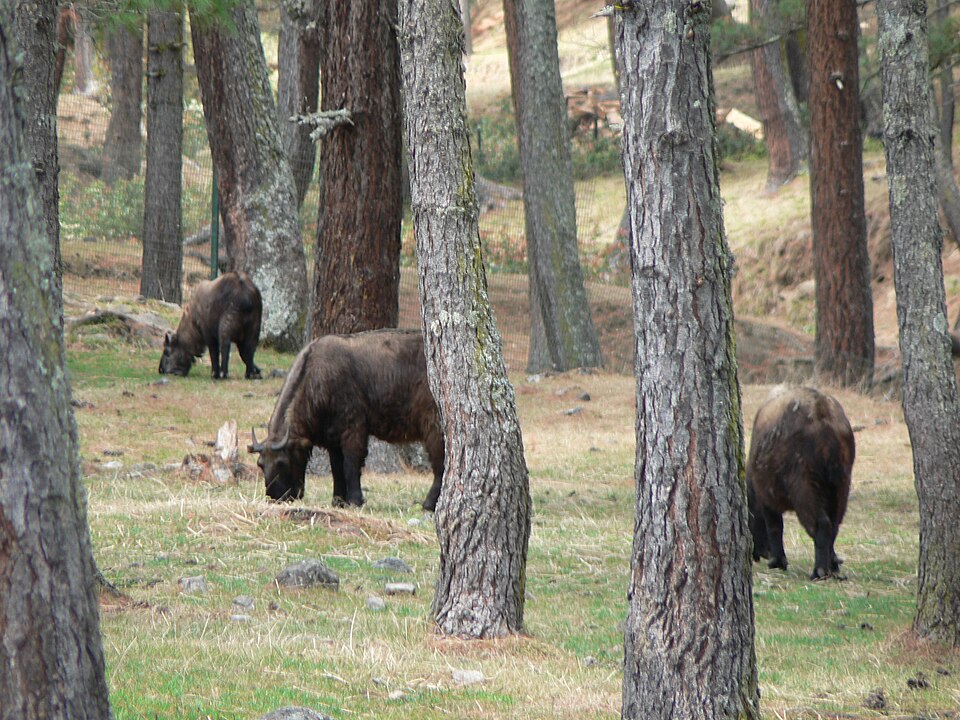
More than 770 species of bird and 5,400 species of plants are known to occur throughout the kingdom. Bhutan has a rich primate life with rare species such as the golden langur.
Administrative divisions
Bhutan is divided into 20 districts. Locally these are named dzongkhags. The districts are:
Bumthang
Chhukha
Dagana
Gasa
Haa
Lhuentse
Mongar
Paro
Pema Gatshel
Punakha
Samdrup Jongkhar
Samtse
Sarpang
Thimphu
Trashigang
Trashi Yangtse
Trongsa
Tsirang
Wangdue Phodrang
Zhemgang
Cities
The major cities of Bhutan are:
- Thimphu, the largest city and capital of Bhutan
- Damphu, the administrative headquarters of Tsirang District
- Jakar, the administrative headquarters of Bumthang District and the place where Buddhism entered Bhutan
- Mongar, the eastern commercial hub of the country
- Paro, site of the international airport
- Phuentsholing, Bhutan’s commercial hub
- Punakha, the old capital
- Samdrup Jongkhar The south eastern town on the border with India
- Trashigang, administrative headquarters of Trashigang District the most populous district in the country
- Trongsa, in central Bhutan which has the largest and the most magnificent of all the dzongs in Bhutan
Sports
Bhutan’s national sport is archery. Competitions are held regularly in most villages. Cricket has gained popularity in Bhutan, particularly since the introduction of television channels from India. The Bhutan national cricket team is one of the more successful affiliate nations in the region. Football is also an increasingly popular sport.
Written for younger readers
Bhutan, in simpler words
This version comes from Wikijunior, a set of books written for children aged 8 to 11. It is shorter and uses plainer language than the article above.
From Wikijunior: Asia
Bhutan (Dzongkha: འབྲུག་ཡུལ), officially the Kingdom of Bhutan, is a country in the Himalayas (in South Asia). Bhutan is a kingdom, and is ruled by the Druk Gyalpo (“Dragon King”). The current king of Bhutan is Jigme Khesar Namgyel Wangchuck, who has been the king of Bhutan since 2006.
In a general survey in 2006, Bhutan was rated the happiest country in Asia, and the 8th happiest country in the world. Bhutan is a member of the United Nations, and the South Asian Association for Regional Cooperation (SAARC).
Bhutan’s currency is the ngultrum.
Bhutan is located in southern Asia on the eastern half of the Himalayas. It is a landlocked country, meaning there is no sea bordering the country. China is found towards the north, while India is found towards the south. The Indian state of Sikkim comes in between Nepal and Bhutan.
As of 2013, around 753,947 people live in Bhutan. The largest city of Bhutan is also its capital, Thimphu, with around 91,000 people (2011). The second biggest city in Bhutan is Phuntsholing, which has 20,537 people (2005), and the third is Punakha, with 18,000 people (2005).
The national language of Bhutan is Bhutanese, which is also known as Dzongkha. Around 24 different languages are spoken in Bhutan, such as Sharchokpa, Nepali, and Bumthangkha.
Vajrayana Buddhism is the state religion of Bhutan and the most common religion with around two-thirds to three-quarters of the Bhutanese people adhering to the old Buddhist tradition. Around one-quarter to one-third of Bhutan’s people are followers of Hinduism, although Hinduism is more common in the southern part of the country. Less than 1 percent have a religion other than Buddhism or Hinduism. It is free to practice religion in Bhutan, but it is not allowed to convince another person to change religion.
Archery is the national sport of Bhutan, with archery competitions widespread across the country. The type of archery commonly practiced in Bhutan is different than that being used in the Olympics. Other popular sports in Bhutan are football and cricket.
- Paro Taktsang (commonly known as the Tiger’s Nest) is a monastery found near Paro Valley. It was first built in 1692 around the Taktsang Senge Samdup cave. It is said that in the 8th century, Guru Padmasambhava, a Buddhist master who introduced Buddhism to Bhutan, meditated in the Paro Taktsang for three years, three months, three weeks, three days and three hours! The monastery is best known for the thirteen Taktsang, or “tiger lair” caves, in which he is said to have meditated in.
- The Drukgyal Dzong is a ruined fortress and Buddhist monastery in the upper part of the Paro District (in Phondey Village). It is said that in 1649, Zhabdrung Ngawang Namgyel created the fortress to commemorate his victory against the Tibetan-Mongol forces. In 1951, a fire caused for only some of the relics of the Drukgyal Dzong to remain, such as the image of Zhabdrung Ngawang Namgyal. After the fire, the fortress was preserved and protected, remaining to be one of Bhutan’s most sensational attractions.
- Kurjey Lhakhang is the site of the burial of the first three kings of Bhutan. Located in Bumthang Valley (in the Bumthang district), the exquisite site hosts a large tree, which is believed to be terma (a number of hidden religious teachings of Buddhism) placed by Guru Padmasambhava.
Where this page comes from
The article above is adapted from “Bhutan” on Simple English Wikipedia, by its contributors. We removed reference markers, navigation boxes and tables, expanded measurement templates into readable numbers, and kept the prose otherwise intact. The simpler version is adapted from Wikijunior on Wikibooks.
Both sources are published under CC BY-SA 4.0, so this page is published under the same licence. You may share and adapt it, including commercially, as long as you credit the original and keep the same licence.
Worksheets, answer keys and printable layouts elsewhere on K5Print are our own work and are not covered by this licence.