Bolivia

Fast facts
- Largest city
- Santa Cruz
- Currency
- Boliviano
- Time zone
- BOT
- Drives on
- right
- Calling code
- +591
Facts from Wikipedia’s “Bolivia” page (CC BY-SA 4.0).
Bolivia , officially the Plurinational State of Bolivia, is a country in South America. It is landlocked by Brazil, Paraguay, Argentina, Peru, and Chile. Rodrigo Paz Pereira became its president in November 2025.
As of 2024 the population of Bolivia was 11,916,453.
Bolivia is named after Simón Bolívar. The main languages are Spanish and Quechua, but there are other languages too.
History
Bolivia used to be a colony of Spain. The silver mines in Bolivia made most of Spain’s money, and Spain used the native Bolivians as slaves to work in the mines.
After many wars, Simón Bolívar helped Bolivia to gain its independence in 1825. After this, the country experienced a very divisive 19th century, both politically and racially. There were strong political differences amongst liberals and conservatives in Bolivia following their independence.
Additionally, creoles in the country dominated Bolivian society until late in the 19th century, when Indians and other indigenous communities started to uprise. A notable figure in these indigenous uprisings was Pablo Zárate Willka.
Bolivia used to own some of the Pacific coast, but it lost it in 1879 in the War of the Pacific.
Geography
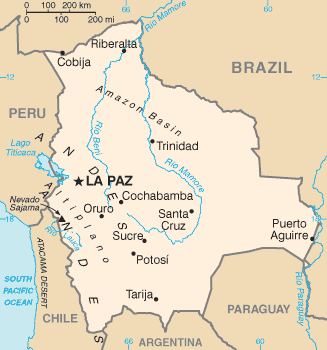
Bolivia is 424,135 mi² (1,098,581 km²). This makes Bolivia the world’s 28th-largest country (after Ethiopia). It is around the same size as Mauritania.
Bolivia is a landlocked nation, which means none of its borders touch the sea. It is surrounded on all sides by other countries.
The west of Bolivia is on the Andes mountain range. The highest mountain in Bolivia, located near the city of Oruro, is called Nevado de Sajama.
Although the west is very high-altitude with lots of mountains, there are also parts of Bolivia which are very flat and/or very near sea level. There is also a bit of Bolivia covered by the Amazon rainforest, and the highest lake in the world: Lake Titicaca.
The major cities are La Paz, El Alto, Santa Cruz de la Sierra and Cochabamba. For other places in Bolivia see List of cities in Bolivia.
Demographics
The population of Bolivia is approximately 10,907,778 people. The ethnic composition of the country is like the following:
- 62% Native American
- 26% Mestizo
- 10% White
- 2% Black
Economy
Bolivia suffers from poverty. Over 65% of the population lives below the poverty line.
Divisions
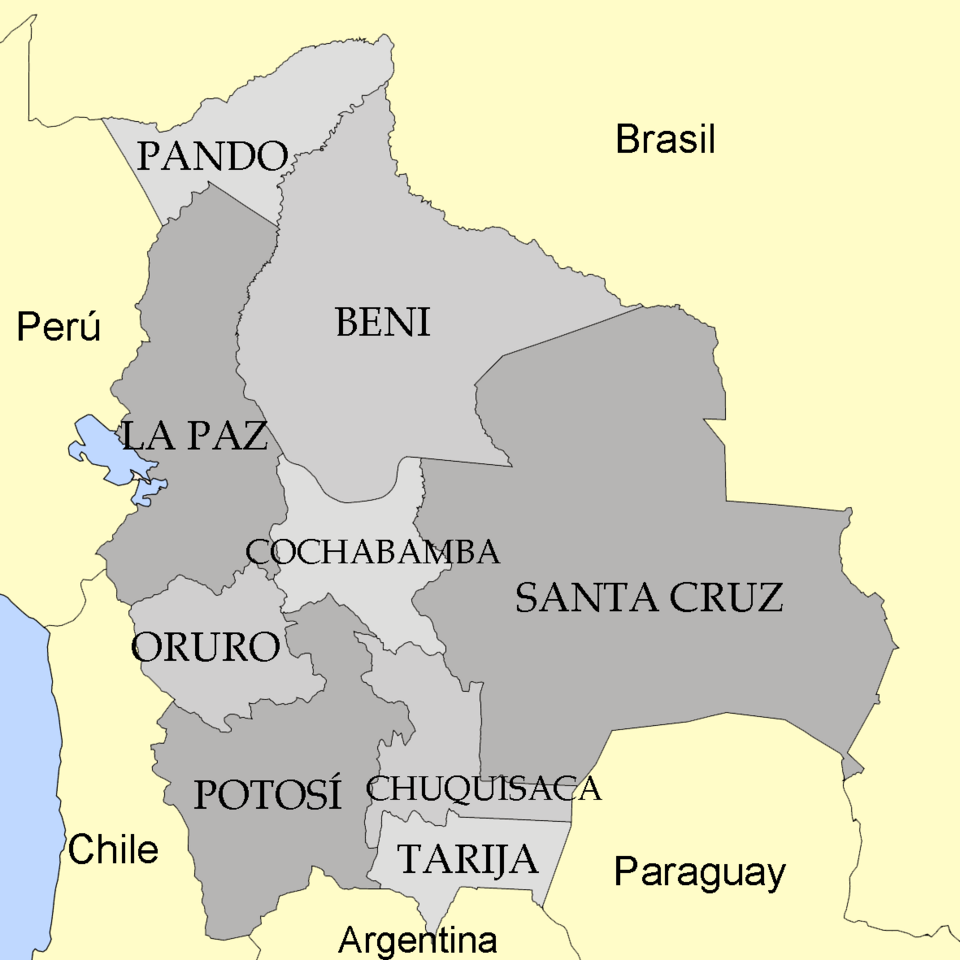
Bolivia is divided into nine departments. These departments are divided into 112 provinces. The provinces are divided into 339 municipalities and into native community lands.
Culture
Bolivian culture has many Inca, Aymara and other native influences in religion, music and clothing. There is a big festival in Oruro, which is called “El carnaval de Oruro”. People in Bolivia like playing football, and football, which is often played in the street. Zoos are also very popular, but they do not have much money.
National symbols
The Cantuta (often spelled kantuta or qantuta) (Cantua buxifolia or Fuchsia buxifolia) is a flower found in the Yungas, and is the national flower of Bolivia along with the patujú (Heliconia rostrata) found in the tropical regions of Bolivia.
Written for younger readers
Bolivia, in simpler words
This version comes from Wikijunior, a set of books written for children aged 8 to 11. It is shorter and uses plainer language than the article above.
From Wikijunior: South America
Bolivia is a landlocked country in the center of South America. It is bordered by ../Brazil/ to the north and east, ../Paraguay/ and ../Argentina/ to the south, and ../Chile/ and ../Peru/ to the west. Its capital is La Paz. At 11,740 ft (3,580 m) above sea level, it is the highest capital in the world. Bolivia is named after Simon Bolivar, one of the greatest South American generals.
The official flag of Bolivia has three stripes of these colours (in descending order): red, yellow and green. Red represents the bravery of their soldiers, yellow representing their wealth, and green for the natural and rural environment.
The west of Bolivia is covered by the Andes mountain range. The Andes is divided in two branches. The Altiplano is a large plateau which is in the west of the country between the two branches of the Altiplano. The west also contains the largest salt flats on earth, Salar de Uyuni. There is also the largest lake commercially available for transport, Lake Titicaca, which was historically important to the indigenous people and now is an important tourist location. The highest peak in Bolivia is also a volcano, and its name is Nevado del Sajama.
Divided into three distinct periods: pre-Columbian, colonial, and republican.
There are six places in Bolivia declared World Heritage for their contributions to world history. Two of them specifically acknowledge indigenous or native cultures: Tiwanaku, which was an archaeological site particularly well known for pre-Columbian pottery and also Chiquitos which the Spanish Conquistadors found after looking at Indian doors and is well known for music.
In 1531 Spanish conquistadors under Francisco Pizarro entered Bolivia. Within two years they controlled the territory known as Alto Peru. In 1544 silver was discovered at Potosi. Native and African slaves were forced to work the silver mines and enriched Spain for over the next 200 years. The slaves were encouraged to chew on coca leaves which became a part of the native culture.
In 1548 La Paz was founded as Nuestra Señora de La Paz (Our Lady of Peace). It became the capital in 1898. Bolivia won its independence from Spain in 1825. The first elected president was General Simon Bolivar, who had led the Bolivian forces in defeating the Spanish. The following year Antonio José de Sucre drew up Bolivia’s constitution, and the country received its name. In 1828 Sucre was forced to resign, and since then Bolivia has been ruled for the most part by a succession of military dictators.
For over 350 years Bolivia’s western boundary extended to the Pacific Ocean. But following a war with Chile in 1883, Bolivia lost its Pacific coastal area thereby becoming landlocked. In subsequent wars with Brazil (1903) and Paraguay (1935), Bolivia lost land in the east including rubber plantations, but came just short of losing important oil and natural gas resources.
In the 1890s mining corporations interested in Bolivia’s tin began to control the country. In 1952 the government was taken over by a revolutionary party, the MNR, which seized the mines, taking them over to be owned by the government. The MNR also divided the estates of the wealthy landowners into smaller farms for their former tenants and peasants, who previously worked the land but didn’t own it.
In 1964 the army took over the government of Bolivia. Since then Bolivia has had a string of generals as presidents, most of them in office for less than a full term.
In 1982 Siles Zuazo became Bolivia’s first democratic, civilian president in over 40 years. Currently the President is Evo Morales, elected 2006.
There are nearly ten million people in Bolivia. Half to nearly two-thirds of people in Bolivia belong to indigenous cultures, which is relatively unusual for a South American country. Over two hundred different languages are spoken by at least as many native nations. Many of those are close to becoming extinct. The largest indigenous group is the Quechua with two and a half million people. There are also the Aymara, and two smaller groups known as the Guaraní and the Chiquitano. There are also many Europeans, Asians and people from other ethnic groups.
If you were a Bolivian man, you could expect to live until you were 62 and if you were a Bolivian woman, you could expect to live to be 68. You would also be expected to give birth to three children, but many children attend school for a year or less.
Much of Bolivia is in poverty, and many people work on farms, while cities continue to grow due to former peasant trying to find a livelihood there. Eighty-seven percent of Bolivians can read and write.
The three official languages are Spanish, Quechua, and Aymara.
There are at least four large cities which are growing rapidly : La Paz, El Alto, Cochabamba and Santa Cruz.
Soy products, zinc, natural gas, and tin.
It is the most well known food in all Spanish speaking countries. Delicacies include fruits from the forest with honey. The food in the north is spicy and full of flavor. Saltenas, a juicy chicken or beef empanada is one of the most famous worldwide foods.
Soccer is the most popular sport in the country. Volleyball, Tennis, Horseback riding, Automobile Racing, and Basketball are also popular.
Where this page comes from
The article above is adapted from “Bolivia” on Simple English Wikipedia, by its contributors. We removed reference markers, navigation boxes and tables, expanded measurement templates into readable numbers, and kept the prose otherwise intact. The simpler version is adapted from Wikijunior on Wikibooks.
Both sources are published under CC BY-SA 4.0, so this page is published under the same licence. You may share and adapt it, including commercially, as long as you credit the original and keep the same licence.
Worksheets, answer keys and printable layouts elsewhere on K5Print are our own work and are not covered by this licence.