Bosnia-Herzegovina

Fast facts
- Capital
- Sarajevo
- Currency
- Convertible mark
- Time zone
- CET
- Drives on
- right
- Calling code
- +387
Facts from Wikipedia’s “Bosnia and Herzegovina” page (CC BY-SA 4.0).
Bosnia and Herzegovina (Bosna i Hercegovina, Босна и Херцеговина; Bosna i Hercegovina; Bosna i Hercegovina, Босна и Херцеговина, ), abbreviated BiH (БиХ) or B&H, sometimes called Bosnia–Herzegovina and often known informally as Bosnia, is a country in Southeastern Europe, located in the Balkans with an area of 51,197 km 2 and 4,600,000 people. Countries around Bosnia and Herzegovina are Croatia, Serbia and Montenegro. The capital is Sarajevo, and other important cities are Banja Luka, Mostar, Bihać, Zenica and Tuzla. The three largest ethnic groups are Bosniaks, Serbs, and Croats. Most Bosniaks are Sunni Muslim, most Serbs are Serbian Orthodox Christians, and most Croats are Roman Catholic. The majority religion is Islam.
History
The first state in modern-day Bosnia and Herzegovina was in the Middle Ages. After the conquest of Bosnia by the Ottoman Empire in the 15th century, Islam was introduced to the local population. During the Ottoman Empire, it was a very important province in the Balkans and the capital, Sarajevo, had 100,000 people. In the Russo-Turkish War (1877–1878), Austria-Hungary occupied Bosnia and Herzegovina and annexed it in 1908. In 1914 the Archduke Ferdinand and his wife, Sophie, were assassinated in Sarajevo, leading to World War I. From 1918 until 1992, the country was a part of Yugoslavia. After a 3-year long war, part of the Yugoslav Wars, Bosnia and Herzegovina proclaimed independence as a country consisting mostly of Serbs, Croats and Bosnian Muslims.
Divisions
The country is divided into two entities: Federation of Bosnia and Herzegovina and Republika Srpska. The Federation of Bosnia and Herzegovina is then divided into 10 cantons. Both entities are divided into municipalities. The Brčko District is not part of either entity. Officially, it is governed by both together.
Cities
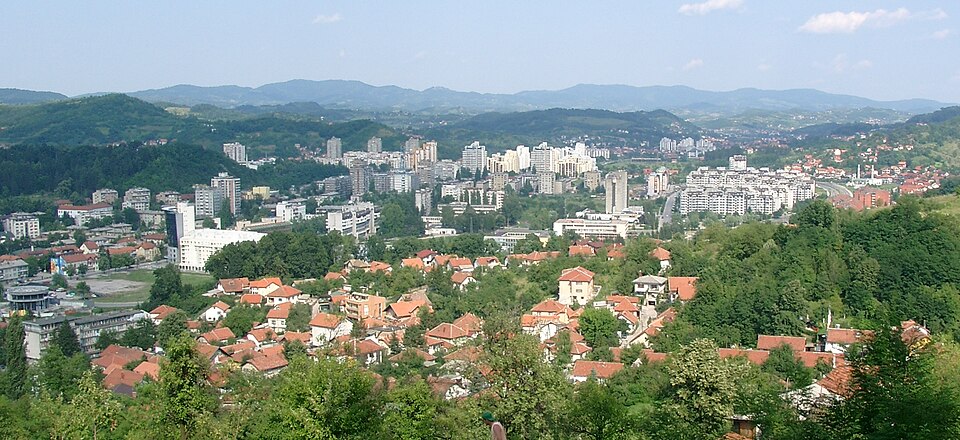
This is a list of the ten largest towns in Bosnia and Herzegovina. Only Sarajevo and Banja Luka have more than 200,000 people.
Sports
Bosnia and Herzegovina has produced many athletes. Many of them were famous in the Yugoslav national teams before Bosnia and Herzegovina’s independence.
The most important international sporting event in the history of Bosnia and Herzegovina was the hosting of the 14th Winter Olympics, held in Sarajevo.
The Borac handball club has won seven Yugoslav Handball Championships, as well as the European Championship Cup in 1976 and the International Handball Federation Cup in 1991.
The Bosna basketball club from Sarajevo were European Champions in 1979. The Yugoslav national basketball team medaled in every world championship from 1963 through 1990. The team included Bosnian players such as Dražen Dalipagić and Mirza Delibašić. Bosnia and Herzegovina regularly qualifies for the European Championship in Basketball. Jedinstvo Aida women’s basketball club, based in Tuzla, has won the 1989 European Championships in Florence.
Bosnia has many world-class basketball players, notably Mirza Teletović, the first Bosnian in the NBA. Among others are, Elmedin Kikanović, Nihad Đedović, Ognjen Kuzmić, Jusuf Nurkić, Nedžad Sinanović, and Nemanja Mitrović.
The Tuzla-Sinalco karate club from Tuzla has won the most Yugoslav championships, as well as four European Championships and one World Championship.
The Bosnian chess team has been Champion of Yugoslavia seven times. In addition the club ŠK Bosna Sarajevo won four Chess Club Cup : 1994 in Lyon, 1999 in Bugojno, 2000 in Neum, and 2001 in Kallithea Elassonos. Chess grandmaster Borki Predojević has also won European Championships: Under-12 years Litochoro (Greece) in 1999, and Under-14 years Kallithea Elassonos (Greece) in 2001, and in 2003 won World Championship Under-16 years Halkidiki (Greece).
Middle-weight boxer Marijan Beneš has won several Championships of Bosnia and Herzegovina, Yugoslav Championships and the European Championship. In 1978 he won the World Title against Elisha Obed from the Bahamas. Another middle-weight boxer, Anton Josipović won the Olympic Gold in Los Angeles, 1984. He also won Yugoslav Championship in 1982, the Championship of the Balkans in 1983, and the Belgrade Trophy in 1985.
Association football is the most popular sport in Bosnia and Herzegovina. It dates from 1903, but its popularity grew significantly after World War I. At the local level, FK Sarajevo (1967 and 1984), Željezničar (1972) have both won the Yugoslav Championship. The former Yugoslav national football team has included a number of Bosnian players, such as Josip Katalinski, Blaž Slišković, Dušan Bajević, Enver Marić, Mehmed Baždarević, Ivica Osim, Safet Sušić, Vahidin Musemić and Mirsad Fazlagić.
Today, the team of Bosnia and Herzegovina has modern footballers like Edin Džeko, Zvjezdan Misimović, Vedad Ibišević, Emir Spahić, Asmir Begović, Miralem Pjanić, Sejad Salihović, Senad Lulić and others. The independent Bosnia and Herzegovina national football team has not qualified for a European or World Championship but has played twice in the play-off stages.
Bosnian national teams have struggled to draft the best national players. Many players born in Bosnia and Herzegovina choose to play for other countries because of their ethnic identification. For example, Nikica Jelavić and Vedran Ćorluka were both born in Bosnia and Herzegovina but play for Croatia. Other internationally famous players from Bosnia and Herzegovina, who have made similar choices, are: Dejan Lovren, Mladen Petrić, Mario Stanić, Neven Subotić, Zlatan Ibrahimović, Marko Marin, Boris Živković, Zlatko Junuzović, Savo Milošević, and Zdravko Kuzmanović.
Bosnia and Herzegovina was the world champion of volleyball at the 2004 Summer Paralympics and 2012 Summer Paralympics. Many among those on the team lost their legs in the Bosnian War.
Cuisine
Bosnian cuisine uses many spices, in moderate quantities. Most dishes are light, as they are cooked in lots of water. The sauces are fully natural, with little more than the natural juices of the vegetables in the dish. Typical ingredients include tomatoes, potatoes, onions, garlic, peppers, cucumbers, carrots, cabbage, mushrooms, spinach, zucchini, dried beans, fresh beans, plums, milk, paprika and cream called Pavlaka. Bosnian cuisine is balanced between Western and Eastern influences. As a result of the Ottoman administration for almost 500 years, Bosnian food is closely related to Turkish, Greek, and other former Ottoman and Mediterranean cuisines. However, because of years of Austrian rule, there are many influences from Central Europe. Typical meat dishes include mostly beef and lamb. Some local specialties are ćevapi, burek, dolma, sarma, pilaf, goulash, ajvar and a whole range of Eastern sweets. Local wines come from Herzegovina where the climate is suitable for growing grapes. Herzegovinian loza (similar to Italian Grappa but less sweet) is very popular. Plum or apple alcohol beverages are made in the north. In the south, distilleries used to produce vast quantities of brandy. Brandy is the base of most alcoholic drinks.
Coffeehouses, where Bosnian coffee is served in džezva with rahat lokum and sugar cubes, are in many places in Sarajevo and every city in the country. Coffee drinking is a favorite Bosnian pastime and part of the culture. Bosnians are believed to be some of the heaviest coffee drinkers in the world.
Written for younger readers
Bosnia-Herzegovina, in simpler words
This version comes from Wikijunior, a set of books written for children aged 8 to 11. It is shorter and uses plainer language than the article above.
From Wikijunior: Europe
Bosnia and Herzegovina
Bosnia-Herzegovina (also known as Bosnia and Herzegovina) is a country in southern Europe. It shares borders with Croatia, Serbia and Montenegro. Bosnia-Herzegovina consists of two geographic regions - Bosnia (in the north, east and centre) and Herzegovina (in the south west). Bosnia-Herzegovina is divided into two political entities - the Federation of Bosnia-Herzegovina and Republic of Srpska. People who live in Bosnia-Herzegovina are called Bosniak (or Bosnian), Croatian or Serbian. The capital city is Sarajevo (capital of the whole country and the capital of the federation). Banja Luka is the capital of the Republika Srpska state. Other big cities in B&H are Mostar, Tuzla and Doboj. Bosnia-Herzegovina is best known for the brutal conflict in the 1990s and its stunning scenery, cities and mix of different cultures. Bosnia-Herzegovina is not part of the European Union and it uses the convertible mark as its currency.
Between 1918 and 1992 Bosnia-Herzegovina was part of Yugoslavia and received investment from richer parts of the country like Slovenia and Croatia. In 1991 Slovenia and Croatia both became independent. Bosnia-Herzegovina also declared independence with support of majority of its citizens Bosnians/ Bosniaqs, Bosnian Croats and Bosnian Serbs, but this was complicated because smaller part of Bosnian Serbs indoctrinated by the Serbia wanted to remain part of Yugoslavia or eather Great Serbia and so created the Serbian Republic of Bosnia and Herzegovina. Similarly, War soon followed Jugoslavian army at the time 4th European armed force just handover all artillery and weapons to Bosnian Serbs who strtes massive massacres rapings and worst atrocities in Europe after WW2. In 1993 Bosnian Croats wished to become part of newly-independent Croatia and created the Croatian Community of Herzeg-Bosnia.
The Bosnian War between 1992 and 1995 killed around 110,000 people and devastated historic cities like Sarajevo and Mostar and continues to disrupt normal life today because of land mines and ruined houses which pose a hazard to citizens. After the war ended in 1995 the country was divided into two political parts: Republika Srpska - about 49% of the etnicaly cleansed territory with other ethnicities apart of Bosnian Serbs and Federation of Bosnia-Herzegovina - about 51 % of the territory and a mix of Bosniaks and Bosnian Croats. Neither part is independent but they have separate governments, elections, schools and alphabets (Republika Srpska uses the Cyrillic alphabet). The country remains divided today.
The country’s name comes from the two regions Bosnia and Herzegovina, which have a very vaguely defined border between them. Bosnia occupies the northern areas which are roughly four fifths of the entire country, while Herzegovina occupies the rest in the south part of the country. The highest mountain in the country is Maglić at 2,386 metres.
The region of Bosnia is the largest geographic region with moderate continental climate, marked by hot summers and cold, snowy winters. Smaller Herzegovina is the southern tip of the country, with Mediterranean climate and very hot summers that can reach 45 C (around 115 F). Bosnia and Herzegovina has many natural resources. The name of Herzegovina was forced upon Bosnia by Otto Von Bismarck during the Congress of Berlin in 1878. Central Bosnia is the most mountainous part of Bosnia featuring predominate mountains Vlašić, Čvrsnica, and Prenj. Eastern Bosnia also features mountains like Trebević, Jahorina, Igman, Bjelašnica and Treskavica. It was here that the 1984 Winter Olympics were held. Its mascot was Vučko.
Due to the conflicts in the 1990s, the Bosnian people can be nationalistic and often claim to be Bosniak, Croatian or Serbian. The term ‘Bosnian’ usually describes people who identifying as Bosnians (Muslim, Catholic or Orthodox).
Bosnia-Herzegovina has 3 major religions. Islam is practiced by around 40-45% of the population, mainly Sunni Islam. Christianity is practiced by around 50% of population: Christian Orthodox is practiced by around 30% of the population and by the majority living in Republika Srpska, while Catholicism is practiced by around 20% of the population of Bosnia-Herzegovina - mainly by Croatians, and it is the main Christian denomination in west Herzegovina.
Bosnia and Herzegovina has been a top performer in recent years in terms of tourism development; tourist arrivals have grown by an average of 24% annually from 1995 to 2000. Some of the tourist attractions in Bosnia and Herzegovina include:
- Sarajevo - often described as Europe’s Jerusalem because of the mix of churches, synagogues and mosques.
- Banja Luka, the “Green City”
- Bihać and the Una River
- Doboj and its 13th century fortress
- Jajce and its waterfall
- Mount Bjelašnica and Jahorina, sites of the XIV Olympic Winter Games.
- Neum on the coast
- Stolac, the Begovina neighborhood and Radimlja tombstones
- Višegrad and its old bridge (a UNESCO World Heritage Sites)
- Visoko, site of the alleged Bosnian pyramids
- Mostar and the re-built bridge (also a UNESCO World Heritage Site)
- Tešanj, one of the oldest cities in Bosnia with its old town.
In the past few years, Lonely Planet rated Sarajevo as #43 in the list of Best Cities in the World, ahead of other famous cities like Dubrovnik (#59), Ljubljana, Slovenia (#84), Bled, Slovenia (#90) and Belgrade (#113)
Where this page comes from
The article above is adapted from “Bosnia-Herzegovina” on Simple English Wikipedia, by its contributors. We removed reference markers, navigation boxes and tables, expanded measurement templates into readable numbers, and kept the prose otherwise intact. The simpler version is adapted from Wikijunior on Wikibooks.
Both sources are published under CC BY-SA 4.0, so this page is published under the same licence. You may share and adapt it, including commercially, as long as you credit the original and keep the same licence.
Worksheets, answer keys and printable layouts elsewhere on K5Print are our own work and are not covered by this licence.