Bulgaria

Fast facts
- Capital
- Sofia
- Official language
- Bulgarian
- Languages
- Cyrillic
- Currency
- Euro
- Time zone
- EET
- Drives on
- right
- Calling code
- +359
Facts from Wikipedia’s “Bulgaria” page (CC BY-SA 4.0).
Bulgaria (officially called the Republic of Bulgaria) is a country in south-eastern Europe, on the Balkan Peninsula. Bulgaria is the south of the River Danube and west of the Black Sea. To the west of Bulgaria are Serbia and North Macedonia, to the south of Bulgaria are Greece and the European part of Turkey. To the north of the Danube and northeast between Silistra and Durankulak is Romania, while to the west of Bulgaria is Serbia.
The capital and the biggest city is Sofia. The name Sofia comes from the Greek language and means wisdom. Since January 2026 the currency in circulation is the Euro. Before 2026 it was the lev or the Bulgarian lev. The Bulgarian government elected, and Bulgaria is a member of the European Union in Europe since 2007, and had political relations with Nato during the 90s during the postmodern movement, and in 2000s had become a member of NATO.
Bulgaria has its own language, called Bulgarian. It is derived from the Thracian language. It is related to languages like Serbian and Russian. Bulgaria borders Romania, Serbia, North Macedonia, Greece, Turkey, and the Black Sea. One of the national heroes of Bulgaria is Vasil Levski who led the fight for independence in the late 1800s.
Prehistory
In what is now Bulgaria, many different people and different cultures lived over time. This includes Neolithic, Hamangia culture, Vinča culture, eneolithic, Varna culture (5th millennium BC) and the Bronze Age Ezero culture.
Classical Antiquity
The Thracians lived in the area of modern Bulgaria (in Thrace or ). King Tere united the people in Odrysian Kingdom around 500 BC.
Alexander the Great had influence over the people in the 4th century BC.
The last Hellenistic Thracian kingdom became part of the Roman Empire in the 1st century AD. The lands of Bulgaria were then part of the Roman Empire.
Eurasian Avars, South Slavs and Huns settled all over the territory of modern Bulgaria during the 6th century.
Medieval Bulgaria
The Bulgars arrived in Thracia in the 7th century. The Bulgars established the First Bulgarian Empire in 681 AD, after a war with the Romans in which the Bulgarians had success. In 1018, the Romans overcame the Bulgarians in war, the Bulgarian state ended, and Bulgaria became part of the Roman Empire again.
The Second Bulgarian Empire started in a rebellion about 1185 AD. The state had Tarnovgrad (present name Veliko Tarnovo) as the capital.
Ottoman Bulgaria
The Ottoman Empire took over in 1396 and ruled Bulgaria for about 500 years. The Ottomans had very strict rules and the Bulgarians suffered. The Bulgarians rebelled several times against the Turkish rulers.
Under the Ottoman Rule Turks and Muslim Gypsys was settled elswhere in Bulgaria, also some of the Rhodope Mountains Bulgarians became Muslim and called Pomak. After the loss of the Crimean Khanate in 1783 Muslim Crimean Tatars and Muslim Crimean Gypsys who called themself Turkoman went to Ottoman Bulgaria in Dobruja part.
19th century
In 1876, there was the April Uprising, a Bulgarian rebellion against the Ottoman Empire. In the Russo-Turkish War (1877–1878), the Russian Empire overcame the Ottomans. In 1878, Bulgaria became, in part, independent, although the Ottomans controlled its foreign policy.
20th century
Bulgaria pulled away from Ottoman Empire’s influence with the help of the Russian Empire who were already fighting the Ottomans. But it was not until 1908 that the whole country of Bulgaria was united as modern Bulgaria.
Bulgaria joined the side of Germany in World War I and lost. Bulgaria had hoped to get part of the lands Bulgaria lost in the Balkan Wars.
During the first year of World War II Bulgaria said it was neutral and refused to join sides with Nazi Germany or the Soviet Union. Bulgaria’s military and economy were had a close connection with Germany. Bulgaria’s leaders signed the Tripartite Pact with Germany in March 1941. This let German forces go through Bulgaria to reach Greece.
Bulgaria’s troops invaded Greece and Yugoslavia just after the governments of those countries surrendered. Bulgaria occupied the lands of modern North Macedonia and parts of Greece. (Both areas had been part of Bulgaria before the Balkan Wars.) The Bulgarian government also sent Jews to concentration camps and ghettoes in the Holocaust. The king of Bulgaria, Tsar Boris III, died after talking to Hitler in August 1943. Before the Tsar died, the Kingdom of Bulgaria had sent at least 11,343 Jews to the extermination camps.
In 1944 when it became clear that the Allied Powers would win the war, Bulgaria had to find another solution. Their leaders declared that they withdrew from the Axis forces and helped the German army leave the Balkans through Bulgaria. The Soviet Union didn’t respect Bulgaria’s claim to be neutral. The Red Army invaded Bulgaria in September 1944. At the same time, a new pro-Soviet government took power in Sofia. At this point, the Jews were released from the ghettoes and concentration camps in Bulgaria. The new government joined the Allies, and the military started to attack the German army, which the Bulgarian government had helped to leave Bulgarian lands.
The Soviets replaced the royal monarchy with Communism in 1947 before they withdrew from Bulgaria in 1949. For 40 years, under their leader Todor Zhivkov, Bulgaria was very close to the Soviet Union and followed their instructions. Bulgaria invaded Czechoslovakia to stop the Prague Spring in 1968.
Shortly after the fall of the Berlin Wall, on 10 November 1989, the Bulgarian Communist Party gave up their rule and allowed the country to elect leaders of their own choice. In a few years, Bulgaria had serious money problems under the new socialist government. Since that time Bulgaria has managed to recover.
Economy and social welfare
Bulgaria’s economy was dependent on the COMECON market. This was a group of communist countries (Soviet Union, Bulgaria, Czechoslovakia, Hungary, Poland, and Romania) that agreed to work together. This group fell apart in 1989 with the fall of communism in Europe. While this was good for personal freedom, it was too much of a change for the businesses and jobs. Also, Yugoslavia, their neighbor, fell into a civil war as their country broke apart, and that did not help Bulgaria. Living standards fell by 40 percent as people lost their jobs and their savings were not worth much, and even some newborn babies were sent to orphanages when their parents could not take care of them.
In 1994 Bulgaria had a short economic boom. But that slowed down in 1996 from bad finance deals and other banking problems. In 1997 there was high inflation (the money could not buy as much as it did before). Retired people had little income (their pension did not go up as fast as inflation did) and their savings were not worth very much. Many retired people were begging in the streets for food. But since then the economy has grown steadily. People from outside the country started putting money into businesses and houses, and Bulgarians learned how to make their own businesses.
The state no longer has free healthcare. This system has been replaced by an insurance plan that people pay for, and drug costs are based on income. Private healthcare is encouraged nowadays. Help for people who lose their jobs is no longer automatic, but some help is available, based on family status and length of unemployment.
The retirement age for men is 64 years and for women 61 years. It will be 63 years and 9 months for woman and 65 years and 3 months for man.
Provinces
Since 1999, Bulgaria has been divided into 28 provinces or regions. Each province is named after its local capital. The provinces are divided into municipalities, there are 264 in total.
Society
File: Downtown Sofia Boby Dimitrov 1.jpg| File: Tvarditsa wind turbines.jpg| File:Veleka-sinemorets-mouth-dinev.jpg| File:Dinevi marina at St Vlas resort.jpg|
There are 6 Bulgarian development regions of 27 smaller provinces. See List of settlements in Bulgaria for a list of all large locations.
In Bulgaria there are 5,664,624 citizens of Christian Bulgarians and Muslim Pomaks, 1,200,000 citizens of Muslim Turks and Crimean Tatarians and 800,000 Citizens of Christian and Muslim Roma/Gypsies.
Bulgaria is classified as a developing country by the EU.
- Number of people living in Bulgaria: 7,351,234
- Female: 3,770,897 (51%)
- Male: 3,580,337 (49%)
- Those living in cities: 5,357,633 (73%)
- Those living in villages: 1,993,601 (27%)
- Number of dwellings (houses, apartments, summer house/villa, any place where people can live): 3,898,688
- Number of households (people living together - families, roommates, etc.): 2,826,740
Maritime waters
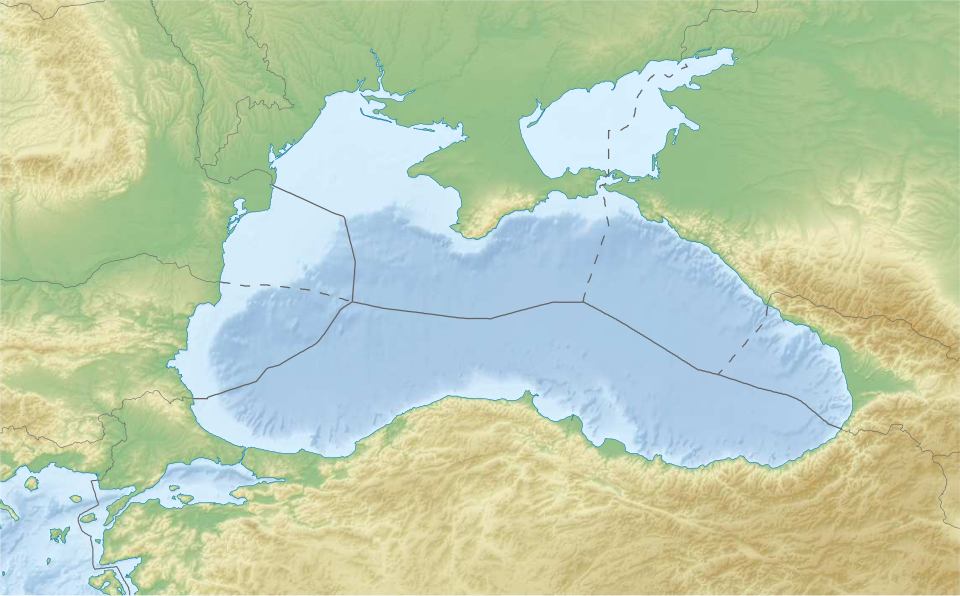
The territorial waters of Bulgaria in the Black Sea cover an area of 35,410 km 2 . Bulgaria’s territorial waters border those of Romania, Turkey and Ukraine.
Bulgaria, together with Romania and Ukraine, are parties to the “United Nations Convention on the Law of the Sea”, so the maritime boundary in the Black Sea between Bulgaria and Romania and the maritime boundary between Bulgaria and Ukraine are subject to mutual delimitation under international law.
In 1997, Bulgaria and Turkey signed a treaty to define the maritime boundary between them.
Written for younger readers
Bulgaria, in simpler words
This version comes from Wikijunior, a set of books written for children aged 8 to 11. It is shorter and uses plainer language than the article above.
From Wikijunior: Europe
Bulgaria is a country in south eastern Europe. It shares borders with Turkey, Greece, Macedonia, Serbia and Romania. The capital city is Sofia. Other big cities are Plovdiv and Varna. Bulgaria joined the European Union on January 1st, 2007. The currency of Bulgaria is the Euro.
In 1912 and 1913, Bulgaria became involved in the Balkan Wars, first entering into conflict alongside Greece, Serbia and Montenegro against the Ottoman Empire. The First Balkan War (1912-1913) proved a success for the Bulgarian army. The Second Balkan War (1913) put Bulgaria against Greece and Serbia, joined by Romania and Turkey. After its defeat in the Second Balkan War, Bulgaria lost a large amount of the territory that they had conquered in the first war.
During World War I, Bulgaria found itself fighting on the losing side as a result of its alliance with the Central Powers. Bulgaria became allied with the Axis Powers, although no Bulgarian soldiers participated in the war against the USSR. During World War II Nazi Germany allowed Bulgaria to occupy parts of Greece and of Yugoslavia. Bulgaria became one of only three countries (along with Finland and Denmark) that saved its entire Jewish population (around 50,000 people) from the Nazi camps by refusing to comply with an August 31, 1943 resolution.
In September 1944, the Soviet army entered Bulgaria, enabling the Bulgarian Communists (the Bulgarian Workers Party) to seize power and establish a communist state. In 1944, Bulgaria’s forces turned against the country’s former ally, Germany. Communism ended in Bulgaria in 1989 and since then the country has been democratic and capitalist. Bulgaria joined the EU in 2007.
The area of Bulgaria is 110,994 km 2 (42,855 sq mi). It borders five other countries: Romania to the north (mostly along the River Danube), Serbia and the Republic of Macedonia to the west, and Greece and Turkey to the south. The Black Sea runs along most of the country to the east. It is a land of mountains, rivers, and rolling plains. More than two-thirds of the country is plains, plateaus, or hilly land. The highest mountain is Rila at 2925 metres.
The coastal climate is moderated by the Black Sea, but strong winds and violent local storms are common during the winter. Winters along the Danube River are bitterly cold. Most of Bulgaria has a temperate climate, with cool and damp winters, very hot and dry summers. Average precipitation in Bulgaria is about 630 millimeters per year. Bulgaria is likely to experience earthquakes and landslides. Bulgaria is currently facing some environmental issues including water pollution, air pollution, and forest pollution in the form of acid rain.
The population of Bulgaria is just over 7.3 million. The official language is Bulgarian. More than 90 percent of the population speak it. Turkish is the largest minority language. Education is free and required for children from the ages of 7 through 14. Most of Bulgaria’s people belong to the Bulgarian Orthodox Church. Other religions that are practiced include Islam and Judaism.
Football has become by far the most popular sport in Bulgaria. Many Bulgarian fans closely follow the top Bulgarian league, the Bulgarian “A” Professional Football Group; as well as the leagues of other European countries.
Bulgaria, a country with a historical and cultural heritage, and attractive natural landscapes, is one of the most visited tourist destinations in Europe. The country has historical cities and towns, summer beaches, and mountain ski resorts. In the northern-hemisphere winter, Samokov, Borovets, Bansko and Pamporovo become well-attended ski-resorts. Summer resorts exist on the Black Sea at Sozopol, Nessebur, Golden Sands, Sunny Beach, Sveti Vlas, Albena, Saints Constantine and Helena and many others. Spa resorts such as Bankya, Hisarya, Sandanski, Velingrad, Varshets and many others attract visitors throughout the year.
Bulgaria has started to become an attractive tourist destination because of the quality of the resorts and prices below those found in Western Europe. Beach-resorts attract tourists from Germany, Russia, Scandinavia, the Netherlands and the United Kingdom. The ski-resorts have become a favorite destination for British and Irish tourists.
There are 9 UNESCO World Heritage Sites in Bulgaria which include the Madara Rider and the Ancient City of Nessebar.
Where this page comes from
The article above is adapted from “Bulgaria” on Simple English Wikipedia, by its contributors. We removed reference markers, navigation boxes and tables, expanded measurement templates into readable numbers, and kept the prose otherwise intact. The simpler version is adapted from Wikijunior on Wikibooks.
Both sources are published under CC BY-SA 4.0, so this page is published under the same licence. You may share and adapt it, including commercially, as long as you credit the original and keep the same licence.
Worksheets, answer keys and printable layouts elsewhere on K5Print are our own work and are not covered by this licence.