Cairo

Fast facts
- Leader
- Atef Abd El Hamid
Facts from Wikipedia’s “Cairo” page (CC BY-SA 4.0).
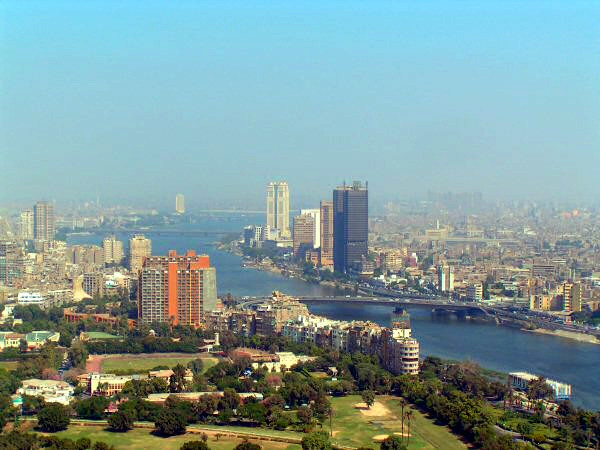
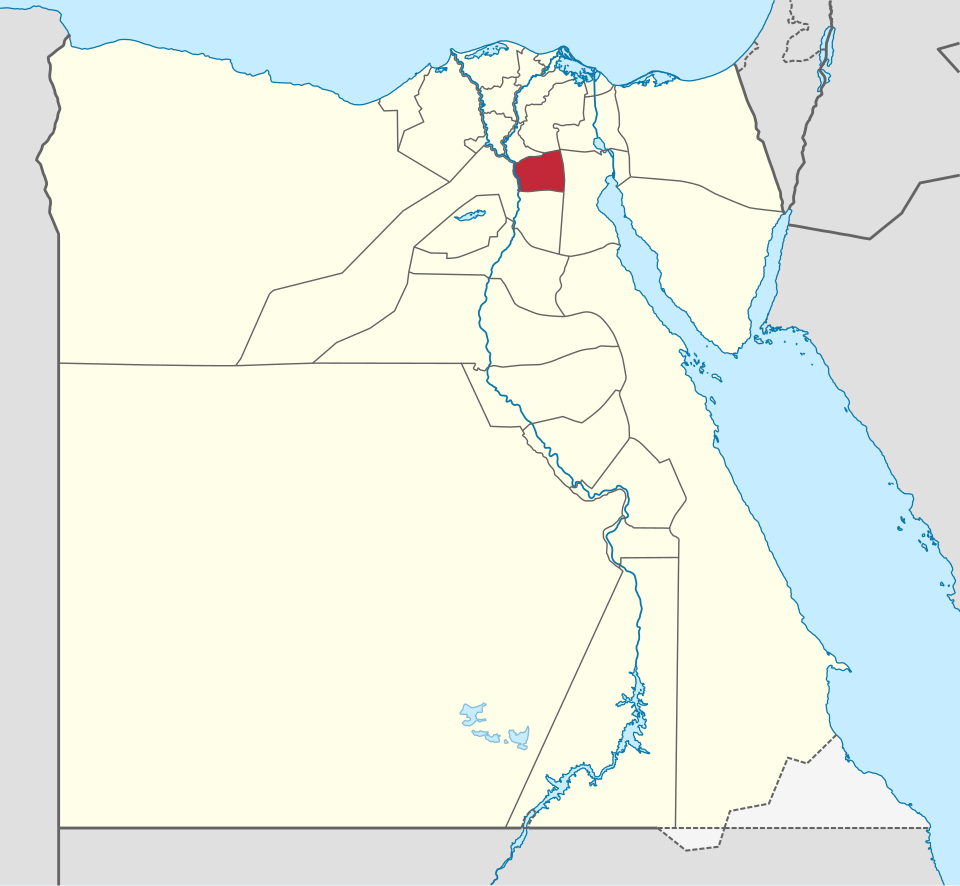
Cairo (, usually transliterated as Al-Qāhirah) is the capital and largest city of Egypt and the Cairo Governorate. The city name can be translated as the one who won.
Cairo has 7,947,121 people. About 17,290,000 people live in its urban area. This makes it the biggest city of the Arab World. It also is the city with the biggest urban area in Africa. The city is on the Nile River.
Ancient settlements
The area that is now Cairo has historically been an important area in Ancient Egypt because of its location at the place where the Nile River and Nile Delta meet. Memphis, an ancient capital of Egypt during the Old Kingdom was located a short distance southwest of what is now Cairo. Heliopolis was also located in the modern districts of Matariya and Ain Shams in Cairo.
The origins of modern Cairo began from a series of settlements in the 1st millenium AD. As Memphis became less important, the Romans built a fortress east of the Nile. This would become the fortress of Babylon, the earliest form of modern Cairo.
Fustat and other early Islamic settlements
After the Arab conquest of Egypt led by Muhammad’s companion Amr ibn al-As, Babylon fortress fell in April 641. After the surrender of Alexandria, he founded a new settlement next to Babylon fortress. The city was called Fustat () and became the new administrative capital of Egypt, replacing Alexandria.
In 720, following the Abbasid Revolution and the overthrow of the Umayyad Caliphate by the Abbasids, the new rulers of Egypt created a settlement north of Fustat called al-Aksar (), and a new mosque was completed.
Founding of Cairo
In 969, the Fatimid Caliphate conquered Egypt. The Fatimid Caliph al-Mu’izz li-Din Allah established a new fortified city northeast of Fustat known as al-Manṣūriyyah. It took four years to build the city, and it was built to become the new capital of their caliphate. During that time, the construction of al-Azhar Mosque was ordered, and the mosque would become a centre for learning and education, with its library having hundreds of thousands of books.
When Caliph al-Mu’izz arrived from the old Fatimid capital of Mahdia, he named the city Qāhirat al-Mu’izz (“The Vanquisher of al-Mu’izz”), which was eventually simplified to al-Qāhira, which is where the English name “Cairo” comes from.
Ayyubid and Mamluk eras
In 1171, Kurdish leader Saladin was appointed as the new vizier of Egypt by the Fatimids. Saladin ended Fatimid rule two years later, beginning the Ayyubid Sultanate. He built a large stone fortress on a hill known as the Cairo Citadel.
Later, in 1250, a group of slave soldiers called the Mamluks took control of Egypt and created the Mamluk Sultanate, ruled by a sultan. The Mamluks built many beautiful mosques and schools with tall towers called minarets. As a result, it became known as the “City of a Thousand Minarets”.
Ottoman era
In 1517, the Ottoman Empire conquered Egypt. Cairo became a provincial capital, ruled by a governor sent from the Ottoman capital Istanbul. During this time, Cairo lost some of its importance as a trade centre after European sailors found new sea routes around Africa to Asia, so fewer traders passed through Egypt.
Despite this, the Mamluks de facto stayed in power in the local government even though the ottomans were officially in charge (de jure)
Modern era
In 1798, the French military leader Napoleon Bonaparte captured Cairo for three years. After the French left, a new leader called Muhammad Ali Pasha became the wali (ruler) of Egypt, and is often called the “founder of modern Egypt”. He built many roads, factories and modern buildings in Cairo.
In the 1860s, Khedive Ismail wanted to make Cairo look like a “Paris on the Nile” and hired French architects to build a new district next to the old city with wide streets and parks, which is now called Downtown Cairo.
In 1992, Cairo was devastated by a 5.8 magnitude earthquake that caused 545 deaths, injuring 6,512, and made 50,000 people homeless, the most destructive since 1847.
In January 2011, Cairo became the centre of a massive revolution called the 2011 Egyptian Revolution during the Arab Spring, where thousands of Egyptians protested in Tahrir Square in downtown Cairo.
Nowadays, Cairo is growing very fast. Millions of people have migrated from the countryside to the city, causing urbanisation. This has led to pollution and traffic problems, and the majority of Egyptians living in slums are in Cairo.
Climate
The city of Cairo has a hot desert climate (BWh). It has a hot, sunny and dry climate all year long. The city, however, has more humidity than other cities with the hot desert climate (BWh).
Tourism
The Great Pyramids of Giza and the step pyramid of Saqqara are located on the west side of the Nile, in the Giza Governorate, which is considered part of the Greater Cairo Metropolitan Area.
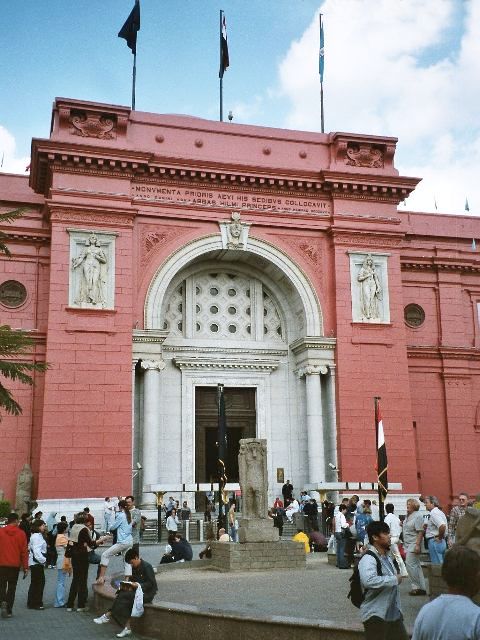
The Egyptian Museum holds the world’s largest collection of antiquities from the time of the ancient Egyptians. Many treasures from the tomb of Pharaoh Tutankhamun were previously in this museum, but have now been moved to the Grand Egyptian Museum in Giza.
Famous Cairenes
People from Cairo are called ‘Cairenes’.
- Abu Sa’id al-Afif - 15th century Samaritan physician
- Boutros Boutros-Ghali, former Secretary-General of the United Nations
- Naguib Mahfouz, novelist, awarded the Nobel Prize in Literature in 1988.
- Mido, Professional soccer player with Middlesbrough F.C
- Mohamed ElBaradei, Director-General of the International Atomic Energy Agency and 2005 Nobel Peace Prize laureate
- Naguib Sawiris, 62nd richest person on Earth in a 2007 list of billionaires, reaching US$10.0 billion with his company Orascom Telecom Holding
- Farouk El Baz, a great contributor to NASA
- Sir Magdi Yacoub, leading cardiologist, knight
- Constantin Xenakis (1931) Greek artist
- Voula Zouboulaki (1931) Greek actress
Where this page comes from
The article above is adapted from “Cairo” on Simple English Wikipedia, by its contributors. We removed reference markers, navigation boxes and tables, expanded measurement templates into readable numbers, and kept the prose otherwise intact.
Both sources are published under CC BY-SA 4.0, so this page is published under the same licence. You may share and adapt it, including commercially, as long as you credit the original and keep the same licence.
Worksheets, answer keys and printable layouts elsewhere on K5Print are our own work and are not covered by this licence.