Cambodia

Fast facts
- Official language
- Khmer
- Languages
- List * Cham * French * English
- Capital
- Phnom Penh
- Currency
- Riel
- Drives on
- right
- Calling code
- +855
Facts from Wikipedia’s “Cambodia” page (CC BY-SA 4.0).
Cambodia or Kampuchea (officially called Kingdom of Cambodia) is a country in Southeast Asia. It is near Vietnam, Laos, and Thailand. About 13 million people live in Cambodia. The people of Cambodia are called Cambodians or Khmer. Khmer is the official language. The country has recently emerged from a long civil war and the rule of the Khmer Rouge. It is part of ASEAN, Association of South East Asian Nations.
History
The ancestors of Cambodia had an empire called Angkor centered in the northwest of present-day Cambodia. The Angkor civilization is the world’s largest pre-industrial civilization. One of the buildings from Angkor is a Hindu/Buddhist temple called Angkor Wat, which is the world’s largest religious structure. This empire was later destroyed due to ecological and environmental problems as well as failing infrastructure. Theravada Buddhism came to the country in the 13th century via monks from Sri Lanka. Since then, Buddhism has been the official religion.
Geography
Cambodia is set entirely in the tropic zone. The Mekong River runs through the middle of the country and is the most important source of water in the country. The country is the size of Missouri.
Sports
In Cambodia, people play many sports. Some sports that are enjoyed that come from the West include golf, rugby and soccer. Traditional Cambodian sports are buffalo racing, dragon boat racing and bokator Khmer martial art also known as pradal serey. Cambodia attended its first Olympic Games in 1956 and participated in two more before warfare and civil strife interrupted its attendance. The country returned to regular participation with the 1996 Summer Games. Cambodia managed fourth in soccer in the 1972 Southeast Asian games. Cambodia hosted the GANEFO games in the 1960s. Sports is played in Cambodia to entertain people and too they can find out more about their own talents.
Culture
The culture of Cambodia has been influenced by Hinduism. Today most people in Cambodia practice Buddhism. A lot of their customs revolve around Buddhism.
The food of Cambodia includes tropical fruits, rice, noodles and various soups. Cambodians like to eat a rice noodle soup called ‘kah-tieu’ in the morning. Cambodians are famous for a type of ‘kah-tieu’ called ‘kah-tieu Phnom Penh’ which has shrimp, beef balls, fried garlic, pork broth and chicken. Cambodians also eat a red curry noodle soup with rice vermicelle noodles. Curry is also eaten with rice or French bread in Cambodia. Cambodian food is similar to Vietnamese and Southern Thai food.
Cambodia also has a mystical tattoo called a yantra tattoo that is popular with soldiers. A yantra tattoo has ancient Khmer and Pali (An ancient Indian language) writing. A yantra tattoo is usually done by a religious person or monk. The tattoo artist guarantees that the person cannot receive any physical harm as long as they follow certain conditions. A person is supposed to not talk to anyone for three days and three nights. Another alternative is to follow the five Buddhist percepts. Movie star actress Angelina Jolie is known to have a yantra tattoo.
Cambodians celebrate the Cambodian New Year in April. It is based on Theravada Buddhism. The date depends on astrological signs but are usually are on April 13-15 or April 14-16.
Flag
The Cambodian flag includes a three-towered temple called Angkor Wat. It is the most famous monument in the country. Many tourists visit the temple. The Cambodian flag has three horizontal bands. There are two blue bands on the top and the bottom. There is a red band that is twice the height of each blue band. The red band represents the nation. The temple represents the structure of the universe.
Provinces
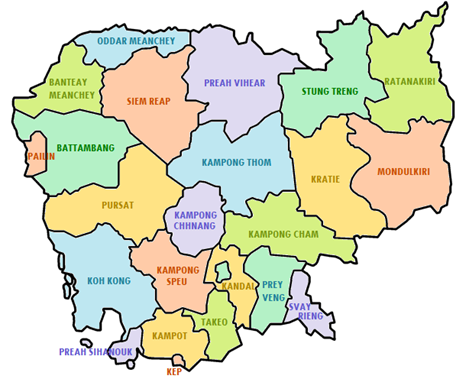
Cambodia is divided into 25 provinces including the capital. The provinces are divided into 159 districts and 26 municipalities. The districts and municipalities are then divided into communes and quarters.
Transportation
People in Cambodia use many different types of transportation. Transportation in Cambodia include: boat, car, motorcycle, elephant, train and airplane.
Economy
The Cambodian economy has been growing rapidly in recent years. Cambodia is set to build its first skyscraper, Gold Tower 42. Cambodia is also building a satellite city next to Phnom Penh which is called Camko City. Camko City is being constructed by Korean companies to modernize Phnom Penh so as to make it appealing to foreign investors and businesses. Cambodia is also one of the most corrupted nations in the world and has been pressured by international communities to fix it.
Foreign relations
Cambodia has foreign relations with most nations. It is part of ASEAN. Cambodia has border issues with Vietnam and Thailand over lost territories. Cambodia is one of a few nations with good relations with both Koreas. South Korean president Lee Myung Bak was an economic advisor to Cambodian prime minister Hun Sen and former Cambodian King Norodom Sihanouk was a good friend with former North Korean leader Kim Il-sung.
Ethnic groups
The Khmer (Cambodians) account for the vast majority of the population. Ethnic minorities include Chinese, Vietnamese, Muslim Cham-Malays, Laotians, and various native peoples of the rural highlands.
Land
Although much of Cambodia is heavily forested, the central lowland region is covered with rice paddies, fields of dry crops such as corn (maize) and tobacco, tracts of tall grass and reeds, and thinly wooded areas. Savanna grassland occur in the plains, with the grasses reaching a height of 5 feet (1.5 metres). In the eastern highlands the high plateaus are covered with grasses and deciduous forests. Broad-leaved evergreen forests grow in the mountainous areas to the north, with trees 100 feet (30 metres) high emerging from thick undergrowths of vines, rattans, palms, bamboos, and assorted woody and herbaceous ground plants. In the southwestern highlands, open forests of pines are found at the higher elevations, while the rain-drenched seaward slopes are blanketed with virgin rainforests growing to heights of 150 feet (45 metres) or more. Vegetation along the coastal strip ranges from evergreen forests to nearly impenetrable mangroves.
Written for younger readers
Cambodia, in simpler words
This version comes from Wikijunior, a set of books written for children aged 8 to 11. It is shorter and uses plainer language than the article above.
From Wikijunior: Asia
Cambodia’s history lies way back where King Jayavarman II founded the Khmer Empire in 9th century. The Khmer Empire was an overwhelmingly agricultural society.
During the 18th century Cambodia found itself squeezed between two powerful neighbors, Thailand and Vietnam. The Thais invaded Cambodia several times in the 18th century and in 1772 they destroyed Phnom Phen. In the last years of the 18th century the Vietnamese also invaded Cambodia. The Cambodian king was forced to look to the Thais for protection. In return Thailand took north-west Cambodia.
In the early 19th century King Chan (1806-1834) turned to the Vietnamese for protection from the Thais! The Thais were annoyed by this policy and when a rebellion occurred in south Vietnam in 1833 they took advantage by invading Cambodia. However the Vietnamese king crushed the rebellion and the Thai army retreated.
As a result the Vietnamese emperor strengthened his control over Cambodia. When Cambodian King Chan died in 1834, one of his sons was installed as King and Vietnamese people settled in Cambodia. The Vietnamese regarded the Cambodians as ‘barbarians’ an tried to ‘civilize’ them by teaching them Vietnamese customs. Resentment at Vietnamese influence led to a rebellion in 1840-1841. The Thais invaded again to re-assert their control of Cambodia.
However in the 1850s French missionaries arrived in Cambodia. The newly installed King Norodom sought French protection to protect him from both the Thais and the Vietnamese. So in 1863 Cambodia became a French protectorate. King Norodom, who was fearful of Siam, sought French protection. Although Cambodia was officially a Protectorate, with its own King, it was too all intents and purposes a colony by the end of the 19th century, and the French, who built their palaces and kept them from performing any significant political activities, placed all the next three kings of Cambodia on their thrones.
The capital city is known Phnom Penh and the currency used is riel
Cambodia is surrounded by three other Southeast Asian countries as well as a main body of water. It shares border with Vietnam to the east, Laos in the northeast, Thailand in the west and northwest, and has a coastline at the Gulf of Thailand in the southwest.Thailand lies to the upper northwest of Thailand, while Laos is to the northeast. Cambodia shares both its eastern and southern borders
As of latest 2019 national census, estimates about 15.3 million people lived in Cambodia. 97% of population are natives Khmer, 1.8% is Cham and 1.2% of population consists of ethnic minorities include Chinese, Vietnamese, Laotians, and various indigenous peoples of the rural highlands.
The most common language spoken in Cambodia are Spoken languages are Khmer (90% of populations). The language is used in government administration, imparting education at all levels, media, etc.
French is one of the important foreign languages spoken in the country. The language was at one time the official language in Indochina and today, a number of older Cambodians speak French. French is also used to impart education in some schools and universities in Cambodia, especially those that are funded by the French Government. Thus, Cambodia is a member of the La Francophonie, an organization of countries or regions where a significant portion of the population speaks French. Cambodian French is a French dialect that is spoken on certain occasions in Cambodia, especially in court environments.
Theravada (Hinayana) and Mahayana Buddhisms is the most common religion practiced in Cambodia with 93% of population practicing Buddhism. The Cham minority is Muslim (4%) , generally of the Sunni branch. The rest of minorities ethnic groups (3%) such as Khmer Loeu groups generally follow local religions, while ethnic Vietnamese and Chinese are eclectic (praying to local deities/gods), following Mahayana Buddhism and Daoism. Many Vietnamese are members of the Roman Catholic Church or of Vietnamese religious movements as Cao Dai.
Sepak takraw, which looks like volleyball, is a very popular sport in Cambodia.
Angkor Wat - It was built in the first half of the 12th century (113-5BC). Estimated construction time of the temple is 30 years by King Suryavarman II, dedicated to Vishnu (Hindu), replica of Angkor Thom style of art. It is now commonly accepted that Angkor Wat most likely served both as a temple and as a mausoleum for Suryavarman II.
Tonle Sap - The Great Lake in native language is the largest natural lake in Southeast Asia, is actually a complicated combined lake/reservoir and river system. The lake is fed by numerous tributaries, and usually, the Tonle Sap river drains the lake and flows to the south and into the Mekong at Phnom Penh.
Where this page comes from
The article above is adapted from “Cambodia” on Simple English Wikipedia, by its contributors. We removed reference markers, navigation boxes and tables, expanded measurement templates into readable numbers, and kept the prose otherwise intact. The simpler version is adapted from Wikijunior on Wikibooks.
Both sources are published under CC BY-SA 4.0, so this page is published under the same licence. You may share and adapt it, including commercially, as long as you credit the original and keep the same licence.
Worksheets, answer keys and printable layouts elsewhere on K5Print are our own work and are not covered by this licence.