Colombia

Fast facts
- Capital
- Bogotá
- Official language
- Spanish
- Currency
- Peso
- Time zone
- COT
- Drives on
- right
- Calling code
- +57
Facts from Wikipedia’s “Colombia” page (CC BY-SA 4.0).
Colombia officially the Republic of Colombia, is a tropical equatorial country in northern South America. It is in the northwest part of the continent, and it has an area of 1 141 748 km 2 (440 839 sq mi).
It is the only South American country with coasts on the Pacific Ocean and the Caribbean Sea.
The countries that have borders on the continent with Colombia are: Venezuela (east), Brazil (southeast), Peru (south), Ecuador (southwest) and Panama (west). The countries that have borders with Colombia on the sea are: Nicaragua, Panama, Costa Rica, Guatemala, Honduras, Jamaica, Haiti and Dominican Republic.
More than 51 million people live in Colombia. It is the third most populated country in Latin America after Mexico and Brazil.
The capital of Colombia is Bogotá. The second city is Medellín, a large industrial center. The third largest city is Cali, home to many multinational companies. The most important city of the country on the Caribbean coast is Barranquilla. It was also the first national port. Cartagena de Indias has a great Spanish wall from the 17th Century and an old town with 500-year-old buildings. After these cities comes Bucaramanga, a large city near the Venezuelan border, and the center of the textile industry in Colombia.
Meaning
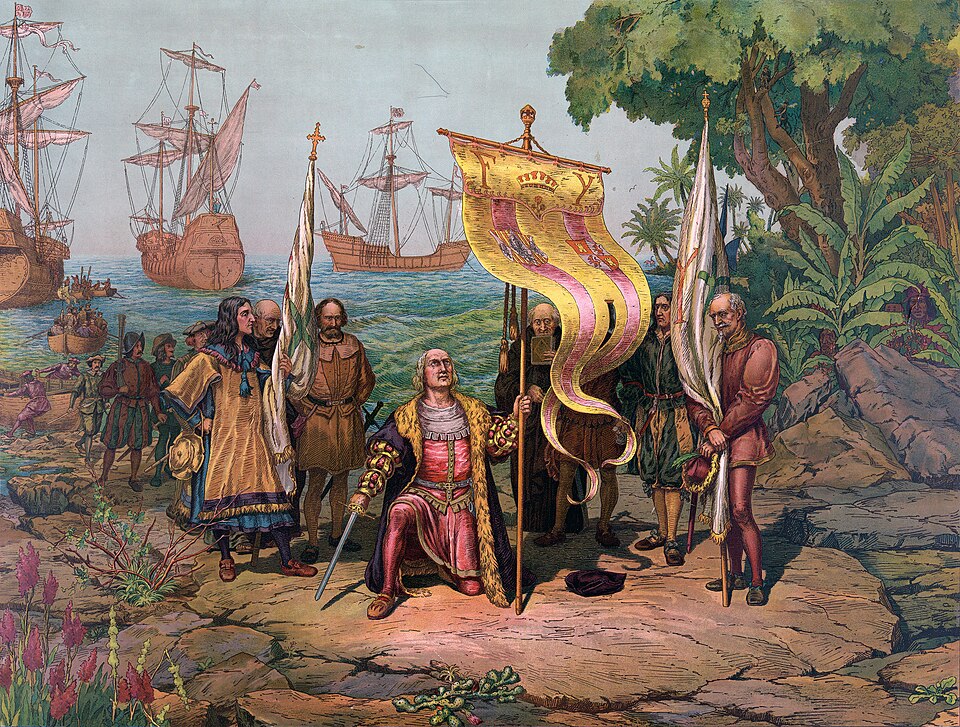
The word “Colombia” is named after Christopher Columbus, the explorer who began the European colonization of the Americas.
In 1819, Colombia, Venezuela, Ecuador and Panama declared independence from Spain, and formed a country called “Gran Colombia”. Venezuela and Ecuador separated in 1830. Panama continued to be part of Colombia until 1903, at which point it proclaimed independence. The official language is Spanish, but there are many languages spoken by minorities that are official in local jurisdictions.
Before the Spanish
The land where Colombia now stands has been home to people for more than 20 000 years. The first people had many groups, cultures, and languages. There are many tools, caves, and things of those peoples. In Colombia, the peoples were similar to those of Asia, because scientists say that the first people came to America from Siberia or southeast Asia more than 50 000 years ago. The peoples of Colombia were called Arawak, Caribe, and Chibcha, but there were many other groups. The most famous were the Muiscas. legend of El Dorado comes from the Muiscas. The king of the Muiscas used to bathe in Lake Guatavita and he used a lot of gold for his bath. The Spanish heard about this, and the people told them that there was a great golden city somewhere. They started to look for El Dorado. The International Airport of Bogotá is called El Dorado International Airport, because the legend was born in Colombia. The descendants of the first peoples of Colombia live integrated with others. Some groups live in the forest, but many live in the countryside and in the cities.
The colony
The Spanish, led by Christopher Colombus, first came to the Americas in 1492. Columbus saw the coasts of Venezuela, Colombia and Panama and he gave them his own name. But Alonso de Ojeda was the first colonist to explore the area of the Gulf of Darién. After that, the Spanish founded the first European cities on the American continent: Santa Marta in 1525 and Cartagena de Indias in 1533. It was from Colombia that the Spanish conquered the Incas of Peru.
Spain would enslave the indigenous peoples who were already living there, but they also used the port they built at Cartagena to bring many black slaves from Africa into the area. The Spanish captured many, many people from Africa and forced them to work on plantations and ranches, in mines, and as personal servants.
While this was happening, they founded the city of Popayán in 1536 and they conquered the Confederation of the Muiscas. In Bacatá, the capital of the Muiscas, the Spanish founded the city of Santa Fe in 1538. In 1550 the Spanish declared the territory as a colony and its capital was Santa Fe de Bogotá, but in the first decades it depended on Peru. Soon after, it was declared a Viceroyalty.
Independence
On November 11, 1810, the city of Cartagena de Indias declared its independence from Spain. The whole region would fight a war to become independent, led by people like Antonio Nariño and Simón Bolívar. Nariño was one of the most important leaders in the war for the independence of Colombia. He was a politician, journalist and soldier. Bolivar was another important leader, and he was a president and a colonel. Bolivar had promised Alexandre Pétion, the president of Haiti, that he would abolish slavery during his independence war. But he only agreed because he was afraid the slaves would revolt against the slaveowners, like they did in Haiti, and only freed slaves if they agreed to fight in his army. He never freed all the slaves, and slavery was not abolished in Colombia until 1851.
Geography
The geography of Colombia has six main natural regions, Each has its own unique characteristics. The Andes mountain region shares borders with Ecuador and Venezuela. The Pacific Coast region shares borders with Panama and Ecuador. The Caribbean coastal region shares borders with Venezuela and Panama. The Llanos (plains) shares a border with Venezuela. The Amazon Rainforest region shares a border with Venezuela, Brazil, Peru and Ecuador. The insular region includes all the islands of the country.
The main rivers of Colombia are Magdalena, Cauca, Guaviare, Atrato, Meta, Putumayo and Caquetá. Colombia has four main drainage systems: the Pacific drain, the Caribbean drain, the Orinoco Basin and the Amazon Basin.
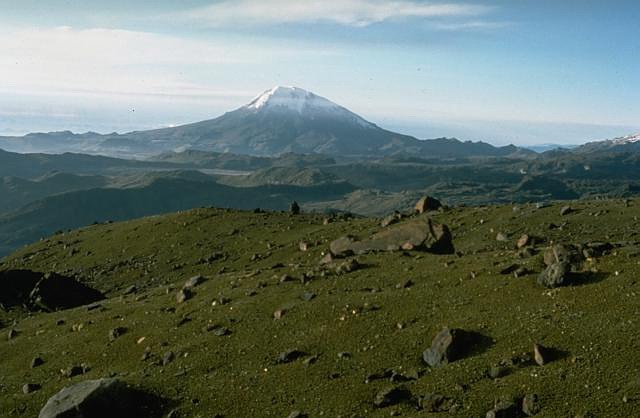
Most of the population lives in the Andes region. But the plains make over half the land. Only about 6% of the people live in the plains. The Sierra Nevada de Santa Marta mountain range includes the country’s tallest peaks (Pico Cristóbal Colón and Pico Simón Bolívar).
Climate
Colombia’s temperature changes with the altitude, and the temperature is different by region. The regions around the Andes are colder than the coast, which is lower.
Because of the many altitudes, Colombia has many different fruits, vegetables and kinds of animals. It has many valleys, beaches, plains, mountains and forests like the Amazon rainforest.
The top of some of the mountains in Colombia are so cold that people can ski over the equator. The lower mountains have warmer climates. The sea shores are cooled by ocean breezes. At sea level near the equator it is hot.
Rivers are important as waterways in the land for shipping things. One of the most important rivers in Colombia is the Magdalena-Cauca. The Magdelena River divides the eastern and center mountains. It makes a fertile valley. The Cauca River divides the center mountain range and the western ridge, making another great valley. The Cauca is really a part of the Magdalena. However, the two do not meet until a few miles before the Magdalena goes into the Caribbean Sea.
Biodiversity
Colombia is a megadiverse country. This means the country is home to a majority of Earth’s species. There are also a high number of endemic species.
Colombia has 1900 species of bird, more than any other country. There are about 2000 species of marine fish. It is the second most diverse country in freshwater fish. As for plants, the country has between (40 000 and 45 000) species. Colombia is second in the number of amphibian species and is the third most diverse country in reptiles. There are about 2900 species of mollusk.
Colombia is the world’s leading producer of emeralds, with 70–90% of the world’s emeralds coming from the country.
Politics
In May 2006, President Álvaro Uribe was re-elected. His term lasted until 2010. Uribe was the first President in Colombia to win a second election in over 100 years.
In August 2010, Juan Manuel Santos became Colombia’s president. Santos won the election on June 20 by a landslide. He promised to “preside over a government of national unity that will bring social prosperity for all Colombians”
Eight years later, conservative Senator Iván Duque Márquez was elected president. He won the election by 2 million votes against his rival liberal Senator Gustavo Petro.
The actual president is Gustavo Petro, former senator and guerrilla in M-19 who won with 11 million votes and the second place was Rodolfo Hernandez, a polemic former mayor and entrepreneur.
Departments
Colombia is divided into 32 departments and one capital district. The capital district is treated as a department. Departments are divided into municipalities. Municipalities are divided into corregimientos. Each department has a local government with a governor and assembly directly elected to four-year terms. Each municipality is headed by a mayor and council. Each corregimiento by an elected corregidor, or local leader.
Demographics
The population of Colombia was approximately 47 million as of 2016. The ethnic groups of the population are:
- 48% Mestizo
- 23% Mulatto
- 20% White
- 6% Black
- 2% Amerindian
- 1% Zambo
Economy
Up to 49.6% of the population is living below the poverty line.
Security
There are several guerilla groups in Colombia, the FARC being the most powerful, a guerilla group responsible for kidnappings, murders, attacks, and drug-dealing. Drug dealing is a problem the government has been trying to fight. This creates violence in the cities. With Operation: Jaque, Ingrid Betancourt, three Americans, and 11 soldiers were rescued from the FARC.
Transport
Most parts of Colombia are modern and the country has many roads. All major Colombian cities have airports and there are many ports on both oceans (Pacific and Atlantic). Because Colombia is a huge country and there are many mountains, airports are very important in the country. There are some regions like the Amazon Forest and Dariend, where the most important way of transportation is by the rivers.
- Roads: The Pan American Highway in South America begins in Colombia. You can go as far as Tierra de Fuego in Chile using that road. Most of the Colombian cities are connected by road in Colombia. The most important roads are the Bogotá-Medellín Highway, the Bogotá-Cali Highway, the Bogotá-Cucuta Highway, the Bogotá-Barranquilla Highway and many others connecting big cities like Medellín, Cali, Barranquilla and Cartagena de Indias with other important centers. You can go by road from Bogotá to Caracas, Venezuela and Quito, Ecuador. The major cities have bus stations.
- Airports: They are very important in Colombia and all the main cities have their own airports. The El Dorado International Airport in Bogotá is the most important. The Palmaseca International Airport in Cali is the second most important. Other important airports are the ones of Medellín, Barranquilla, San Andrés and Cartagena de Indias. The Colombian airports have international connections with most of the South American capitals, North America and Europe. The main Colombian airline is Avianca and it is the second oldest world airline and one of the most important in Latin America.
- Ports: Colombia has coasts on both oceans - Atlantic and Pacific - and it is one of the first world water reserve because it has many rivers and lakes. The longest rivers are the Amazon, Magdalena, Cauca, and the Atrato. The main ports on the Atlantic coast are Barranquilla, which was the first Colombian port, Cartagena de Indias and Santa Marta. There are other ones like Rioacha and Turbo. The ports on the Pacific coast are Buenaventura and Tumaco. The port of the San Andres Island is also one of the most important for the country in the Caribbean and Antillean Sea. The city of Leticia is a very important river port on the Amazon river.
- Train: The National Train was very important to Colombia during the 20th century, but it was forgotten when roads and airports were developed. Today the railways in Colombia are used more for tour visits, and they are not modern.
- Transportation in the cities: The major Colombian cities have a very good system of transportation. There are public buses that connect the suburbs to the center of the cities. There are many taxi companies in Colombia. There are also very modern urban transports in the main cities like Transmilenio in Bogotá, the Metro in Medellín, and similar proposals in Cali, Barranquilla, Cartagena de Indias and many others that are being developed.
Cities
Colombia also has some very well known cities.
- Bogotá is the second largest capital city of South America after Buenos Aires and the third largest city after Buenos Aires and São Paulo. It is also one of the highest capital cities of the world, 2640 meters above sea level. It has a very active cultural, political, industrial and commercial life. Bogotá also has many international meetings, seminars, NGOs, organizations, universities, telecommunication centers and conventions. It is in the Andes. Many famous Colombians come from Bogotá like Rafael Pombo, José Asunción Silva and Juan Pablo Montoya.
- Medellín is the second largest city of Colombia. At the end of the 20th Century it was known as the “most violent city of the world” because it was the hometown of Pablo Escobar, the leader of the Colombian Mafia. Now Medellín is safer and has become a very beautiful city. It is a very important industrial center, the first commercial area of the country and a leader in healthcare and medicine. Many foreigners come to Medellín for health services. It is in the Andes and it is known as the “City of the Eternal Spring” because it has nice weather. Many famous Colombians come from Medellín like the singer Juanes, the soccer player René Higuita, the artist Fernando Botero and many others.
- Cali is the third largest city. It is very famous for its plantations of sugar cane. Cali is known as the “World Capital of Salsa”. In Cali there are many skillful salsa dancers and very important Salsa groups. Cali is also a very modern city. It is an industrial city and its airport is the second in Colombia. Near Cali is the port city of Buenaventura in the Pacific Ocean. Cali is in a valley of the Andes. The name of the Valley is Cauca because it is crossed by the Cauca River.
- Barranquilla is the fourth largest city and it was the first city in Colombia on the Caribbean Sea. Barranquilla is famous for its trade and international connections because it has a big port. The Colombian singer Shakira is from Barranquilla.
- Cartagena de Indias is the most important tourist center in Colombia on the Caribbean Sea. It is also a very beautiful city. Many tourist come to visit the city.
- Bucaramanga is near the Colombian border with Venezuela. This city is a great destination for travelers due to its Spanish history and its technological & urban development; it is a very popular city.
- Eje Cafetero (Coffee Growing Axis) is the name of the region where coffee is grown in Colombia. There are three important cities: Pereira, Manizales and Armenia.
Science
Colombia has made many advances in medicine. Many foreigners come to the country to get health services, such as organ transplants or plastic surgery. Doctor Manuel Elkin Patarroyo of Colombia discovered a medicine against malaria. He donated his discovery to be used in Africa and Latin America. He did not want to make business of it, instead he wanted to use it to help people.
Resources
Colombia is known for its coffee, coal, and emeralds. It is also the biggest supplier of plantains to the United States. There are a few armed conflicts in Colombia. Most rebel groups finance their operations with the trade of illegal drugs (mostly cocaine).
Written for younger readers
Colombia, in simpler words
This version comes from Wikijunior, a set of books written for children aged 8 to 11. It is shorter and uses plainer language than the article above.
From Wikijunior: South America
Part of Wikijunior South America project
Colombia is a country in the northwest of South America. It is home to forty-eight million people. This includes nine million or more people living in the capital Bogota D.C. (Bogota Distrito Capital = Capital District of Bogota). Nearly three-quarters of the Colombian people live in cities, as compared to under two-thirds at the year 1955.
Of the people, 1.4% are indigenous Amerindians. They live in the eastern lands and around the country. A third have less than 15 years of age, two-thirds are aged between 15 and 64 years, and five percent have more than 64 years. The average Colombian man today has an expected life 67 years; the average Colombian woman today has an expected life 76 years. For each 1000 Colombians, 22 babies are born each year, and 5 people die each year.
Most Colombians live in western Colombia in the valleys and basins of the Andes Mountains.
Colombians are generally close to their families, especially because of the Catholic faith of most Colombians. Many families are extended as well as nuclear. Godparents (padrinos) are particularly important. They give money and help the family of the child in his or her upbringing.
Many women in Colombia are working outside the home, and are professionals and in high positions in government, education, etc.
The flag of Colombia has yellow, blue and red stripes. The yellow is wider than the other two and represents the native gold, blue indicates two oceans and red represents the blood spent in the struggle for independence from Spain.
The Coat of Arms of Colombia contains a shield with numerous symbols. Perched on top of the shield is a condor holding olives. The national flag is draped on each side of the shield. On the shield itself, there are ships, a Phrygian cap, a pomegranate and two horns of plenty containing fruit and gold and silver coins.
Bogotá is the capital of Colombia, as well as the county’s largest city with more than eight million inhabitants. The first European settlement was in 1538, but it was a population center for the native Muiscas long before that. Bogotá is the business hub of the nation and is home to Colombia’s stock market. It also has many schools, Universities, and colleges.
There were two main groups living in Colombia before Spanish Colonization. They were the Carib and the Chibcha. A Chibchan tribe called the Muisca lived in the region where Bogota is now. The Muisca traded salt, emeralds, beans, maize and other crops with other tribes.
The first permanent Spanish settlement, at Santa Marta, was founded in 1525. In 1549, Santa Fe de Bogota became the capital of New Granada. New Grenada was what the Spanish called the area that is now Colombia.
In 1819, forces led by Simon Bolivar won Colombia’s independence. At first, Colombia, Venezeula, Panama and some other nearby areas were all part of a country called Gran Colombia (Greater Colombia). Venezuela and Ecuador split off from Colombia first. Later Panama revolted, and gained its independence.
In the last forty years of the twentieth century, there was civil war in Colombia. This war continues today. The main combatants are the Colombian military, independent private armies (called paramilitaries), and two different rebel groups. The Colombian government is working to disarm the paramilitary and disarm or defeat the rebels.
Colombia is very close to the equator and parts of the country are very hot. The country also has many high mountains and the higher the altitude the cooler the climate. Colombia has less than 1% of the world’s area, but 10% of the species in the world can be found there. There is a wide variety of birds there too. Almost 15% of the world’s species of birds are found in Colombia.
Colombia exports oil and petroleum products. Colombia is also renowned all over the world for its coffee. The coffee is mainly grown in volcanic soil on plantations in the Andes mountains. Colombia has many delicious native fruits that it sells. Colombia produces tropical fruit juices and concentrates. Cut flowers are another product that Colombia is famous for, they are sold to the rest of the world. Colombia is also famous for their roses. They ship roses all across the world for countries to sell.
Most Colombian kids go to primary school between the ages of 6 and 11. Primary schooling is paid for by the government and mandatory for all kids. Still, some kids in this age group do not go to school, especially in rural areas. School is conducted in Spanish. There is often Catholic religious instruction as well as instruction in mathematics, science, reading, and writing.
In rural areas there may be many different ages in the same classroom. Because many of the students in rural areas are poor some must frequently miss school so they can work. Some rural Colombian schools are “New Schools”. They provide guidebooks that allow students to work self-directed at their own pace with assistance from an instructor and other students. Students of all ages will sit at a large table each working on a different course of study from their guidebooks.
Only half of Colombian kids continue their education into secondary school. Secondary school starts at age 11 and continues for six years. Unlike some other countries, there is no vocational training in secondary school. Colombia has twenty-four public Universities, so there are opportunities for good students to pursue higher education.
Colombians eat a wide variety of meats, vegetables, and fruits. The biggest meal of the day happens at midday. One very common dish is called Ajiaco. It is a type of chicken soup. It typically contains chicken, corn, potatoes, sour cream, capers, and avocado. Bandeja paisa is a dish from a mountainous region named Antioquia. This dish typically has many different types of foods and large portions, it is served on large trays. Typically, bandeja paisa includes beans, rice, ground meat, spicy sausage, fried egg, corn cakes(arepas) and pork skin(chicharon). It is usually accompanied by avocado, and tomato.
A unique musical style in Colombia is called cumbia. It comes from Ghana, Africa, and is a combination of folk and dance. Many working people enjoy it. The costumes associated with cumbia are colourful.
In the north part of Colombia, vallenato is played. Vallenato is a musical genre characterized by instruments like accordion, guacharaca, etc. Big vallenato singers are: Diomedes Diaz, Los Hermanos Zuletas, Los Betos, Ivan Villazon, El Binomio de oro, etc. Today, there are a lot of new and great vallenato singers.
Champeta is another type of music develop in the Atlantic Coast, especially in Cartagena. At the beginning it was rejected because it was considered not appropriate, since the singers came from low-status families, the content in it was not appropriate and its dancing was very sensual. Today is well recognized and played in most of Colombian cities.
Some of the national sports include soccer, tennis, baseball, and bicycle racing, and also competitive skating. The indigenous people contributed the ancient game TEJO! to Colombia. The players use a heavy metal disk and throw it at a distance to a triangular piece of paper (usually pink) filled with gunpowder, and Boom! The aim of the game is to cause many explosions for your throw.
The famous novel writer: “Gabriel Garcia Márquez”, is a national from this country. The international pop music star Shakira is also from Colombia. A famous Colombian painter named Fernando Botero is noted for his portraits. In the portraits, his subjects look very fat. The actor and comedian John Leguizamo was born in Colombia before immigrating to the United States. Also the famous singer Shakira was born in Colombia.
es:Wikichicos/América del Sur/Colombia
Where this page comes from
The article above is adapted from “Colombia” on Simple English Wikipedia, by its contributors. We removed reference markers, navigation boxes and tables, expanded measurement templates into readable numbers, and kept the prose otherwise intact. The simpler version is adapted from Wikijunior on Wikibooks.
Both sources are published under CC BY-SA 4.0, so this page is published under the same licence. You may share and adapt it, including commercially, as long as you credit the original and keep the same licence.
Worksheets, answer keys and printable layouts elsewhere on K5Print are our own work and are not covered by this licence.