Colorado

Quick facts
- Capital
- Denver
- Largest city
- capital
- Motto
- Nil sine numine
- Abbreviation
- CO
- Became a state
- August 1, 1876 (the 38th state)
- Area
- 104,185 sq mi (269,838 km²)
- Population (2020)
- 6,012,561
Facts from Wikipedia’s “Colorado” page (CC BY-SA 4.0).
Colorado is a state in the western United States. Its capital and largest city is Denver. Other large cities are Colorado Springs and Aurora. Colorado became the 38th state admitted to the union on August 1, 1876.
History
Native Americans were the first people to live in Colorado. Some important Colorado Native American peoples are the Navajo, Ute, and Cheyenne-Arapahoe Indians. The state was named after the Colorado River by Spanish explorers. US Army officer and amateur explorer Zebulon Pike was recruited by the United States government in 1806 to find the source of the Mississippi River and to check out Spanish settlements in New Mexico. Even though his recorded location for the source of the Mississippi was wrong and he allegedly got lost in his expedition, he did explore much of what would become the American Southwest. When he reached what is now Colorado Springs, he named a mountain after himself, Pikes Peak, which remains a symbol for the city as well as the state to this day.
Colorado has a long history of mining and digging for gold. It is the place where the Pike’s Peak Gold Rush took place. When gold in California was becoming harder and harder to find, people came to Colorado in large numbers when gold was discovered there in 1859, ten years after the California Gold Rush began. Many mining camps set up in Colorado would later become cities, such as Denver City and Boulder City. The motto for the gold rush was “Pike’s Peak or Bust”.
Geography
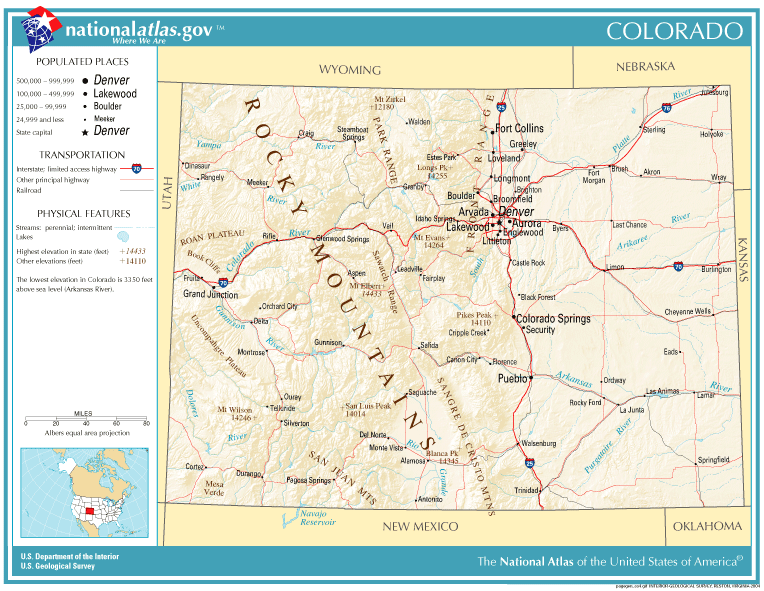
The State of Colorado is shaped like a rectangle. The borders are latitude and longitude lines. The four borders are at 37°N, 41°N, 102°03’W, and 109°03’W. (The east and west borders are 25°W and 32°W from the Washington Meridian.) Colorado, Wyoming, and Utah are the only three U.S. states that have only lines of latitude and longitude for boundaries and that have no natural borders. When government surveyors made the border markers for the “Territory of Colorado”, minor surveying mistakes made many small kinks along the borders, most seen along the border with the “Territory of Utah.”
The tip of Mount Elbert at 14,440 feet (4,401 m) elevation in Lake County is the state’s highest point and the highest point in the entire Rocky Mountains. Colorado has more than 100 mountain peaks that reach over 4,000 meters (13,123 ft) in height. Colorado is the only U.S. state that lies entirely above 1,000 meters (3,281 ft) in height. Colorado has the highest average elevation of any state at 6,800 ft. It borders New Mexico, Arizona, Utah, Oklahoma, Kansas, Nebraska, and Wyoming.
The land area of Colorado is roughly the same size as New Zealand.
Climate
The weather and temperatures in Colorado are quite different compared to most of the United States. In most other states, the southern part is warmer than the northern part, southern Colorado is not noticeably warmer than northern Colorado. Mountains and surrounding valleys greatly affect local climate. As a normal rule, with an increase in height comes a decrease in temperature and an increase in rain. The Rocky Mountains on the west have a very different climate than the Great Plains on the east. Between these two areas is a smaller mountain range known as “the Foothills”.
Population
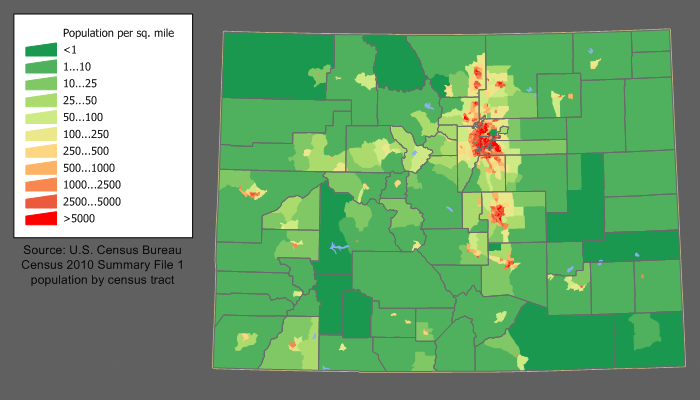
The state’s largest city, and capital, is Denver. The “Denver-Aurora-Boulder Combined Statistical Area”, is home to 2,927,911 people, it has more than two-thirds of the state’s population.
As of 2005, Colorado has an estimated population of 4,665,177, which is an increase of 63,356, or 1.4%, from the last year and an increase of 363,162, or 8.4%, since the year 2000. This has a natural increase since the last census of 205,321 people (that is 353,091 births minus 147,770 deaths) and an increase because of migration of 159,957 people into the state. Immigration from outside the United States makes a net increase of 112,217 people, and migration within the country made a net increase of 47,740 people.
Religion
Colorado’s most common religion is Christianity, and its most common denomination is Catholicism. Colorado, and mostly the city of Colorado Springs, serves as the headquarters of many Christian groups, many of them Evangelical. “Focus on the Family” is a big conservative Christian organization headquartered in Colorado Springs.
Major religious affiliations of the people of Colorado are:
- Christian – 65%
- Protestant — 44%
- Unaffiliated – 25%
- Evangelical – 23%
- Mainline — 19%
- Roman Catholic — 19%
- Other Religions – 5%
- Jewish — 2%
- Latter Day Saint / Mormon— 2%
- Other Protestant – 2%
- Muslim — 1%
- Orthodox — 1%
Economy
The Bureau of Economic Analysis estimates the total state product in 2007 was $236 billion. Income per person in 2007 was $41,192, ranking Colorado eleventh in the United States. Early companies were based on mineral extraction and agricultural. Today’s agricultural products are cattle, wheat, dairy products, corn, and hay.
On January 1, 2014 Colorado became the first state to make marijuana legal. In the first week of 2014, $5 million of marijuana was sold. The marijuana industry was expected to add $359 million to Colorado’s economy by the end of 2014.
Written for younger readers
Colorado, in simpler words
This version comes from Wikijunior, a set of books written for children aged 8 to 11. It is shorter and uses plainer language than the article above.
From Wikijunior: North America
Colorado is a state located in the Rocky Mountain region of the United States of America. Colorado may also be considered to be a part of the Western and Southwestern regions of the United States. Denver is the capital as well as the most populous city of Colorado. Residents of Colorado are known as Coloradans.
The region that is today the State of Colorado has been inhabited by Native Americans for more than 13 thousand years. Colorado women were granted the right to vote beginning on July 11, 1863, making Colorado the first U.S. state to grant universal suffrage by popular vote. By the 1930 U.S. Census, the population of Colorado had grown to more than one million residents. The state suffered through the Great Depression and the Dust Bowl of the 1930s, but a major wave of immigration following World War II boosted Colorado’s fortune. Colorado’s population had grown to more than 4 million by the year 2000.
Weather is often extreme in Colorado. Thunderstorms are common east of the Continental divide in the spring and summer, and Colorado is one of the leading states in deaths due to lightning. Hail is a common sight in the mountains east of the divide and in the northwest part of the state. While not as common as some of the states to the east, much of the Eastern Plains are prone to tornadoes, and there have been some damaging tornadoes there.
Floods are also a factor in the plains, not just from the thunderstorms, but also because of the heavy snow in the mountains followed by a warm, dry period which makes rivers rise with melted snow. In 2008, from July through August, a new record was set that was previously held in 1901 of twenty-three straight days of 90 degree heat, beating the previous record by almost a week. Colorado is also known for its droughts that occur every few years, causing major wildfires such as the Hayman Fire, one of the largest wildfires in US history.
Where this page comes from
The article above is adapted from “Colorado” on Simple English Wikipedia, by its contributors. We removed reference markers, navigation boxes and tables, expanded measurement templates into readable numbers, and kept the prose otherwise intact. The simpler version is adapted from Wikijunior on Wikibooks.
Both sources are published under CC BY-SA 4.0, so this page is published under the same licence. You may share and adapt it, including commercially, as long as you credit the original and keep the same licence.
Worksheets, answer keys and printable layouts elsewhere on K5Print are our own work and are not covered by this licence.