Croatia

Fast facts
- Official language
- Croatian
- Languages
- Latin
- Capital
- Zagreb
- Currency
- Euro
- Time zone
- CET
- Drives on
- right
- Calling code
- 385
Facts from Wikipedia’s “Croatia” page (CC BY-SA 4.0).
Croatia ( ) is a unitary democratic parliamentary republic in Central and Southeastern Europe. Croatia has been influenced by powers from both regions at varying points in its history. Its capital and largest city is Zagreb. Croatia is a part of the Balkans, and was one of the republics of the Socialist Federal Republic of Yugoslavia. It became independent in 1991. It joined the European Union on 1 July 2013.
History
In earlier times, the land now known as Croatia was inhabited by different kinds of humans including Neanderthals and Neolithic cultures. In Roman times seafaring pirates known to the Romans as the Dalmatian Tribes lived there, as the Histri, Liburni and the Delmatae. The Romans conquered and annexed the territory in 9 AD. They called it the province of “Dalmatia,” named after these tribes. During more than 400 years of Roman rule, the province of Dalmatia would become Romanized. The Roman invaders mixed with the natives. Their descendants adopted a Roman lifestyle even after the collapse of the Roman state in 476 AD.
In the early seventh century pagan West Slavs named the Croats (where Croatia gets its name) came to live in the former province of Dalmatia. They conquered the people already living there. They were influenced by Roman Catholic Christian missionaries who completed the process of Christianization in the early 9th century. Tomislav in 925 was the first King of Croatia. Croatia was an independent Catholic kingdom until 1102, when a Hungarian prince inherited the Croatian throne. The Hungarians would rule as Kings of Croatia until the early modern period. The last Hungarian king of Croatia Louis II was killed at the Battle of Mohacs in 1526. The kingdom chose the Austrian Archduke Ferdinand as king the next year.
Croatia would remain as a part of the empire of Austria-Hungary under Ferdinand’s descendants until 1918. In 1918 it became a part of the Kingdom of Slovenians, Croats and Serbs, later named Yugoslavia. It was occupied in World War II. After a short war with Italy a fascist dictatorship formed the Independent State of Croatia in 1941. It was not independent from the control of Nazi Germany (see also Jasenovac concentration camp).
In 1945, Croatia became a part of the Socialist Federal Republic of Yugoslavia which was non-aligned after breaking connections with the Eastern Bloc. It collapsed in 1991. Slovenia, then Croatia, later the other republics claimed independence and became parliamentary democracies. War in Yugoslavia made a strong impact on society in economic, political and cultural terms. Civil society and media that came out of anti-war struggle in Croatia grew against nationalism, media and civil freedoms, later also corruption.
The country’s democratic development around 2000, made it possible for Croatia to finally join Slovenia as a European Union member on 1 July 2013.
In recent decades Croatia is a popular tourist destination, especially the coastal regions of Dalmatia and Istria.
Geography
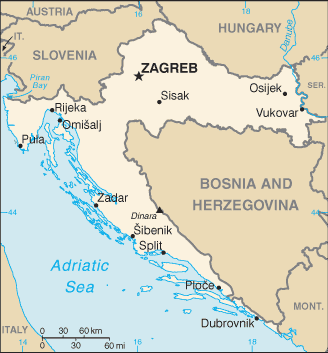
Croatia is in Central and Southeast Europe, bordering Hungary to the northeast, Serbia to the east, Bosnia and Herzegovina to the south-east, Montenegro to the south-east, the Adriatic Sea to the south-west and Slovenia to the northwest. It lies mostly between latitudes 42° and 47° N and longitudes 13° and 20° E. Part of the territory in the extreme south surrounding Dubrovnik is a practical exclave connected to the rest of the mainland by territorial waters. It is separated by a short coastline strip belonging to Bosnia and Herzegovina around Neum. Croatia is divided into 21 counties.
Croatia is the 127th largest country in the world. The highest point is the Dinara peak at 1,831 metres (6,007 ft). Thousands of islands are part of Croatia. 48 have people living there year-round. The largest islands are Cres and Krk. Major rivers are the Sava, Drava, Kupa and Danube.
There are many deep caves in Croatia. 49 are deeper than 250 m. Croatia’s most famous lakes are the Plitvice lakes.
Climate
Most of Croatia has a moderately warm and rainy continental climate. Average temperature ranges between -3 degrees Celsius (-3 °F) in January and 18 degrees Celsius (18 °F) in July. The coldest parts of the country are Lika and Gorski Kotar. The warmest are at the Adriatic coast.
Biodiversity
There are several ecoregions in Croatia. The coastline, forests, mountains, and rivers give Croatia diverse flora and fauna. There are more than a thousand endemic species.
Croatia is home to the only known aquatic cave vertebrate—the olm.
There are 444 protected areas of Croatia. Those include eight national parks, two strict reserves, and ten nature parks. The oldest national park in Croatia is the Plitvice Lakes National Park, a UNESCO World Heritage Site.
Politics
Croatia adopted its constitution in 1990. It declared independence from Yugoslavia on 8 October 1991.
The President of the Republic is the head of state. The President is directly elected to a five-year term. The Constitution limits the President to a maximum of two terms. Zoran Milanović became president in 2020. The Prime Minister of Croatia is the head of government. Since 2016, the prime minister of the government is Andrej Plenković.
Economy
Croatia is one of the richest countries of the Balkan Peninsula and of the former Yugoslavia’s countries. But Croatia had also the highest cost prices of the whole Central Europe. The average monthly salary/wages in Croatia standing on 739 euro or nearly US$1000.
The retirement age for men is 65 years and for women 60 years. Healthcare is quite good.
Education
Education is free and required until the child reaches the age of 15. Many choose to continue their studies in high school until the age of 18.
Tourism
After the war that devastated the country, Croatia has rebuilt its infrastructure. Its image is a Mediterranean country with crystal clear waters. It has medieval cities that mix western and eastern architecture. Dubrovnik is the symbol of this new Croatia that is strongly committed to European tourism.
There are many reasons to visit Croatia. Its six UNESCO World Heritage sites : Dubrovnik’s Old Town (undoubtedly one of the most beautiful cities in Europe), the Diocletian’s Palace in Split, the historic core of Trogir, the Cathedral of St. James of Sibenik, the Plitvice Lakes National Park, or the Episcopal Ensemble of the Euphrasian Basilica in the Historic Center of Porec (Istria) .
The coastline winds from the Istria Peninsula to the south of Dalmatia. Many people visit the islands, such as Hvar or Korcula in Dalmatia or Rab and Losinj in Kvarner Bay. Nudism is associated with Croatia, in its crystalline waters.
Written for younger readers
Croatia, in simpler words
This version comes from Wikijunior, a set of books written for children aged 8 to 11. It is shorter and uses plainer language than the article above.
From Wikijunior: Europe
Croatia is a country in southern Europe. It shares borders with Slovenia, Hungary, Serbia, Bosnia Herzegovina and Montenegro. The capital city is Zagreb. Other big cities are Split, Rijeka and Dubrovnik. The currency of Croatia is the euro. On July 1, 2013, Croatia became the 28th member of the European Union.
The name Croat dates back to 6th and 7th centuries, when the Croats came from the Carpathian Mountains to today’s Croatia.
From the early 20th century Croatia was part of Yugoslavia. In 1991, Croatia proclaimed independence by holding the first democratic elections in the country. The complicated situation meant that it was forced to fight a brutal war took place that devastated many parts of Croatia and other parts of Yugoslavia.
Croatia was recognized as an independent country on January 15, 1992 by the European Union and the United Nations. The first country to recognize Croatia was Iceland on December 19, 1991.
Croatia is famous for its diverse geography. Although it is a small country, Croatia has thousands of kilometres of coastline and more than thousand islands. Inland the government has set aside large parts of the country as national parks and forests.
The largest island is Cres which is 405km². The highest mountain in Croatia is Dinara at 1,830 metres.
The majority of people in Croatia are Croats but there are also large minorities of Serbs. In addition there are small minorities of Hungarians, Italians and Bosnians. The language of Croatia is Croatian which was previously known as Serbo-Croat. The majority of Croats are Catholic but there are also many Orthodox Christians and Muslims. Small numbers of Italian speakers live in Istria in the north-west of the country.
Croatia is one of the most popular holiday destinations in the world. It is famous for its thousands of kilometres of indented coast line and islands. It is home to many national parks, UNESCO World Heritage Sites and historical cities. The city of Dubrovnik in southern Croatia is considered to be one of the most beautiful cities in the world. Other places popular with tourists include the Istrian peninsula (and its cities of Pula and Rovinj), the capital Zagreb, Split and Zadar.
More than 12 million tourists visit Croatia every year. The country has seven UNESCO World Heritage Sites including: Plitvice Lakes National Park, an area full of lakes, caves and forests and the Old City of Dubrovnik, consistently rated as one of the most beautiful cities in the world. Before the wars in the 1990s ten million tourists visited the country every year. During the Yugoslavian wars tourists disappeared and the number of tourists didn’t reach pre-war levels again until 2006. Now more tourists visit the country than ever before.
Where this page comes from
The article above is adapted from “Croatia” on Simple English Wikipedia, by its contributors. We removed reference markers, navigation boxes and tables, expanded measurement templates into readable numbers, and kept the prose otherwise intact. The simpler version is adapted from Wikijunior on Wikibooks.
Both sources are published under CC BY-SA 4.0, so this page is published under the same licence. You may share and adapt it, including commercially, as long as you credit the original and keep the same licence.
Worksheets, answer keys and printable layouts elsewhere on K5Print are our own work and are not covered by this licence.