Czech Republic

Fast facts
- Capital
- Prague
- Languages
- Czech
- Currency
- Czech koruna
- Time zone
- CET
- Drives on
- right
- Calling code
- +420 b
Facts from Wikipedia’s “Czech Republic” page (CC BY-SA 4.0).
The Czech Republic (Česká republika, ), otherwise referred to as Czechia (), is a country in Central Europe. The capital and biggest city is Prague (, ). The currency is the Czech Crown (koruna česká - CZK). €1 is about 23 CZK. The president of Czechia is Petr Pavel. Czechia’s population is about 10.5 million.
The local language is the Czech language, a Slavic language related to languages like Slovak and Polish.
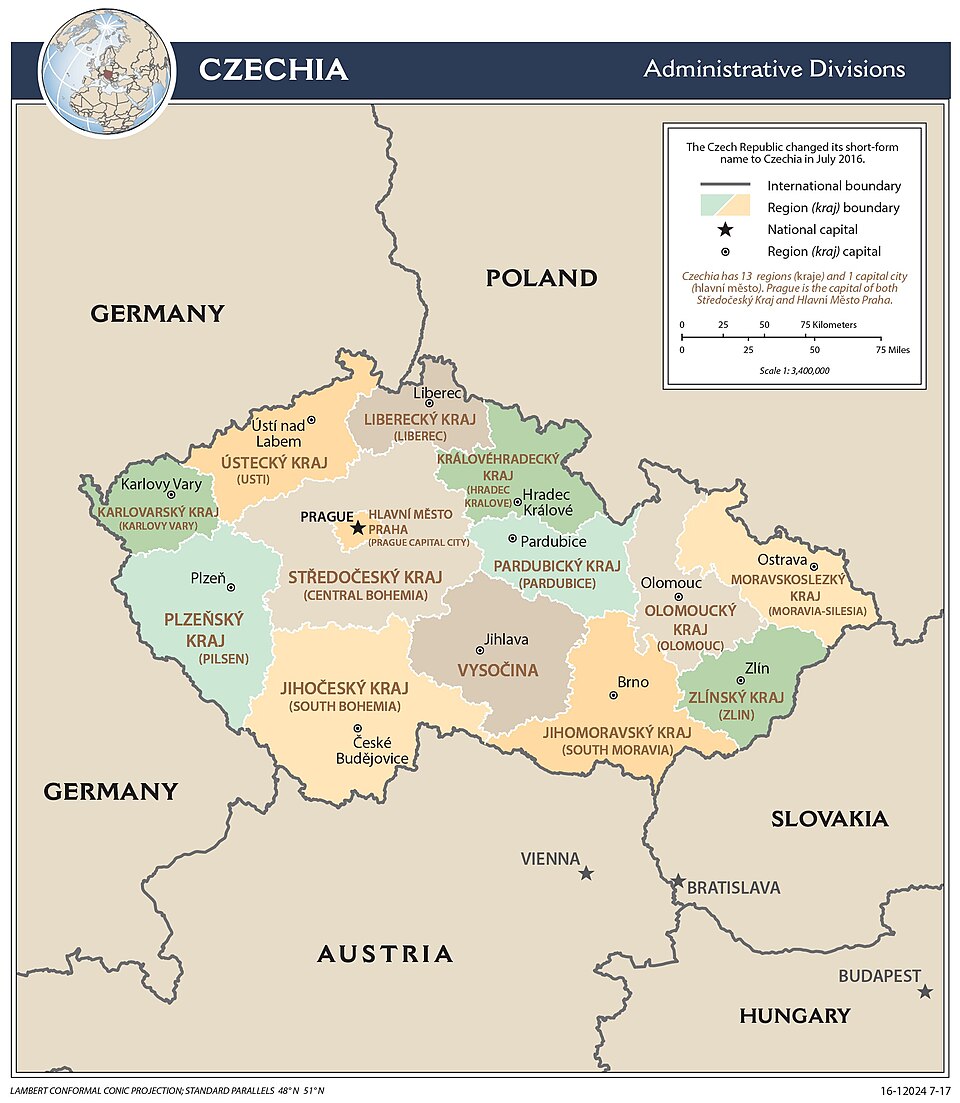
Czechia has no sea; its neighbour countries are Germany, Austria, Slovakia, and Poland.
History
Its history dates from the 9th century AD, for a long time it was one of the most powerful countries in Central Europe. Later on it was the biggest, most populated and richest country of the First Reich, where many Emperors started their career. Under the conditions of the Treaty of Vienna 1515 parts of Czechia, then in the Kingdoms of Bohemia and Hungary, came under Habsburg rule after the death of Louis the Jagiellon in 1526. They stayed a part of the Habsburg dynasty rule until 1918.
The area of the today’s Czechia was a part of Czechoslovakia (current area of Czechia and Slovak republic) from 1918 to 1992. Czechoslovakia became independent in 1918 from Austro-Hungarian Empire. The first Czechoslovakian president was Tomáš Garrigue Masaryk. In February 1948 the Communist party took over the country and for the next 41 years Czechoslovakia was a Socialist state with a rule of one (Communist) party. In 1968 there was a reformation movement (Prague Spring) within the Communist party, but reforms were stopped by the invasion of Warsaw pact armies. In November 1989 Czechoslovakia returned to democracy through the peaceful “Velvet Revolution”. Czechoslovakia peacefully split into two countries (Czechia and Slovakia) in 1993. Czechia has been a member of the European Union since 1 May 2004, and a member of NATO since 12 March 1999.
Geography
The Czech Republic is between the latitude of 48° and 51° N and longitudes 12° and 19° E
Western Czechia is made up of Bohemia. Eastern Czechia is made up of Moravia.
The highest point in the country is Sněžka at 1,602 m (5,256 ft).
There are four national parks in Czechia. The oldest is Krkonoše National Park. The others are Šumava National Park, Podyjí National Park, Bohemian Switzerland.
Regions
In 1949 the Communist government created 13 centralized regions instead of historical countries. In 1960 the regions changed leaving only 8 regions. In 2000 14 regions were formed with their own regional self-government.
Religion
Czechia is one of the least religious countries in the world. According to the 2011 census, 34.2% of the population stated they had no religion, 10.3% were Roman Catholic, 0.8% were Protestant (0.5% Czech Brethren and 0.4% Hussite), and 9.4% followed other forms of religion both denominational or not (of which 863 people answered they are Pagan). 45.2% of the population did not answer the question about religion.
Written for younger readers
Czech Republic, in simpler words
This version comes from Wikijunior, a set of books written for children aged 8 to 11. It is shorter and uses plainer language than the article above.
From Wikijunior: Europe
The Czech Republic (also known as Czechia) is a small country in central Europe. It shares borders with Germany, Austria, Slovakia and Poland. The capital city is Prague. Other big cities include Ostrava and Brno. The Czech Republic has been part of the European Union since 2004 but uses the Koruna as its currency.
The Czech Republic was founded in 1993, after Czechoslovakia split to form both the Czech Republic and Slovakia. But the country has a longer history.
The Czech nation has not always been the same size and area that it is today, and throughout history it has been ruled by many different kings and the kingdom size has changed over time.
The Slavs, ancestors of the modern Czechs, settled on the hills in the area for safety in the 5 th and 6 th Centuries AD. After this, in the 9 th Century the Czech kingdom was founded by Duke Bořivoj, a member of Přemyslid family, who became a Christian during his rule. The original foundations of Prague castle were also built at this time.
Bořivoj’s grandson, Prince Wenceslas I (Vacláv) built a church to St. Vitus at Prague Castle. However, Wenceslas was murdered by his younger brother Boleslav who then took the throne. Wenceslas was sainted (and is now the patron saint of the Czech Republic) and Boleslav ruled as king. Despite the murder, he kept power and ruled as a strong king of Bohemia for nearly 50 years.
In the 11 th Century, Břetislav I, Boleslav’s great-grandson extended the kingdom into Moravia and made the Přemyslid dynasty more powerful. His son, Vratislav II became friends with the German Emperor and this friendship allowed Germans and Czechs to exchange ideas.
A succession of kings from 1230 to 1306 led to a strong kingdom, with the discovery of silver mines helping to make the Czechs powerful. Prague became a famous capital city and many Germans and other nationalities immigrated there. However, the young king Wenceslas III was murdered and he was the last Přemyslid king.
Charles was originally called Wenceslas IV, but he changed his name. He had a good education in Paris and this helped him to be a wise and good king. He ruled for 36 years and left a legacy on the country and the city of Prague.
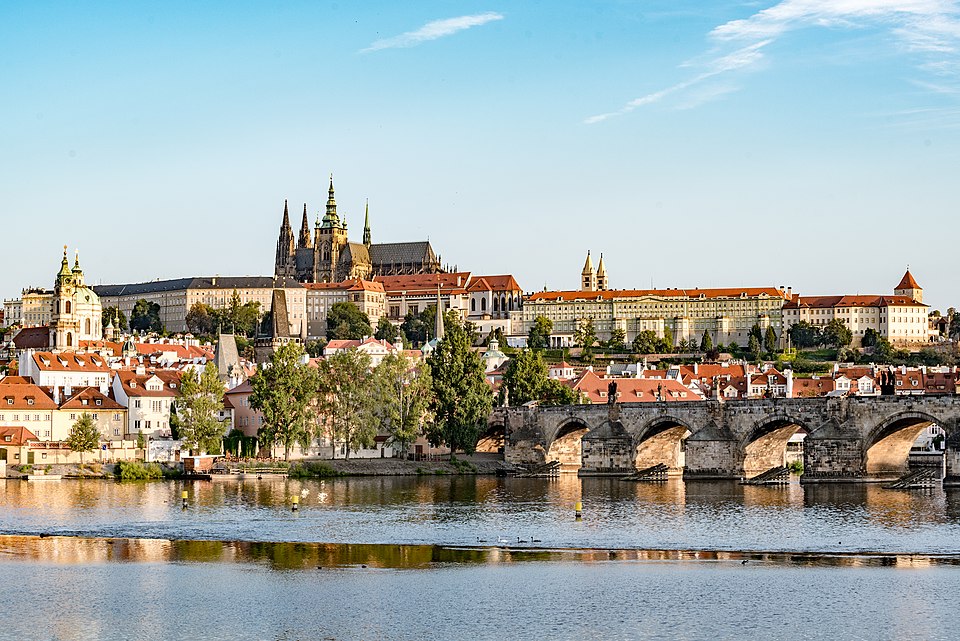
As a religious man, Charles improved the existing St. Vitus Church (Katédrála Sv. Vita) and made it into a cathedral that still stands to this day, next to Prague Castle (Pražský Hrad). He built the first university in Europe in Prague and he also constructed the famous Charles Bridge (Karlův Most), which is still standing today at 650 years old!
Outside of Prague Charles built Karlštejn Castle, superbly hidden between two hills so that armies could not see it. Charles used it to hide all his treasure and a special ‘golden room’ in the centre of the main tower held crown jewels, holy relics and state records. Although the castle was attacked, the invaders were never able to steal the treasure because it was too well protected. Even the Swedish cannons could not capture the main tower!
Later in his life, in 1355, Charles was made Holy Roman Emperor and the Czech kingdom became very powerful, with Prague as a major city at the heart of it. Charles died in 1378.
After Charles’ death, his son, Wenceslas IV came to the throne. However, he was not a good king and he did not listen to the people. A man called Jan Hus challenged the Catholic Church and asked for changes to it, known as Protestantism. However, he was arrested and burnt at the stake in 1415. When Wenceslas IV died of a heart attack in 1419, Jan Hus’ supporters raised an army known as the Hussites. The brother of Wenceslas, Sigismund, raised his own army to fight back.
There were many battles, but eventually the Hussites were defeated. Sigismund died with no heir, and Albrecht of Austria took the throne. Soon after, a politician called George of Poděbrady became king. George agreed with the Hussites, and the Pope did not like this, so Prague lost its power.
After George’s death, several kings ruled the Czech nation but it was not very powerful any more. Eventually, a group of Austrian kings called the Hapsburgs took over and added the Czech nation to their empire.
In 1576, Emperor Rudolph II allowed the Protestants to worship in their way and helped make peace within the land. However, the next King, Ferdinand II did not agree with this, and he started killing Protestants, leading to a Thirty-Years War. Ferdinand was thrown out as king, but his supporters raised an army and they won the battle in 1620, putting Ferdinand back on the throne.
From then on, Catholicism was the only religion allowed, and with the defeat many Protestants ran away to other countries.
A hundred years later, the great Austrian Queen, Maria Theresa ruled over Prague. Her son, Joseph II, allowed the Protestants to worship once more, and Prague became a more powerful, peaceful city again.
In the 19 th Century, the Czechs were becoming fed up being ruled by Austrians. They tried to rebel in 1848, but this failed. In the later years in which the Czechs were under Austrian rule, the country became heavily industrialised with railways and factories built all over Prague and the rest of the country.
Among people known worldwide from among the Czech people in Austrian times were born Bedrich Smetana, Antonín Dvořák, Sigmund Freud, Gustav Mahler, and Franz Kafka.
At the end of the World War I, after the fall of the Austro-Hungarian empire, Czechoslovakia was founded and the kings were replaced by presidents. After this, Czechoslovakia became involved in World War II, when Hitler wanted to take over Europe. One of the first places he targeted was Czechoslovakia since it is next to Germany. The country was freed from the Nazis in 1945 by the Russians.
Following World War II, Czechoslovakia was under Communist rule. However, the Communists allowed no political freedom and no opportunity to own and operate businesses, and the people of Czechoslovakia wanted to end this situation. A politician called Alexander Dubček tried to make things better for the people during what was called the Prague Spring in 1968. However the Communists did not want their authority challenged, so the Soviet Union (now mostly Russia) sent tanks to crush the rebellion and restore Communist rules.
In 1989 when Communism collapsed, Dubček was put in power along with other protesters to bring democracy to Czechoslovakia. Soon after, in 1993 Czechoslovakia was split into two countries: The Czech Republic and Slovakia. This was one of the most peaceful splits as the politicians talked to avoid war, and the two separate nations were formed.
Recently, in 2002 Prague suffered from terrible floods causing thousands of Korunas worth of damage. In 2004 it joined the EU and NATO and has become a central region of investment and development.
The total area of the Czech Republic is 78,864 km 2 (30,450 sq mi). The Czech Republic has a temperate, continental climate with relatively hot summers and cold, cloudy winters, usually with snow. Most rains are during the summer. The temperature difference between summers and winters is relatively high due to its landlocked geographical position.
Even within the Czech Republic, temperatures vary greatly depending on the elevation. In general, at higher altitudes the temperatures decrease and precipitation increases. Another important factor is the distribution of the mountains. The highest mountain in the Czech Republic is Sněžka at 1,602 metres.
The coldest month is usually January followed by February and December. During these months there is usually snow in the mountains and sometimes in the major cities and lowlands. During March, April and May, the temperature usually increases rapidly and especially during April the temperature and weather tends to vary widely during the day. Spring is also characterized by high water levels in the rivers due to melting snow followed by floods at times.
The warmest month of the year is July, followed by August and June. Autumn generally begins in September, which is still relatively warm, but much drier. During October, temperatures usually fall back under 15° or 10°C (59° or 50°F) and deciduous trees begin to shed their leaves. By the end of November, temperatures usually range around the freezing point.
The population is just over 10 million. Czechs make up about 90 percent of the country’s population. The Slovaks make up about 3 percent and Poles, Germans, Roma (Gypsies), and Hungarians account for most of the remainder. Czech is the official language of the Czech Republic.
Christianity is the main religion in the Czech Republic. Around 27 percent of Czech’s population is Roman Catholic and another 59 percent claim to have no religion at all.
Nearly all of the people in the Czech Republic are literate (can read and write), education is required from 6 through 15 years of age and most of the students go on to further their education.
There are several centers of tourist activity: The historic city of Prague is the primary tourist attraction, and the city is also the most common point of entry for tourists visiting other parts of the country. Prague is known for its famous for its beautiful architecture.
Most other cities in the country attract significant numbers of tourists, but the spa towns such as Karlovy Vary, Mariánské Lázně and Františkovy Lázně are particularly popular holiday destinations. Other popular tourist sites are the many castles and chateaux, such as those at Karlštejn, Konopiště and Český Krumlov. Away from the towns, areas as Český ráj, Šumava and the Krkonoše Mountains attract visitors seeking outdoor pursuits.
Czech Republic Czech Republic
Where this page comes from
The article above is adapted from “Czech Republic” on Simple English Wikipedia, by its contributors. We removed reference markers, navigation boxes and tables, expanded measurement templates into readable numbers, and kept the prose otherwise intact. The simpler version is adapted from Wikijunior on Wikibooks.
Both sources are published under CC BY-SA 4.0, so this page is published under the same licence. You may share and adapt it, including commercially, as long as you credit the original and keep the same licence.
Worksheets, answer keys and printable layouts elsewhere on K5Print are our own work and are not covered by this licence.